


20 Common YCMOU Assignment Mistakes Costing You Marks

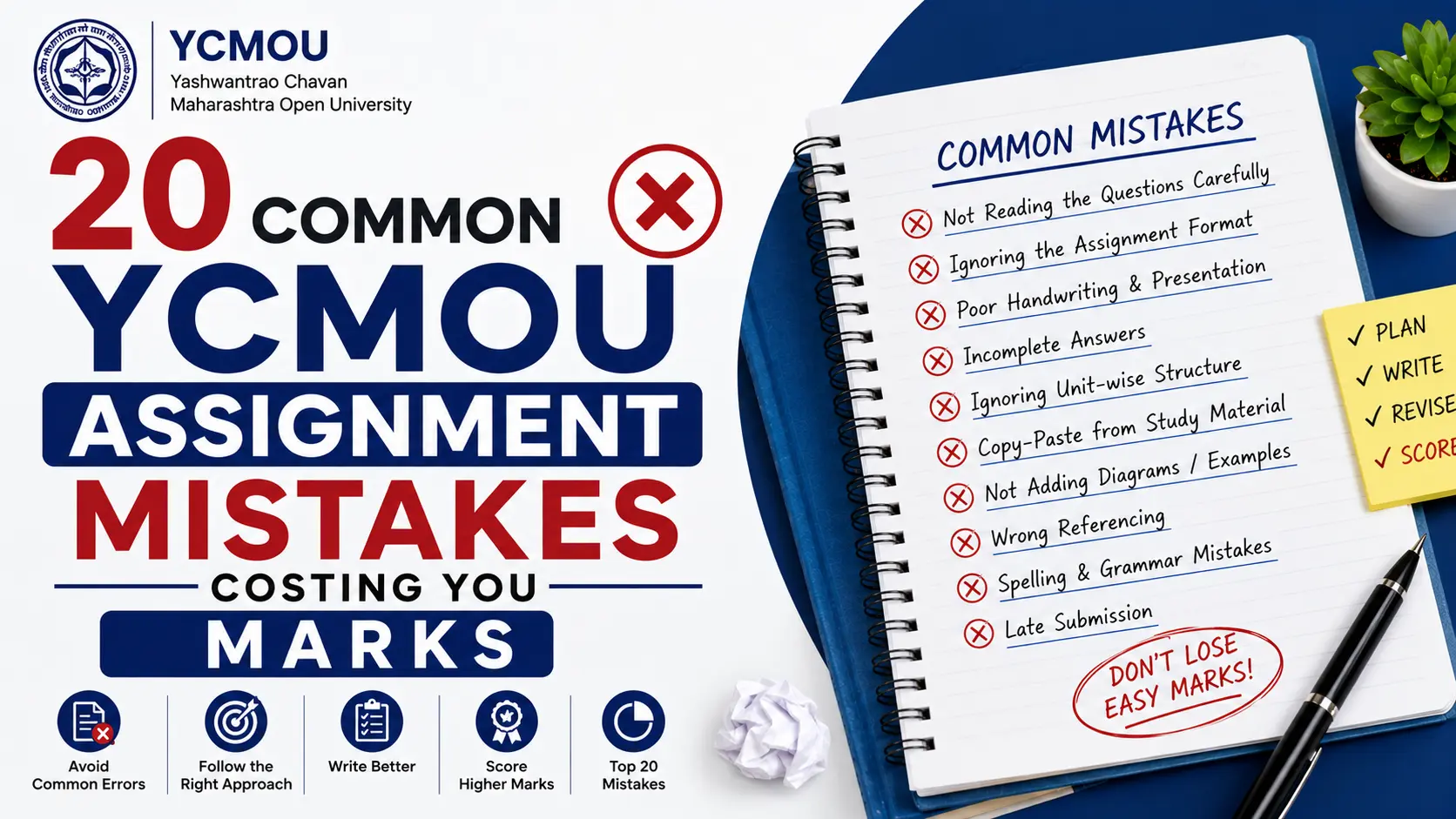
Right now, YCMOU students are losing marks for reasons they don’t even know about. Some lose 5 marks. Some lose 10. Some lose everything—zero marks for the entire assignment—because they committed one preventable mistake.
The frustrating part? Most of these mistakes are entirely avoidable.
You’re not losing marks because you don’t understand the material. You’re losing marks because you didn’t know the specific rule, the specific format requirement, or the specific penalty. You’re losing marks because nobody told you that writing on both sides of the paper costs you marks, or that missing one example drops you from 8/10 to 5/10, or that submitting in the wrong file format means zero marks.
This guide breaks down the 20 most common assignment mistakes that YCMOU examiners see—the ones they mark down for repeatedly. We’ve organized them into four categories: Formatting, Content, Submission, and Quality. For each mistake, you’ll see exactly why it fails, what penalty it carries, a real example, and how to avoid it.
After reading this, you’ll know what NOT to do. More importantly, you’ll understand the specific consequences of each mistake, which makes them impossible to forget. Awareness is prevention.
CATEGORY 1: Formatting Mistakes (5 Critical Rules That Kill Marks)
These five formatting mistakes account for nearly 15-20% of mark deductions. Most are simple rules that take seconds to follow—yet students skip them.
Mistake #1: Typed or Printed Instead of Handwritten
Why it fails: YCMOU’s core requirement is that all assignments must be handwritten. This isn’t optional. This isn’t flexible. Typed, printed, or digitally generated text violates university policy. The reasoning: handwritten assignments ensure authenticity, verify that the work is the student’s own, and maintain consistency with distance learning principles.
Penalty: AUTOMATIC REJECTION = ZERO MARKS
Your assignment won’t be evaluated at all. It will be returned with a note that it doesn’t meet format requirements.
Real Example: Priya Sharma wrote an excellent 12-mark LAQ on organizational behavior. The content was accurate, well-organized, included examples. She typed it neatly, printed it, and submitted it. The examiner returned it rejected within 24 hours. Priya had to write the entire assignment again by hand, missed the deadline for resubmission, and got zero for that assignment.
✅ How to avoid:
- Write by hand. Period. No exceptions.
- If your handwriting is small or tight, that’s okay as long as it’s legible.
- If you’re worried about neatness, practice the answers before writing the final version.
- Never, ever type an assignment for YCMOU submission.
Mistake #2: Poor Handwriting (Illegible Answers)
Why it fails: Even if you handwrite your answer, if the examiner can’t read it, they can’t evaluate it. Illegible handwriting creates frustration for the examiner and results in lower marks regardless of content quality.
Penalty: 0-5 mark deduction (even if content is excellent)
The same answer written neatly might earn 8/10, but written messily might earn 3/10. That’s not because the content changed—it’s because readability is a marking criterion.
Real Example: Rajesh wrote a comprehensive 10-mark LAQ on distance education policy. The content showed genuine understanding, included relevant examples, and was well-organized. But his handwriting was tiny, cramped, and rushed. The examiner struggled to read every line. She marked the answer as “partially legible” and deducted 3 marks for clarity. Same answer written neatly would have earned 9/10, but it earned 6/10 due to poor handwriting.
✅ How to avoid:
- Write at a normal, comfortable pace (not rushing).
- Use a quality pen (smooth-flowing ballpoint or gel pen).
- Maintain consistent letter size and spacing.
- Leave adequate space between lines.
- If your natural handwriting is very small, use slightly larger spaces to compensate.
- Write slowly. Speed creates illegibility.
Mistake #3: Wrong Margins or Incorrect Paper Size
Why it fails: YCMOU requires A4 white paper with 1-inch margins on all sides. Using wrong margins shows you either didn’t read instructions or don’t care about following them. Both result in mark deductions.
Penalty: Usually 1-2 marks deducted for presentation
Additionally, if margins are too small, your content may be cut off when the assignment is scanned or printed for additional review.
Real Example: Vikram used narrow 0.5-inch margins to fit more content on each page. He thought this showed efficiency. The examiner marked it as “poor presentation” and deducted 1.5 marks. The narrow margins also made the assignment look cramped and hard to read, affecting clarity marks as well—total loss of 2.5 marks.
✅ How to avoid:
- Use A4 white paper (standard size: 210 x 297 mm).
- Set 1-inch margins on all sides (top, bottom, left, right).
- Use a ruler to mark margin boundaries lightly in pencil if needed.
- Erase pencil marks after writing.
- Verify margins before writing your final assignment.
Mistake #4: Missing Cover Page
Why it fails: Your cover page contains critical information: your name, enrollment number, study center, date of submission, course code. Without it, the examiner might not know whose assignment it is, might misfile it, or might not be able to credit it to your account.
Penalty: Could result in ZERO marks (assignment can’t be verified)
At minimum, the assignment faces administrative delays and potential loss of marks due to misidentification.
Real Example: Neha submitted her assignment without a cover page, thinking the digital submission portal would automatically attach her information. The portal didn’t. The assignment was received but couldn’t be matched to her enrollment number for two weeks. By then, the deadline had passed on the university’s system. She was marked as late, losing 2 marks. If YCMOU couldn’t verify it was hers, she might have received zero.
✅ How to avoid:
- Always include a cover page as your first page.
- Include all required fields: Course Code, Course Name, Year/Semester, Assignment Number, Your Name, Enrollment Number, Regional Centre, Study Centre, Date of Submission, Signature.
- Verify all information is correct before finalizing.
- Fill it out legibly and neatly.
Mistake #5: Writing on Both Sides of the Paper
Why it fails: YCMOU requires one-sided writing only. When you write on both sides, content on the reverse side may not be evaluated. Additionally, when assignments are scanned, text from the back shows through the front, creating illegibility issues.
Penalty: Content on back side is NOT evaluated = Marks lost
If critical answers are on the back, you lose those marks entirely.
Real Example: Aarjun, trying to save paper, wrote his 10-mark LAQ on pages 1-2 and continued writing on the reverse of pages 1-2. The examiner only read the front of the assignment and missed half of his answer. He lost 5 marks because half his response wasn’t even evaluated.
✅ How to avoid:
- Write on the front side of the paper only.
- Use additional blank sheets if needed—there’s no penalty for using more paper.
- Ensure the back of every page is completely blank.
- If you need to add something on the reverse, clearly indicate it on the front side (e.g., “See reverse for continuation”).
CATEGORY 2: Content Mistakes (5 Errors That Show Weak Understanding)
These mistakes make it seem like you don’t understand the material—even if you do. They directly impact marks for accuracy and originality.
Mistake #6: Copying from Textbook or Online (PLAGIARISM)
Why it fails: YCMOU uses plagiarism detection software. Copied content is flagged automatically. Beyond detection, copying shows you don’t actually understand the concept—you’ve just repeated someone else’s words.
Penalty: ZERO marks + potential academic penalty
Some universities take plagiarism seriously enough to recommend course repetition or other disciplinary action.
Real Example: Anjali copied 4 lines directly from her textbook about learning theories. Plagiarism detection flagged 23% of her assignment as copied content. She received zero marks for the entire assignment and had to resubmit. The next time, she wrote all content in her own words and scored 7/10—not because the content changed, but because it was now original.
✅ How to avoid:
- Follow the 3-Step Process: Read the concept thoroughly → Close the book → Write in your own words → Verify accuracy against the source.
- Paraphrase, don’t copy. Paraphrasing means completely rewriting in your own words and style.
- If you use direct quotes (rare and minimal), use quotation marks and cite the source.
- Use Grammarly or similar tools to catch copied content before submission.
- Remember: Examiners recognize textbook language. Original language shows understanding.
Mistake #7: Not Understanding the Question (Answering the Wrong Thing)
Why it fails: You spent time writing a good answer—but it’s an answer to a different question than what was asked. The examiner asks “Compare A and B,” but you only explain A. Or the question asks for examples, but you provide only definitions.
Penalty: 0-2 marks even if content is excellent
You’re marked down for not addressing the question, regardless of how good your content is.
Real Example: The question: “Discuss the advantages AND disadvantages of distance education.”
Mukesh’s answer: Two pages about advantages only. No discussion of disadvantages. His content was accurate and well-explained. He earned 4 marks for “advantages well-covered” but lost 4 marks for “disadvantages missing.” Total: 4/10 instead of potential 8/10, because he misunderstood “discuss both sides.”
✅ How to avoid:
- Read the question at least three times before answering.
- Underline or circle key action words: Discuss, Explain, Compare, Contrast, Analyze, Evaluate.
- Identify exactly what’s being asked (one concept? two concepts? both pros and cons?).
- Reread the question after finishing your answer to ensure you’ve covered everything.
- If uncertain, ask your study center coordinator to clarify.
Mistake #8: Incomplete Answers (Not Covering All Aspects)
Why it fails: A 5-mark question requires a complete answer covering all major aspects. An incomplete answer shows you either didn’t understand the full scope or ran out of time.
Penalty: 30-50% mark deduction
If a 5-mark SAQ should have 3 key points, providing only 1 point means losing 40-60% of marks.
Real Example: The question asked: “Explain the functions of the study center in distance education.” A complete answer requires: counseling, evaluation support, practical training, social integration, administrative support.
Diya’s answer covered only: “Study centers provide face-to-face counseling.” That’s one function out of five. She earned 1.5/5 marks because her answer was incomplete—it was accurate but didn’t cover the scope of the question.
✅ How to avoid:
- Check marks allocated: If it’s a 10-mark question, it requires comprehensive coverage.
- SAQ (5 marks): Cover 3-4 key points minimum.
- LAQ (10 marks): Cover multiple dimensions, include examples, address different aspects.
- After writing, ask: “Have I covered everything this question asks for?”
- Expand with explanations, examples, and sub-points.
Mistake #9: Generic or Irrelevant Answers (No Specificity)
Why it fails: Generic answers show you didn’t engage deeply with the topic. “Distance education is important” is generic. “Distance education increases accessibility for students in remote areas by eliminating geographic barriers, as evidenced by YCMOU’s reach across 35 districts in Maharashtra” is specific.
Penalty: 1-3 marks even for lengthy answers
Examiners recognize generic content and mark it down for lack of engagement or understanding.
Real Example: The question: “How does technology support distance learners?”
Generic answer: “Technology helps students learn. It provides access to information. Students can use technology to study anytime.”
Specific answer: “Technology supports distance learners through Learning Management Systems (LMS) that deliver course materials, discussion forums for peer interaction, video lectures allowing asynchronous learning, and real-time communication tools. For example, YCMOU’s online portal provides centralized assignment submission, reducing postal delays from weeks to minutes.”
The generic answer scored 2/5. The specific answer scored 4.5/5—same topic, but one is generic, one is specific.
✅ How to avoid:
- Be specific: Name concepts, frameworks, tools, examples.
- Use course context: Reference YCMOU, Maharashtra, distance education specifically—not general education.
- Include examples: Real scenarios, case studies, applications.
- Avoid vague statements like “very important,” “very good,” “really helpful.”
- Show critical thinking: Explain why, not just what.
Mistake #10: No Examples or Illustrations (Memorization Without Understanding)
Why it fails: Examples prove you understand the concept, not just memorized a definition. Without examples, your answer seems hollow—theoretical without application.
Penalty: Missing 20-30% of available marks
Examples are worth 20-30% of marks. Skipping them automatically costs you that much.
Real Example: Question: “What is formative assessment?”
Answer without example: “Formative assessment is the process of evaluating student learning during instruction. It helps identify strengths and weaknesses.”
Same answer with example: “Formative assessment evaluates student learning during instruction. For instance, when a YCMOU student submits an assignment and receives feedback within 3 days, identifying specific gaps, that feedback guides improvement in the next assignment. This ongoing, in-process evaluation is formative assessment.”
Without example: 3/5 marks. With example: 4.5/5 marks. Same time investment, 1.5 more marks.
✅ How to avoid:
- Include at least 1 example in every SAQ (even 5-mark questions).
- Include 2-3 examples in every LAQ (10-mark questions).
- Make examples specific and relevant: YCMOU, Maharashtra, distance education contexts.
- Use real scenarios or case studies, not hypothetical “what ifs.”
- For technical subjects, use diagrams alongside text.
- Ask yourself: “Can I give an example here?” If yes, add it.
CATEGORY 3: Submission Mistakes (5 Errors That Result in Zero Marks)
These are the mistakes that happen after you’ve written a perfect assignment. One submission error and all your work is wasted.
❌ Mistake #11: Missing the Deadline
Why it fails: YCMOU’s online portal closes at the deadline. Submissions after the deadline are rejected automatically by the system. There are no exceptions, no extensions, no “just 5 minutes late.”
Penalty: ZERO marks for entire assignment (non-negotiable)
Late submission = Zero. No partial credit. No “I’ll accept it anyway.” Zero.
Real Example: Sanjay worked on his assignment until the last hour. He finished writing at 10:55 PM. Deadline was 11:00 PM. He started scanning at 10:56 PM. Scanning took 2 minutes. Conversion to PDF took 2 minutes. Upload started at 10:59:30 PM. It failed. He retried. Failed again. At 11:01 PM, the portal closed. His assignment is still sitting on his computer. Zero marks.
✅ How to avoid:
- Submit 3-4 days before the deadline, never on the last day.
- Set a personal deadline 5 days before the university deadline.
- Complete writing at least 2 days before deadline (allows time for scanning, conversion, verification).
- Keep backup copies; your device might crash.
- If using internet café, go early to avoid crowds and network slowdowns.
- Save the submission confirmation page and email confirmation.
Mistake #12: Wrong File Format (Not PDF)
Why it fails: YCMOU’s submission portal accepts only PDF files. If you upload a Word document, image file, or any other format, the portal rejects it.
Penalty: Can’t submit at all = Zero marks
You can’t submit if the format is wrong.
Real Example: Deepti scanned her assignment as JPG images. She tried uploading to the portal. The system rejected each image with an error: “PDF files only.” She had to convert each image to PDF using an online tool (taking extra time). She submitted successfully, but this mistake cost her 20 minutes and unnecessary stress.
✅ How to avoid:
- Always convert to PDF before uploading.
- Use online converters (Smallpdf.com, ILovePDF.com) or software (LibreOffice, Microsoft Word).
- Test your PDF by opening it on your device before submitting.
- Verify the file name ends with “.pdf”
- If using a scanner app (CamScanner, Adobe Scan), export as PDF, not JPEG.
Mistake #13: Submitting to Wrong Subject Code
Why it fails: YCMOU’s portal requires selecting the correct subject code before uploading. If you select the wrong subject, your assignment gets credited to the wrong course.
Penalty: Won’t be credited to correct subject = Have to re-submit
You’ll miss the deadline while fixing this, potentially losing marks for late submission.
Real Example: Vaibhav had three assignments to submit: ENG101, ENG102, and HIS101. In his hurry, he submitted his HIS101 assignment but selected ENG101 in the portal. It got credited to English. His history assignment was marked as late (and zero) when he discovered the error and tried to re-submit to the correct subject.
✅ How to avoid:
- Triple-check subject code before submitting.
- Match the code on your assignment paper with the code on the portal.
- Write the subject code on your cover page for reference.
- If uncertain which code to use, check your study material or contact the study center.
- Take a screenshot of the portal showing correct subject before uploading.
Mistake #14: File Size Too Large (Over 5MB)
Why it fails: YCMOU’s portal has a 5MB file size limit. If your PDF is larger, the portal won’t accept it.
Penalty: Upload fails = Can’t submit
Real Example: Ishita scanned her 20-page assignment at the highest quality setting. File size: 8.2MB. She tried uploading. The portal rejected it with an error: “File exceeds maximum size limit (5MB).” She had to compress the PDF at an internet café, wasting 15 minutes and creating unnecessary stress.
✅ How to avoid:
- Check file size before uploading (right-click → Properties in Windows, Get Info on Mac).
- If file is too large, compress using Smallpdf or ILovePDF.
- When scanning, use medium quality (not highest), which is sufficient and reduces file size.
- Delete any blank pages before converting to PDF.
- Target file size: under 4MB (gives you buffer).
- Test upload before the final deadline day.
Mistake #15: Not Saving Submission Confirmation
Why it fails: If the portal crashes or there’s a system error, you need proof that you submitted. Without confirmation, you can’t prove you submitted on time.
Penalty: If can’t prove submission, might have to re-submit = late submission penalty
Real Example: Shruti submitted her assignment successfully. She closed the browser immediately without taking a screenshot. The next day, YCMOU’s portal showed her assignment as not received (system glitch). She couldn’t prove she’d submitted. She had to re-submit, which was technically late, and the university imposed a 2-mark penalty.
✅ How to avoid:
- Take a screenshot of the confirmation page showing “Submitted Successfully.”
- Save or forward the confirmation email from the portal.
- Note the submission ID, date, and time.
- Keep these records for at least one semester.
- Screenshot the assignment status in your profile showing submission.
CATEGORY 4: Quality Mistakes (5 Errors That Lower Your Grade)
These mistakes don’t result in zero marks, but they systematically lower your score across multiple categories.
Mistake #16: Not Following the Marking Rubric
Why it fails: YCMOU provides a marking rubric showing what examiners look for. If you ignore the rubric, you might spend time on things that aren’t worth marks.
Penalty: Lose marks for things that matter to evaluation
The rubric is your roadmap. Ignoring it is like driving without a GPS.
Real Example: The rubric stated: “Provide 3 examples demonstrating understanding.” Rohan provided only 1 example and spent extra time on theoretical explanation instead. He earned marks for theory but lost 1-2 marks for missing examples, even though he had time to include them.
✅ How to avoid:
- Read the marking rubric in your assignment paper carefully.
- Identify exactly what’s being marked: accuracy, clarity, examples, organization.
- Allocate your time and words according to the rubric.
- If rubric asks for examples, include them.
- If rubric asks for structure, use headings and organization.
- Align your answer with the rubric requirements, not your preferences.
❌ Mistake #17: Exceeding Word Limit
Why it fails: A 10-mark LAQ should be 300-500 words. If you write 800 words, it suggests you either don’t understand the concept (padding content) or can’t organize concisely (poor communication).
Penalty: 1-2 marks deducted for exceeding limit
Some examiners only read up to the word limit and ignore additional content.
Real Example: Kavya wrote a 10-mark answer in 750 words, exceeding the 300-500 guideline by 250 words. Much of the extra content was repetitive. The examiner marked it as “unnecessarily verbose” and deducted 1.5 marks for clarity and conciseness.
✅ How to avoid:
- SAQ (5 marks): Write 100-150 words maximum.
- LAQ (10 marks): Write 300-500 words maximum.
- Count words after completing the answer.
- If over limit, trim repetitive sentences and redundant explanations.
- Prioritize quality over quantity.
- Use a word counter (Google Docs, Microsoft Word, Grammarly).
Mistake #18: Falling Short of Word Limit (Too Brief)
Why it fails: If a 10-mark question should be 300-500 words but you write 150 words, you haven’t developed your ideas sufficiently. This results in incomplete or shallow answers.
Penalty: Automatic 0.5-1 mark deduction
You can’t get full marks for an incomplete answer, even if the content is accurate.
Real Example: Harish wrote a 10-mark LAQ in just 120 words. The answer was accurate but superficial. He earned 5/10 because while technically correct, the answer didn’t demonstrate sufficient depth or understanding for a 10-mark question.
✅ How to avoid:
- SAQ (5 marks): Write at least 100 words (develop 3-4 key points).
- LAQ (10 marks): Write at least 300 words (develop 4+ sections with examples).
- Expand with explanations, examples, and analysis.
- If too brief, add more details, examples, or case studies.
- Count words as you write to ensure you’re meeting the minimum.
Mistake #19: Poor Organization and Structure
Why it fails: A jumbled, unorganized answer is hard to read. Examiners get frustrated, lose interest, and mark lower than they would for well-organized content.
Penalty: 1-2 marks deducted for clarity
Same content, organized vs. disorganized, earns different marks.
Real Example: Two students answered the same 10-mark question with equally accurate content. Student A used clear structure: introduction, three main points with headings, examples section, conclusion. Earned 8/10. Student B wrote the same content in paragraph form with no headings or breaks. Earned 6/10. The examiner marked Student B’s answer as “hard to follow” despite equal content quality.
✅ How to avoid:
- Use headings to break up content (Subsection: Definition, Subsection: Examples, Subsection: Analysis).
- Use bullet points or numbered lists for clarity.
- Start paragraphs with topic sentences.
- Group related ideas together.
- Use transitions between sections (“Furthermore,” “In contrast,” “Additionally”).
- Write for scannability: Make it easy for the examiner to skim and understand.
❌ Mistake #20: Grammatical Errors Throughout
Why it fails: Multiple spelling mistakes, run-on sentences, and grammatical errors create doubt about your language skills and understanding. Examiners interpret poor grammar as poor clarity.
Penalty: 0.5-1.5 marks deducted for clarity/language
Even if content is accurate, poor grammar lowers marks for clarity.
Real Example: Mehul wrote a technically accurate answer but with errors: “The distance education has many advantage because the students can study anytime and anywhere without depending on institute schedule.” Errors: “advantage” should be “advantages,” missing article usage, awkward phrasing. He earned 7/10 instead of 8.5/10 due to language issues.
✅ How to avoid:
- Proofread before finalizing (read aloud to catch errors).
- Check spelling using Grammarly or similar tools.
- Use short, simple sentences (easier to write correctly).
- Avoid run-on sentences and comma splices.
- Use active voice (“The student studied”) instead of passive (“It was studied by the student”).
- Have someone else review if possible.
Conclusion: Awareness Prevents Marks Loss
These 20 mistakes are costing students approximately 15-40 marks per assignment cycle. That’s potentially the difference between passing and failing, or between 65% and 90%.
The good news? 80% of these mistakes are preventable through awareness and simple systems.
- Formatting mistakes: Prevent by following the 5 formatting rules (handwritten, legible, correct paper, cover page, one-sided).
- Content mistakes: Prevent by understanding the question, covering all aspects, including examples, and writing in your own words.
- Submission mistakes: Prevent by submitting early, using correct format, verifying details, and saving confirmation.
- Quality mistakes: Prevent by following the rubric, managing word count, organizing clearly, and proofreading.
Start here: Print this list or bookmark it. Before your next assignment, review these 20 mistakes. Identify which ones you’re most prone to making. Create a simple checklist.
Before submitting, ask yourself:
- ✅ Is this handwritten?
- ✅ Is handwriting legible?
- ✅ Are margins correct (1-inch)?
- ✅ Is cover page included?
- ✅ Is content only on front sides?
- ✅ Did I write in my own words (no copying)?
- ✅ Did I answer the exact question asked?
- ✅ Is my answer complete (covered all aspects)?
- ✅ Did I include specific examples?
- ✅ Is it submitted before deadline?
- ✅ Is it in PDF format?
- ✅ Is it under 5MB?
- ✅ Is organization clear with headings?
- ✅ Have I proofread for grammar?
One checklist. 20 mistakes prevented. Potentially 20-30 more marks earned.
Next Step: After mastering what NOT to do, read our guide on [how to score better in YCMOU assignments] to learn the positive strategies that earn full marks. This guide tells you what to avoid. That guide tells you what to do.
Between these two guides, you have the complete system: What to avoid and what to do.

One thought on “20 Common YCMOU Assignment Mistakes Costing You Marks”