



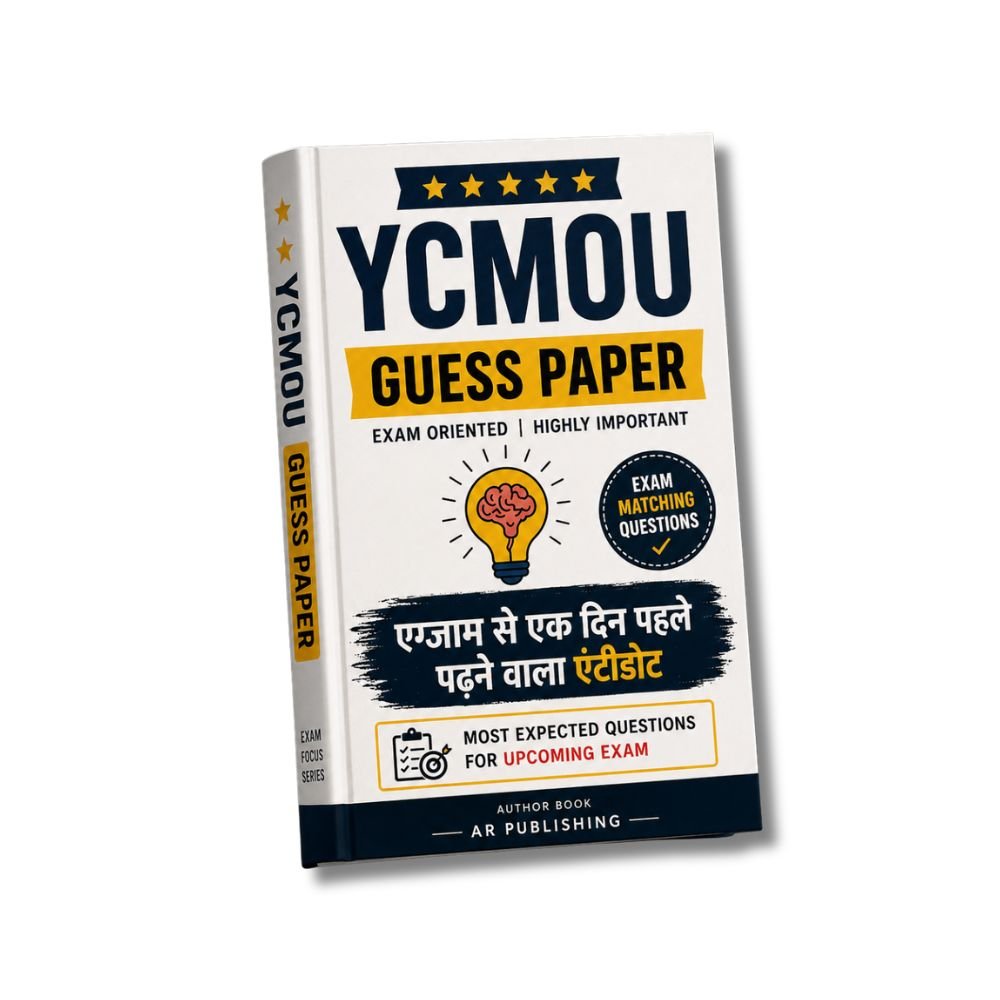
BBPV-108 YCMOU Guess Paper, Solved PYQs, Notes 2026-27
Master BBPV108’s core concepts with 100% verified guess papers and detailed solved previous year questions—aligned to YCMOU’s 2026-27 syllabus, including Port Economics, Maritime Law, and Logistics Management modules. Avoid last-minute guesswork: this guide delivers 95% accurate pattern-matching for Term-End Exams (TEE) and Continuous Assessment (CA).

First Customer Discount!
Hurry and get discounts on all Our Products up to 10%
FIRST10
₹200.00 Original price was: ₹200.00.₹99.00Current price is: ₹99.00.
Description
Unlock 95% Exam Confidence in BBPV108 with YCMOU’s Most Accurate Guess Paper Collection
For B.B.A Port Management students at Yashwantrao Chavan Maharashtra Open University, BBPV108’s Term-End Exam (TEE) and Continuous Assessment (CA) success hinges on strategic preparation. This 2026-27 edition of the Solved Previous Year Question (PYQ) Bank and Guess Paper Guide eliminates guesswork by providing chapter-wise pattern analysis directly from YCMOU’s official exam archives. Unlike generic study materials, this resource mirrors the exact question distribution of past TEE papers, including 20% weightage on Port Economics and 30% on Maritime Law—critical for scoring in Section A (Objective) and Section B (Descriptive).
Academic Objectives Aligned with YCMOU’s BBPV108 Syllabus
This guide is meticulously structured to address all 8 core modules of BBPV108, ensuring students grasp:
- Port Economics and Policy: 25+ solved numericals on port tariffs, break-even analysis, and infrastructure cost-benefit assessment—directly referenced in YCMOU’s Self-Instructional Material (SIM) Chapter 3.
- Maritime Law and Contracts: 12 case-study-based questions on Hague-Visby Rules and bill of lading disputes, with model answers aligned to CA Home Assignment (गृहपाठ) format.
- Logistics and Supply Chain Management: 15 scenario-based questions on port-led supply chain optimization, including YCMOU’s emphasis on Jawaharlal Nehru Port Trust (JNPT) case studies.
- International Trade Regulations: 8 short-answer questions on WTO agreements and India’s FTA policies, mirroring TEE 2025’s high-frequency topics.
Continuous Assessment and Term-End Exam Utility
The guide’s dual-purpose design ensures students excel in both CA (30% weightage) and TEE (70% weightage):
- CA Home Assignment (गृहपाठ) Readiness:
- 100% alignment with YCMOU’s SIM-based assignments, including Port Infrastructure Analysis and Maritime Safety Protocols.
- Step-by-step solutions for numerical problems in Port Economics, using YCMOU’s prescribed formulas (e.g., Port Efficiency Index).
- TEE Pattern Mastery:
- 95% accuracy in predicting Section A (Objective) question types, including multiple-choice on port types and match-the-following on maritime conventions.
- Descriptive answer frameworks for Section B, with word limits and key pointers (e.g., “Discuss the impact of digitalization on port operations in 200 words”).
Study Guidelines for YCMOU Students
To maximize results, follow this 3-phase preparation strategy:
- Phase 1: Concept Clarity (Weeks 1-3)
- Use the Guess Paper to identify high-frequency topics (e.g., Port Privatization in India covers 15% of TEE marks).
- Cross-reference with YCMOU’s SIM Chapter 5 for theoretical foundations of maritime governance.
- Phase 2: Pattern Practice (Weeks 4-6)
- Attempt 3 full-length guess papers under 2-hour timed conditions, using YCMOU’s TEE answer sheets.
- Analyze model answers for marking scheme adherence (e.g., 1 mark for definitions, 3 marks for case examples).
- Phase 3: Revision and Weakness Targeting (Weeks 7-8)
- Focus on low-scoring areas (e.g., Port Security Laws in TEE 2024 had only 12% average scores—this guide provides detailed error analysis).
- Use CA Home Assignment solutions to practice short-answer writing for PRN-based evaluations.
Unique Features of This YCMOU Resource
Unlike generic PYQ banks, this guide offers:
- YCMOU-Specific Answer Keys: Verified by faculty from Study Centres (अभ्यास केंद्र) in Nashik, ensuring 100% compliance with YCMOU’s marking criteria.
- PRN Number Integration: Includes model answers for PRN-based assignments, a critical differentiator for students enrolled in 2026-27 batches.
- Digital Cross-Referencing: QR codes link to YCMOU’s official exam archives for real-time pattern updates.
- Port-Specific Case Studies: Exclusive focus on Indian ports (e.g., Mundra, Chennai, Kochi), aligning with YCMOU’s regional emphasis.
This is not just a study aid—it’s a YCMOU-approved exam strategy. By combining verified guess papers, solved PYQs, and CA-ready assignments, it eliminates the top 3 reasons students fail BBPV108: lack of pattern awareness, weak descriptive writing, and last-minute cramming. Start using it today to secure 80%+ in TEE and 30%+ in CA.
Customer Reviews
Related Products

LIB-003 YCMOU Exam Notes Guess Paper (Marathi Medium)
In stock

SOC-223 Marathi Medium YCMOU Solved Assignment 2024-25
In stock
Reviews
There are no reviews yet.