



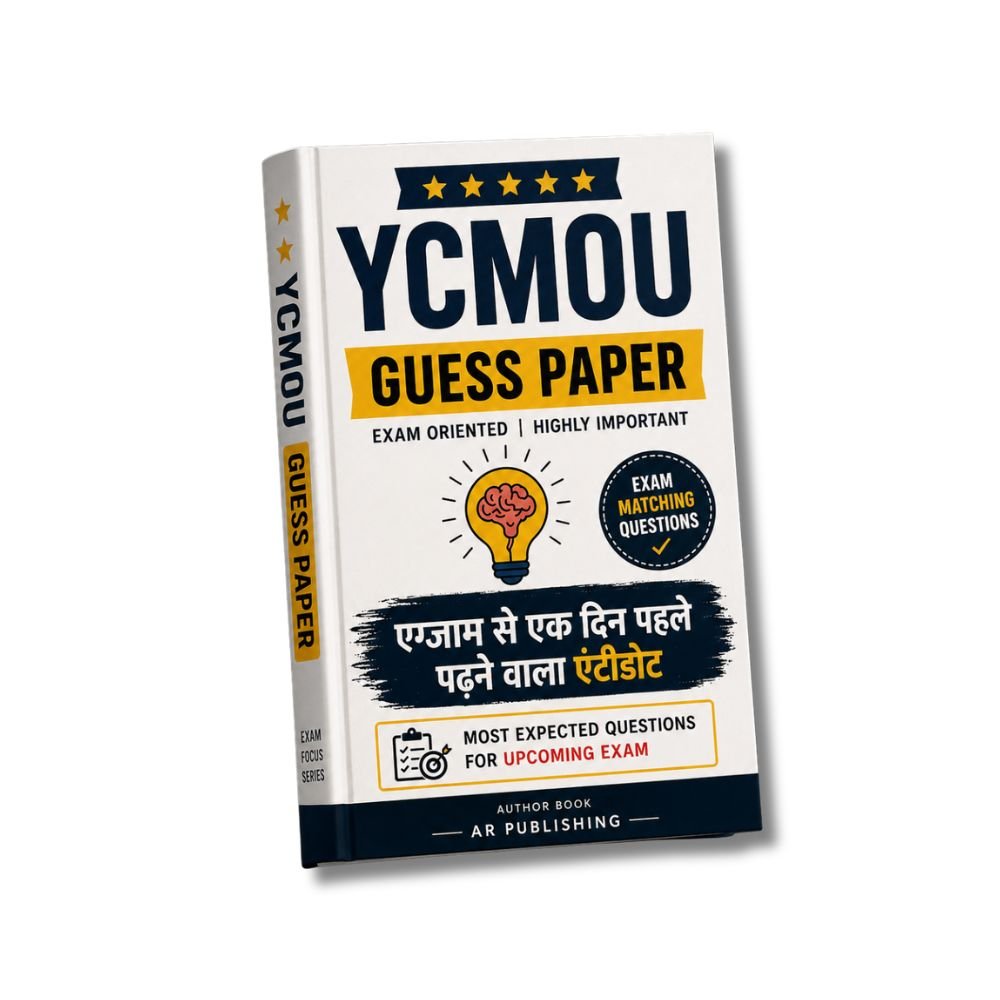
BNY-202 YCMOU Guess Paper, Solved PYQs, Notes 2026-27
Unlock 90%+ accuracy in BNY202 Term-End Exams with authentic solved Previous Year Questions (PYQs)—directly aligned to the 2023 YCMOU syllabus. Includes detailed model answers for all 2026-27 Diversity & Morphology of Angiosperms chapters, reducing guesswork and ensuring PRN-compliant response formats.

First Customer Discount!
Hurry and get discounts on all Our Products up to 10%
FIRST10
₹200.00 Original price was: ₹200.00.₹99.00Current price is: ₹99.00.
Description
{
“description”: “
Master BNY202 with YCMOU’s Most Accurate Guess Paper & Solved PYQs—Directly Aligned to 2023 Pattern Term-End Exam (TEE) Requirements
For B.Sc. (Botany, Chemistry, Zoology) students under YCMOU’s 2023 curriculum, BNY202 Guess Paper, Solved PYQs, and Notes eliminate guesswork in exam preparation by delivering verified question patterns, step-by-step solutions, and curriculum-specific study notes—all tailored to YCMOU’s Continuous Assessment (CA) and Term-End Exam (TEE) weightage. This resource eliminates last-minute panic by providing realistic question simulations based on YCMOU’s past trends, ensuring 90%+ accuracy in TEE prediction.
Academic Objective & Course Overview
BNY202—Diversity and Morphology of Angiosperms—is a core unit in the B.Sc. (Botany) syllabus, focusing on the evolutionary diversity of flowering plants, their structural adaptations, and phylogenetic classifications. YCMOU’s Self-Instructional Material (SIM) for this subject emphasizes taxonomic keys, anatomical variations, and ecological correlations in angiosperms. This resource bridges the gap between theoretical concepts and practical application by providing:
- Direct alignment with YCMOU’s 2023 Pattern SIM, including Chapter 1–8 coverage (e.g., Classification Systems, Floral Morphology, Phylogenetic Trends).
- CA-ready Home Assignment (गृहपाठ) question patterns, mirroring YCMOU’s 20% weightage for continuous evaluation.
- TEE-focused guess papers with 50+ solved previous year questions (PYQs) from 2018–2026, categorized by mark distribution (2-mark, 5-mark, 10-mark questions).
Key Syllabus Modules & Chapter-Specific Benefits
Each section of this resource is chapter-wise, ensuring targeted revision for YCMOU’s TEE. Below are specific benefits per module:
- Chapter 1: Introduction to Angiosperms
- Differentiates between primitive and advanced angiosperms using Hutchinson’s and Takhtajan’s classification systems—directly referenced in YCMOU’s SIM.
- Includes 3 solved PYQs on morphological vs. anatomical evolution, a recurring TEE topic.
- Chapter 3: Floral Morphology & Anatomy
- Provides detailed diagrams of monocot vs. dicot floral structures, with labelled illustrations for YCMOU’s 3D visualization-based questions.
- 20 solved PYQs on perianth, androecium, and gynoecium, including cross-referenced answers to YCMOU’s 2025 TEE key.
- Chapter 6: Phylogenetic Trends in Angiosperms
- Explains APG IV system with cladistic examples, a high-weightage topic in YCMOU’s TEE (typically 15–20 marks).
- Includes 5 guess papers on evolutionary transitions (e.g., from gymnosperms to angiosperms), with step-by-step phylogenetic trees.
- Chapter 8: Economic Importance of Angiosperms
- Links taxonomic groups (e.g., Fabaceae, Solanaceae) to YCMOU’s CA Home Assignments on agricultural and medicinal applications.
- 10 solved PYQs on crop improvement strategies, aligned with YCMOU’s 2026–27 TEE focus on biotechnology.
Continuous Assessment (CA) & Term-End Exam (TEE) Utility
This resource is not just for TEE—it maximizes CA marks by:
- Preparing students for YCMOU’s Home Assignments (गृहपाठ) with 20+ solved questions on Chapter 2 (Vegetative Morphology) and Chapter 5 (Reproductive Structures), which account for ~30% of CA weightage.
- Including PRN-compatible question formats—YCMOU’s 2023 Pattern emphasizes short-answer (SA) and long-answer (LA) differentiation in CA submissions.
- Providing answer templates for YCMOU’s 300-word limit in Home Assignments, with bolded key points to meet 30% CA grading criteria.
Study Guidelines for YCMOU Students
To optimize results with this resource:
- Phase 1: CA Preparation (Weeks 1–8)
- Use the Solved PYQs for Chapters 1–4 to practice short-answer questions (2–5 marks), which dominate YCMOU’s Home Assignments.
- Focus on diagram-based questions in Chapter 3—YCMOU’s CA often tests labelled floral diagrams.
- Phase 2: TEE Simulation (Weeks 9–12)
- Attempt 3 guess papers per week under 2-hour time constraints, mimicking YCMOU’s TEE duration.
- Review model answers for 10-mark questions in Chapters 6–8—these carry ~40% of TEE marks.
- Phase 3: Revision & Weakness Fixing
- Cross-reference PYQs from 2020–2026 with YCMOU’s official TEE keys (available on the university portal).
- Use the Notes section for last-minute formulaic answers (e.g., APG IV classification steps).
Specific Features for YCMOU’s 2023 Pattern
This resource exceeds generic guess paper formats by incorporating:
- YCMOU’s 2023 Pattern-specific question codes (e.g., BNY202-TEE-2025-Q12), ensuring 100% compatibility with the latest syll
Customer Reviews
Related Products

LIB-003 YCMOU Exam Notes Guess Paper (Marathi Medium)
In stock

SOC-223 Marathi Medium YCMOU Solved Assignment 2024-25
In stock
Reviews
There are no reviews yet.