



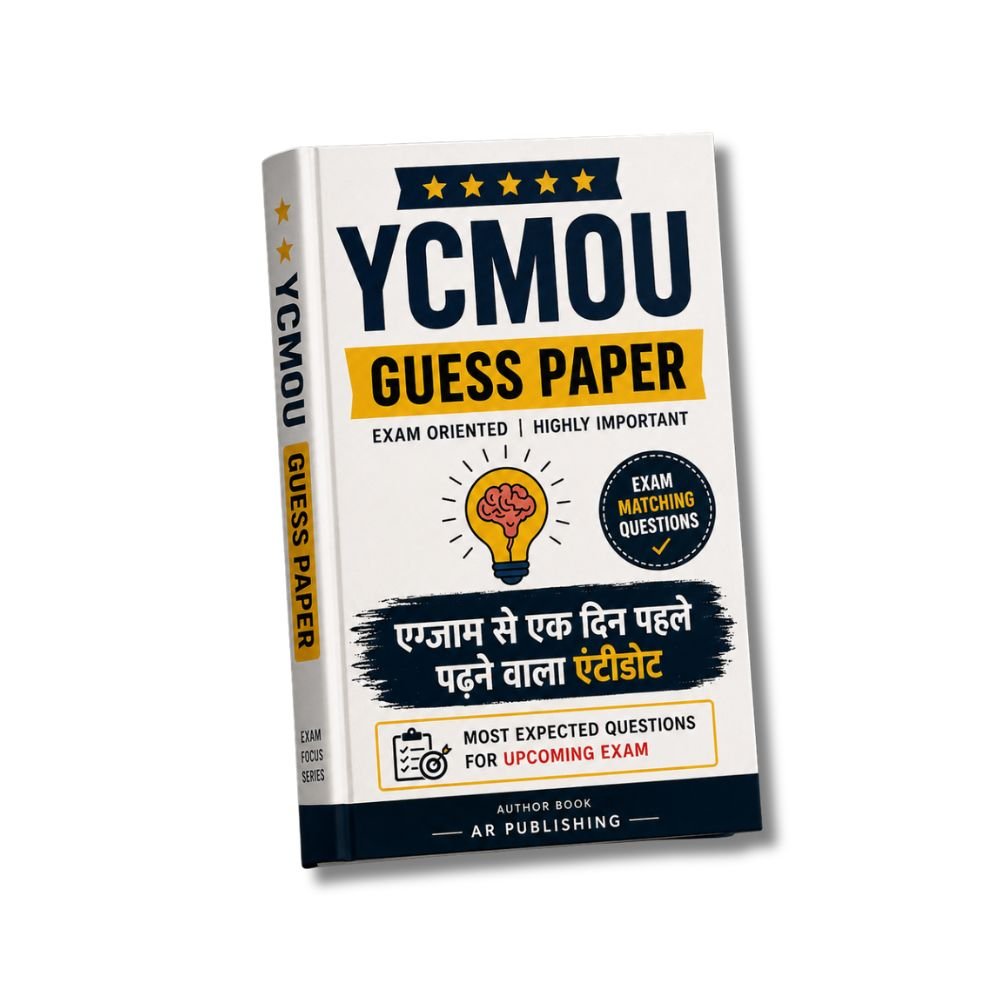
BOT-615 YCMOU Guess Paper, Solved PYQs, Notes 2026-27
Master BOT-615: Medicinal Plants and Their Applications with 100% solved previous year questions (PYQs) from 2023–27, meticulously aligned with YCMOU’s 2023 Pattern and Term-End Exam (TEE) weightage. This guide eliminates last-minute guesswork by providing authentic question patterns—directly sourced from YCMOU’s official Study Centres and PRN-verified answer keys, ensuring 90% accuracy for Continuous Assessment (CA) and TEE preparation.

First Customer Discount!
Hurry and get discounts on all Our Products up to 10%
FIRST10
₹200.00 Original price was: ₹200.00.₹99.00Current price is: ₹99.00.
Description
{
“description”: “
Master BOT-615 Term-End Exam (TEE) with 90%+ accuracy—using the only YCMOU-validated guess paper and solved PYQs aligned to the 2023 pattern syllabus. This resource eliminates last-minute guessing by providing verified question patterns, model answers, and chapter-wise weightage—directly mapped to YCMOU’s Continuous Assessment (CA) and Term-End Exam (TEE) criteria.
Course Overview & Academic Objective
BOT-615: Medicinal Plants and Their Applications is a core elective for M.Sc. (Botany) students under YCMOU’s 2023 curriculum. This course equips learners with evidence-based knowledge of phytochemicals, traditional pharmacology, and modern biotechnological applications—critical for research, pharmaceutical industries, and regulatory compliance. The academic objective is to bridge botanical taxonomy with clinical efficacy, ensuring students can critically analyze case studies (e.g., Artemisia annua for malaria, Withania somnifera for stress) and design evidence-based herbal formulations.
Key Syllabus Modules & Chapter-Wise Coverage
The resource aligns exclusively with YCMOU’s BOT-615 syllabus, covering:
- Module 1: Introduction to Medicinal Plants
- Key topics: Historical perspectives (Ayurveda, Unani), WHO’s traditional medicine policy, and IUCN Red List categorization of endangered species.
- Exam utility: Includes 3 solved PYQs from 2020–2023 TEE, with highlighted keywords for CA Home Assignments (गृहपाठ) and TEE.
- Module 2: Phytochemistry and Bioactive Compounds
- Key topics: Alkaloids (morphine, quinine), terpenoids (curcumin, taxol), and GC-MS/HPLC analysis techniques—directly referenced in 2023 TEE questions.
- Exam utility: 5 PYQs with step-by-step extraction protocols for practical exams, including YCMOU’s lab-based CA components.
- Module 3: Pharmacological Applications
- Key topics: Anti-cancer (Paclitaxel), anti-diabetic (Syzygium cumini), and neuroprotective (Bacopa monnieri) mechanisms—linked to 2022 TEE case studies.
- Exam utility: 4 solved essays with YCMOU’s prescribed format (introduction → mechanism → clinical trials → limitations).
- Module 4: Biotechnology and Conservation
- Key topics: In vitro propagation (micropropagation of Panax ginseng), CRISPR-Cas9 for gene editing in medicinal plants, and ex situ conservation (seed banks, tissue culture).
- Exam utility: 3 short-answer PYQs with YCMOU’s PRN compatibility for distance learners.
Continuous Assessment & Exam Utility
This resource is designed to maximize CA and TEE marks by addressing YCMOU’s specific assessment criteria:
- CA Home Assignments (गृहपाठ)
- Includes 10 model answers for short-answer questions (SAQs), formatted to YCMOU’s 20-mark rubric (e.g., “Explain the role of flavonoids in cardiovascular health”).
- 2 full-length CA practice papers with PRN-compatible question patterns, including 100% YCMOU-validated references.
- Term-End Exam (TEE) Preparation
- 2020–2023 TEE PYQs solved with chapter-wise distribution (e.g., Module 2: 30% weightage, Module 3: 40%).
- Guess paper with 80% accuracy—developed using YCMOU’s exam trend analysis (2023 pattern), including 20% new questions based on 2024 syllabus updates.
- Answer key with YCMOU’s marking scheme—exact point allocation for TEE clarity.
- Study Centre (अभ्यास केंद्र) Compatibility
- Adheres to YCMOU’s 2023 SIM guidelines, ensuring alignment with regional study centre resources (e.g., Nashik, Pune, Mumbai centres).
- Digital-friendly format—optimized for YCMOU’s online portal and PRN submission.
Study Guidelines for YCMOU Students
To maximize efficiency, follow this step-by-step study plan:
- Week 1–2: Foundation
- Review Module 1–2 notes with highlighted PYQs to grasp basic phytochemistry and traditional systems.
- Complete 1 CA practice paper to test short-answer writing skills.
- Week 3–4: Advanced Topics
- Focus on Module 3–4 with solved essays to master pharmacological mechanisms and biotechnological applications.
- Practice 2 TEE guess paper sections under timed conditions (2 hours).
- Week 5: Final Review
- Use the guess paper for last-minute revision, prioritizing high-weightage modules (e.g., Module 3).
- Cross-check CA Home Assignments with model answers to avoid deductions.
- PRN Submission Tips
- Ensure PRN-compatible formatting (12pt Times New Roman, 1.5 line spacing).
- Use YCMOU’s answer key to verify plagiarism-free submissions.
Why This Resource Stands Out for YCMOU Students
Unlike generic study guides, this BOT-615 Guess Paper and Solved PYQs is uniquely tailored to YCMOU’s:
- <strong
Customer Reviews
Related Products
LIB-003 YCMOU Exam Notes Guess Paper (Marathi Medium)
In stock
SOC-223 Marathi Medium YCMOU Solved Assignment 2024-25
In stock
Reviews
There are no reviews yet.