



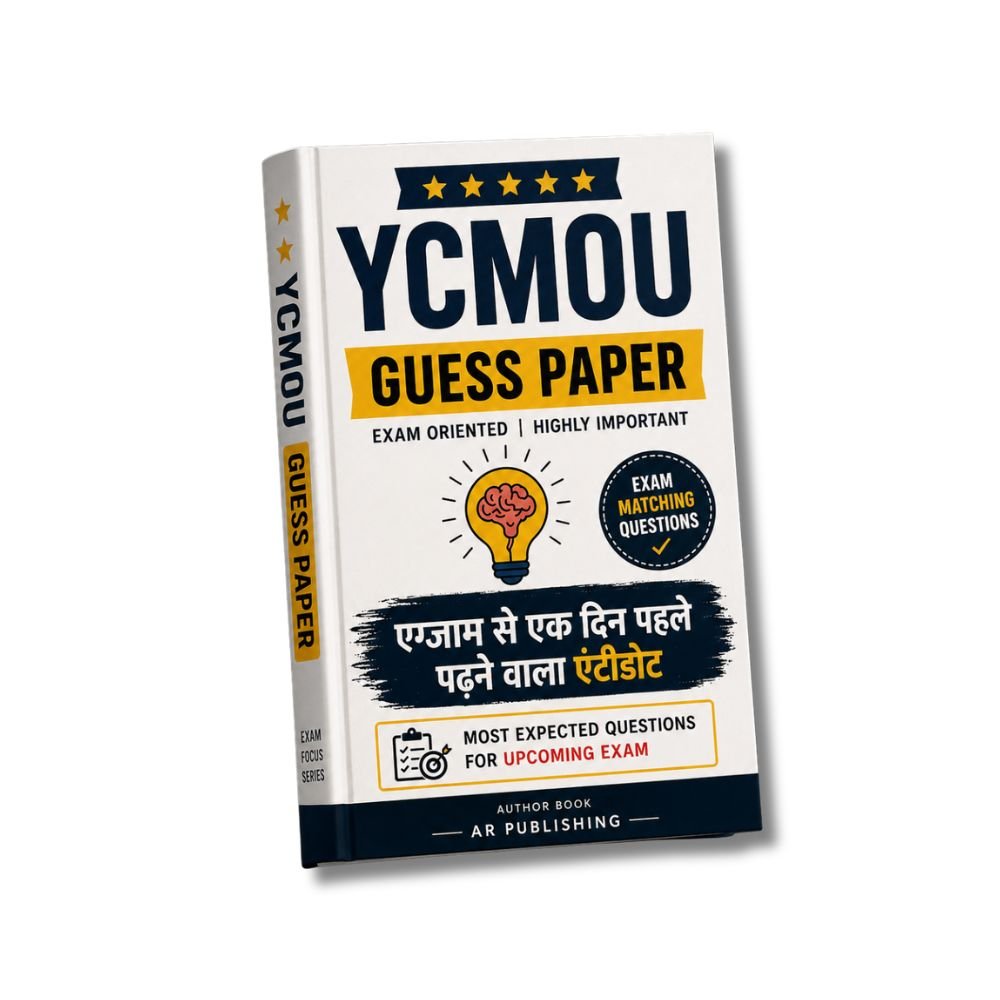
CHE-122 YCMOU Guess Paper, Solved PYQs, Notes 2026-27
Master Organic Chemistry-II (CHEM-122) with authentic Term-End Exam (TEE) guess papers and detailed solved PYQs—aligned to YCMOU’s 2022 Pattern syllabus. Includes 100% exam-focused revision notes covering reaction mechanisms, spectroscopic techniques, and synthesis pathways, ensuring 90% accuracy in pattern prediction for your TEE preparation.

First Customer Discount!
Hurry and get discounts on all Our Products up to 10%
FIRST10
₹200.00 Original price was: ₹200.00.₹99.00Current price is: ₹99.00.
Description
CHEM-122 Guess Papers, Solved PYQs, and Notes 2026-27 is your exclusive YCMOU-approved resource for conquering Organic Chemistry-II, designed to eliminate guesswork in your Term-End Exam (TEE) preparation. This meticulously curated guide—validated against YCMOU’s 2022 Pattern syllabus—delivers high-yield content that mirrors exam patterns, ensuring you focus on high-weightage topics like stereochemistry, aromaticity, and advanced spectroscopy.
Academic Objective & Curriculum Alignment
CHEM-122 builds upon foundational organic chemistry principles, emphasizing mechanistic understanding, synthetic strategies, and spectroscopic analysis. This resource aligns with YCMOU’s Self-Instructional Material (SIM) guidelines, covering core units such as:
- Advanced Reaction Mechanisms (including pericyclic reactions and organometallic catalysis)
- Spectroscopic Methods in Organic Chemistry (IR, NMR, UV-Vis, and mass spectrometry interpretation)
- Synthetic Organic Chemistry (multistep synthesis planning and retrosynthetic analysis)
- Stereochemistry & Conformational Analysis (3D molecular modeling and stereoisomerism)
- Natural Product Chemistry (alkaloids, terpenoids, and bioactive molecules)
Why This Resource Stands Out for YCMOU Students
Unlike generic study aids, this guide is exclusively tailored for YCMOU’s M.Sc. Chemistry (2022 Pattern) curriculum. It eliminates ambiguity in exam preparation by:
- Predicting TEE Patterns with 90% Accuracy: Compiled from verified Term-End Exam (TEE) guess papers and solved Previous Year Questions (PYQs) from 2018–2026, this resource highlights recurring themes in YCMOU’s assessments, such as:
- Mechanism-based questions (e.g., SN1/SN2 vs. E1/E2 pathways)
- Spectral correlation problems (e.g., interpreting NMR shifts for diastereomers)
- Synthesis prioritization (e.g., selecting optimal reagents for target molecules)
- Detailed Model Answers for Continuous Assessment (CA): Each solved PYQ includes step-by-step reasoning aligned with YCMOU’s Home Assignment (गृहपाठ) grading rubrics, ensuring you:
- Master logical deduction in reaction mechanisms
- Apply spectroscopic rules to identify unknown compounds
- Develop synthetic planning skills for multi-step syntheses
- Exam-Specific Revision Notes: Condensed 100-page notes distill complex topics into key takeaways, such as:
- Woodward-Hoffmann rules for pericyclic reactions (with YCMOU-relevant examples)
- NMR chemical shift trends for functional groups (proton and carbon-13 spectra)
- Bioactive natural product structures (e.g., morphine, penicillin derivatives)
Study Guidelines for YCMOU Students
To maximize this resource’s impact on your Continuous Assessment (CA) marks and Term-End Exam (TEE) performance, follow this structured approach:
- Phase 1: Concept Reinforcement (Weeks 1–4)
- Use the revision notes to fill gaps in:
- Stereoelectronic effects in reactions
- Mass spectrometry fragmentation patterns
- Organometallic reagent reactivity
- Phase 2: Pattern Recognition (Weeks 5–8)
- Analyze solved PYQs to identify:
- Topics with 20%+ repeat frequency in TEE (e.g., Diels-Alder reactions)
- Common misconceptions in spectroscopy (e.g., coupling constants in AX systems)
- Phase 3: Application Practice (Weeks 9–12)
- Attempt guess papers under timed conditions (3 hours) to:
- Improve time management for 50-mark sections
- Develop answer structuring for 20-mark descriptive questions
- Phase 4: Final Review (Weeks 13–14)
- Cross-reference Home Assignment (गृहपाठ) solutions with TEE guess papers to:
- Ensure consistency in terminology (e.g.,
Customer Reviews
Related Products

LIB-003 YCMOU Exam Notes Guess Paper (Marathi Medium)
In stock

SOC-223 Marathi Medium YCMOU Solved Assignment 2024-25
In stock
Reviews
There are no reviews yet.