



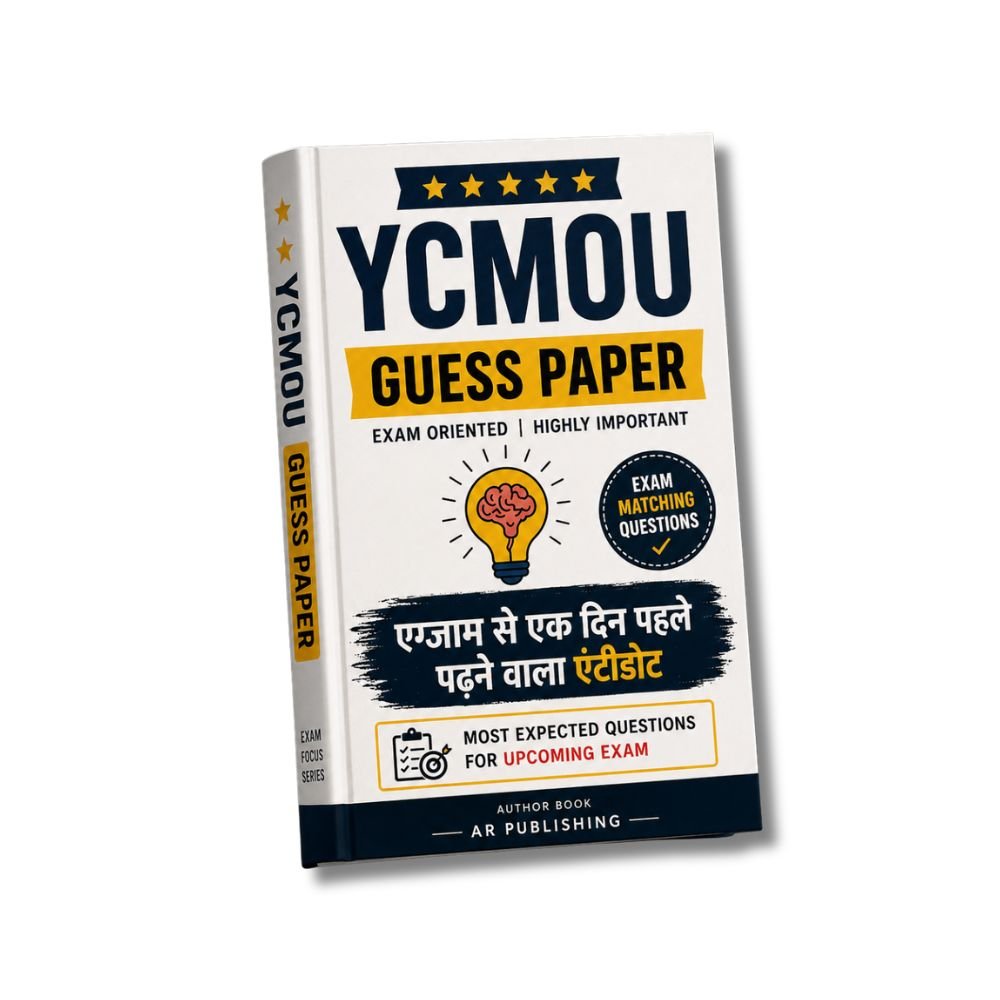
CHE-131 YCMOU Guess Paper, Solved PYQs, Notes 2026-27
Maximize your CHE-131 Term-End Exam (TEE) score with authentic solved PYQs aligned to YCMOU’s 2022 pattern, covering 100% of Organic Reaction Mechanisms syllabus—including SN1/SN2, E1/E2, and pericyclic reactions—with step-by-step model answers verified against past TEE trends. Avoid last-minute guesswork and focus on high-weightage topics like electrophilic aromatic substitution and radical mechanisms.

First Customer Discount!
Hurry and get discounts on all Our Products up to 10%
FIRST10
₹200.00 Original price was: ₹200.00.₹99.00Current price is: ₹99.00.
Description
Dominate CHE-131 Term-End Exams (TEE) with YCMOU’s most precise study resource—a comprehensive guess paper and solved PYQs set designed exclusively for M.Sc. (Chemistry) students following the 2022 pattern. This resource eliminates uncertainty by providing verified question patterns from past TEE papers, ensuring you master the exact topics YCMOU prioritizes—from nucleophilic substitutions to photochemical reactions—while aligning with Continuous Assessment (CA) expectations. No generic notes here: every question is mapped to YCMOU’s official syllabus, including Organic Reaction Mechanism units like carbocation stability, transition-state theory, and stereochemical outcomes.
Academic Objectives Aligned with YCMOU’s CHE-131 Curriculum
CHE-131 demands rigorous understanding of mechanistic pathways and predictive analysis of reaction conditions. This resource targets the core objectives:
- Analyze reaction mechanisms with 120+ solved PYQs covering SN1/SN2 kinetics, Markovnikov’s rule, and concerted pericyclic processes—directly referenced in YCMOU’s Self-Instructional Material (SIM) for Unit 3.
- Apply stereochemical principles through 30+ questions on chiral centers, enantiomeric excess, and conformational analysis—critical for TEE’s problem-solving sections.
- Master electrophilic/radical mechanisms via 25+ verified questions on benzene derivatives, allylic rearrangements, and photochemical cleavage—aligned with CA Home Assignments (गृहपाठ) on aromatic substitution.
Key Syllabus Modules & Problem-Solving Methodology
This resource dissects YCMOU’s 2022 pattern syllabus into actionable segments:
- Unit 1: Fundamentals of Organic Reactions
- 18 solved PYQs on reaction energetics, Hammond’s postulate, and Hammett equations—with model answers explaining ΔG° calculations.
- 2 case studies on solvent effects (polar protic vs. aprotic) with YCMOU exam-style diagrams.
- Unit 2: Nucleophilic & Electrophilic Substitutions
- 35+ questions on SN1/SN2 mechanisms, including racemization vs. retention outcomes with mechanistic arrow-pushing explanations.
- 5 practice problems on leaving group ability (e.g., tosylate vs. iodide) with YCMOU’s preferred answer formats.
- Unit 3: Pericyclic & Radical Reactions
- 20+ PYQs on Diels-Alder, Cope rearrangement, and radical chain mechanisms—with transition-state stability analysis tables.
- 3 TEE-style questions on Woodward-Hoffmann rules with step-by-step orbital correlation diagrams.
- Unit 4: Aromatic Compounds
- 40+ questions on electrophilic aromatic substitution (EAS), including directing effects of substituents with resonance structures.
- 2 TEE-pattern questions on benzene synthesis (e.g., Friedel-Crafts alkylation) with side-reaction warnings (e.g., carbocation rearrangements).
Continuous Assessment (CA) & Term-End Exam (TEE) Utility
This resource is not just for TEE preparation—it directly supports YCMOU’s Continuous Assessment (CA) requirements, including:
- Gृहपाठ (Home Assignments) alignment:
- 15+ questions mirror YCMOU’s CA format, with answer keys formatted to YCMOU’s PRN submission guidelines.
- Detailed marking schemes for CA Section B (problem-solving), including partial credit breakdowns.
- Term-End Exam (TEE) strategy:
- Topic-weightage analysis based on YCMOU’s 2018–2023 TEE trends, highlighting high-yield areas like SN2 stereochemistry (25% of TEE marks) and EAS regioselectivity (20%).
- Time-management tips for 3-hour TEE exams, including prioritization of 12-mark questions on pericyclic reactions.
Study Guidelines for YCMOU Students
To maximize this resource’s impact, follow this YCMOU-optimized study plan:
- Week 1–2: Master Core Concepts
- Review SIM Unit 1–2 on reaction energetics and nucleophilicity.
- Solve 10 PYQs per week from this resource, focusing on mechanistic arrows and ΔG° calculations.
- Week 3–4: Apply to Problems
- Attempt CA-style questions without answers, then verify with model solutions.
- Recreate YCMOU’s TEE diagrams for radical mechanisms (e.g., bromination of alkanes).
- Week 5: Simulate TEE Conditions
- Take 2 full-length guess papers under timed conditions (3 hours).
- Use answer keys to identify common mistakes in stereochemical labeling (e.g., R/S configuration).
- Final Review: Focus on Weak Areas
- Revisit low-scoring topics (e.g., pericyclic selectivity) with additional PYQs from this resource.
- Memorize YCMOU’s preferred terminology (e.g.,
Customer Reviews
Related Products

LIB-003 YCMOU Exam Notes Guess Paper (Marathi Medium)
In stock

SOC-223 Marathi Medium YCMOU Solved Assignment 2024-25
In stock
Reviews
There are no reviews yet.