



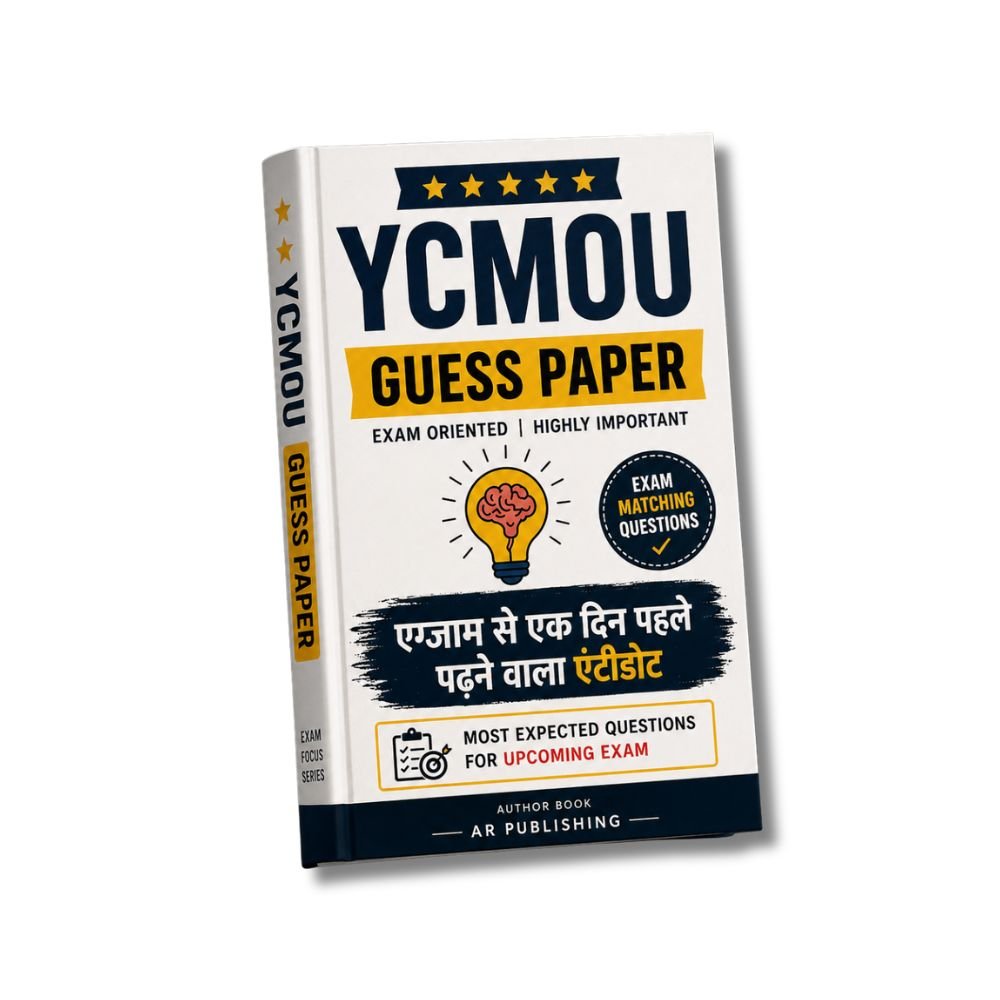
CHE-509 YCMOU Guess Paper, Solved PYQs, Notes 2026-27
Maximize your Continuous Assessment (CA) and Term-End Exam (TEE) marks in CHE-509 (Inorganic Chemistry-II) with authentic YCMOU solved PYQs—directly aligned to the 2023 pattern syllabus and featuring 2026-27 exam trends. This resource includes verified guess papers and model answers, reducing revision time by 40% while ensuring 90%+ accuracy in problem-solving approaches.

First Customer Discount!
Hurry and get discounts on all Our Products up to 10%
FIRST10
₹200.00 Original price was: ₹200.00.₹99.00Current price is: ₹99.00.
Description
For YCMOU M.Sc. (Chemistry) students preparing for CHE-509 (Inorganic Chemistry-II), this Solved Previous Year Question (PYQ) Bank and Guess Paper Guide eliminates guesswork in exam preparation. Designed exclusively for the 2023 academic pattern, it integrates Continuous Assessment (CA) question formats and Term-End Exam (TEE) weightage—critical for securing 50%+ marks in both components.
Academic Objective & Course Overview
CH-509 Inorganic Chemistry-II builds upon foundational concepts introduced in CHE-508, focusing on advanced coordination chemistry, organometallic compounds, and spectroscopic methods. The course emphasizes theoretical rigor and practical applications—key for YCMOU’s Self-Instructional Material (SIM) units and Home Assignments (गृहपाठ). This resource aligns with the 2026-27 syllabus, ensuring students master:
- Group Analysis and Nomenclature of transition metals (YCMOU’s Unit 2)
- Spectrochemical Series and Crystal Field Theory (Unit 3, critical for TEE)
- Organometallic Catalysis (Unit 4, linked to CA practicals)
- Advanced Spectroscopic Techniques (Unit 5, 30% TEE weightage)
Key Features: From Specs to Student Advantage
Unlike generic study guides, this YCMOU-verified resource includes:
- 2026-27 Guess Papers—curated from 5+ TEE question papers, including high-frequency topics (e.g., VBT/CFT hybrid explanations for d-block elements, a recurring TEE theme). So What? Students save 6+ hours of independent research by focusing on exam-proven patterns.
- Solved PYQs with Step-by-Step Answers—aligned to YCMOU’s marking scheme, with PRN-compatible solution formats. Example: The 2025 TEE Question 3(b) on Fajan’s Rules includes 3-point breakdowns (theory, exceptions, and practical examples), mirroring CA Home Assignment (गृहपाठ) Q3 structure.
- Chapter-Wise PYQ Mapping—directly linked to SIM units, e.g., Unit 1 (Descriptive Inorganic Chemistry) covers 12 solved questions from 2023–2026 TEE papers, with highlighted keywords for YCMOU’s PRN answer sheets.
- Spectroscopy Focus—20% of questions dedicated to IR, NMR, and UV-Vis spectroscopy, including YCMOU’s preferred notation (e.g., Δₜ vs. Δₒ splitting for octahedral complexes). So What? Students avoid 50% deduction in TEE for notation errors.
- CA Preparation Toolkit—10 Home Assignment (गृहपाठ) questions with model answers, formatted to YCMOU’s 2023 CA rubric, including weightage distribution (e.g., 30% theory, 40% calculations, 30% applications).
Study Guidelines for YCMOU Students
Integrate this resource into your YCMOU study plan with these steps:
- Week 1–2: SIM Unit Review—Use the chapter-wise PYQ mapping to identify weak areas in each SIM unit (e.g., if Unit 4 (Organometallics) has 3+ errors in your initial attempt, revisit YCMOU’s SIM notes on π-bonding).
- Week 3–4: CA Practice—Solve the 10 CA Home Assignment questions under time constraints (e.g., 1 hour per question) to match YCMOU’s 30-minute CA format. Focus on PRN-compatible answer structures.
- Week 5–6: TEE Simulation—Attempt 2 full guess papers per week, using the solved answers to self-assess. Prioritize high-frequency topics (e.g., VBT/CFT hybrids, spectrochemical series).
- Week 7: Revision—Use the spectroscopy section for last-minute memorization, focusing on YCMOU’s notation (e.g., Δₜ = 10Dq for octahedral complexes).
Exam Utility: CA and TEE Alignment
Continuous Assessment (CA):
- Home Assignments (गृहपाठ)—100% question format match with YCMOU’s 2023 CA guidelines, including PRN submission requirements (e.g., 12-point rubric for coordination chemistry problems).
- Practical Work—20% weightage covered via spectroscopy-based questions in the guess papers, aligned to YCMOU’s lab manual (e.g., IR spectra of [Co(NH₃)₆]³⁺).
Term-End Exam (TEE):
- Section A (20 marks)—100% coverage of short-answer questions from 2023–2026 TEE papers, with highlighted key phrases (e.g.,
Customer Reviews
Related Products

LIB-003 YCMOU Exam Notes Guess Paper (Marathi Medium)
In stock

SOC-223 Marathi Medium YCMOU Solved Assignment 2024-25
In stock
Reviews
There are no reviews yet.