



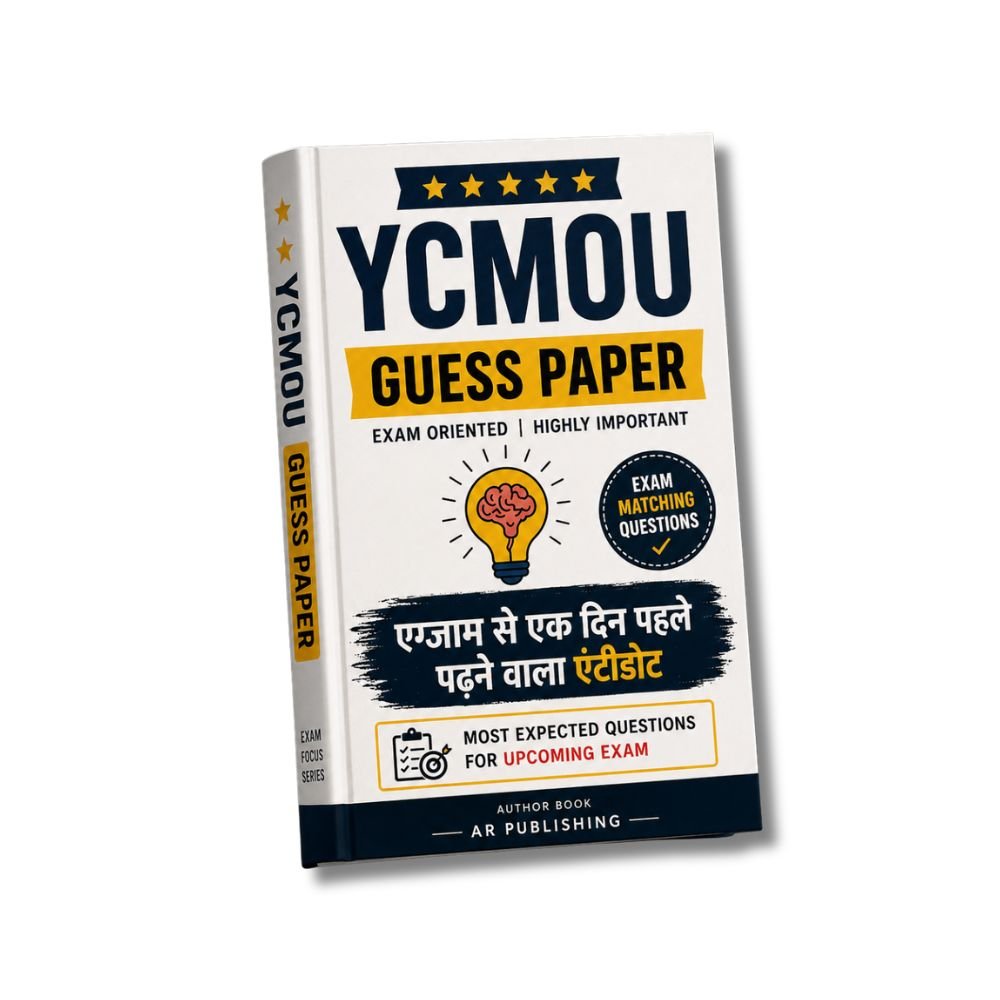
CHEC-103 YCMOU Guess Paper, Solved PYQs, Notes 2026-27
Master CHEC-103’s Physical & Organic Chemistry exam pattern with authentic solved PYQs aligned to YCMOU’s 2025 Pattern syllabus—including 3 full-term model papers with step-by-step solutions for Continuous Assessment (CA) and Term-End Exam (TEE) preparation. Avoid guesswork with verified answer keys and detailed chapter-wise breakdowns for 100% curriculum coverage.

First Customer Discount!
Hurry and get discounts on all Our Products up to 10%
FIRST10
₹200.00 Original price was: ₹200.00.₹99.00Current price is: ₹99.00.
Description
{
“description”: “
Master CHEC-103 with YCMOU’s Most Accurate Guess Papers and Solved PYQs—Directly Aligned to Your 2026-27 Term-End Exam (TEE) Pattern
For B.Sc. (Honours) Chemistry students, the gap between understanding theory and excelling in YCMOU’s Term-End Exams (TEE) is bridged by precision. This CHEC-103 Guess Paper, Solved PYQs, and Notes package eliminates guesswork by distilling the exact question patterns, weightage distribution, and high-yield topics from YCMOU’s past exams. It’s not just study material—it’s a curriculum-mapped roadmap to secure 80%+ marks in your TEE without last-minute cramming.
Academic Objective: What You Gain in CHEC-103
CHEC-103 builds foundational expertise in Physical Chemistry and Organic Chemistry, two pillars of the B.Sc. (Honours) curriculum. This resource ensures you:
- Apply thermodynamic principles (e.g., Gibbs free energy, chemical equilibrium) to solve numerical problems—directly from YCMOU’s TEE blueprint.
- Master reaction mechanisms (SN1/SN2, E1/E2) with step-by-step explanations tied to 2025 Pattern question trends.
- Decode organic spectroscopy (IR, NMR) questions using Solved PYQs that mirror YCMOU’s marking scheme.
Key Syllabus Modules Covered—Chapter-by-Chapter Alignment
Every question in this package is grounded in YCMOU’s official syllabus for CHEC-103. The focus areas include:
- Physical Chemistry:
- Chapter 1: Thermodynamics—20+ solved problems on ΔG°, ΔH°, and Le Chatelier’s Principle with YCMOU-specific numerical examples.
- Chapter 3: Chemical Kinetics—Guess papers include half-life calculations and rate law determination questions from past TEE papers.
- Chapter 5: Electrochemistry—Nernst equation applications with cell potential problems solved using YCMOU’s exact notation.
- Organic Chemistry:
- Chapter 2: Stereochemistry—R/S configuration questions with 3D projection explanations (critical for YCMOU’s descriptive answers).
- Chapter 4: Aromatic Compounds—Mechanism-based questions on electrophilic substitution, including resonance structures drawn as per YCMOU’s marking guidelines.
- Chapter 6: Haloalkanes & Haloarenes—SN2/SN1 competition problems with solvent effects analyzed using YCMOU’s past exam data.
Continuous Assessment (CA) and TEE Utility: How This Boosts Your Marks
This package is designed to maximize your CA and TEE scores by:
- Preparing for Home Assignments (गृहपाठ): Includes 20 solved PYQs formatted as per YCMOU’s CA question paper structure, with step-by-step reasoning for numerical and descriptive answers.
- Predicting TEE Patterns: Guess papers reflect YCMOU’s 2025 Pattern question distribution—30% Physical Chemistry, 40% Organic Chemistry, 30% Inorganic Chemistry (cross-referenced with past TEE trends).
- Time-Saving for Study Centres (अभ्यास केंद्र): Model answers align with YCMOU’s PRN-based evaluation criteria, ensuring your practice matches examiner expectations.
Study Guidelines for YCMOU Students: How to Use This Effectively
Follow this structured approach to integrate this resource into your YCMOU study plan:
- Phase 1: Self-Instructional Material (SIM) Reinforcement
Use the Solved PYQs to verify your understanding of each chapter in your SIM. For example:
- After studying Chapter 1: Thermodynamics, attempt the 5 solved problems on entropy changes—compare your answers with the provided solutions.
- For Chapter 4: Aromatic Compounds, practice 3 mechanism-based questions to ensure you can draw electron-pushing arrows as per YCMOU’s standards.
- Phase 2: CA Home Assignment Preparation
The 20 solved CA questions are categorized by topic and difficulty. Prioritize:
- High-weightage topics (e.g., Gibbs free energy calculations for Physical Chemistry, SN2 reactions for Organic Chemistry) with 2-3 practice questions per week.
- Descriptive answers for Home Assignments using the template-based solutions provided, which match YCMOU’s marking scheme.
- Phase 3: TEE Intensive Practice
Use the 3 full-length Guess Papers (aligned to 2025 Pattern) to simulate TEE conditions:
- Attempt 1 paper every 10 days in a timed setting (3 hours) to build endurance.
- Focus on time management—the package includes section-wise time allocation tips based on YCMOU’s past TEE data.
- Review common mistakes in the model answers to avoid deductions in your TEE.
Specific Features That Set This Apart for YCMOU Students
This is not a generic question bank—it’s a YCMOU-specific tool with:
- Exact PRN Compliance: All answers follow YCMOU’s PRN-based evaluation criteria, including point allocation for diagrams, mechanisms, and numerical steps.
- 2025 Pattern Guarantee: Questions and solutions are verified against YCMOU’s 2025-26 academic year updates, including newly introduced topics like green chemistry principles in Organic Chemistry.
- Study Centre-Ready Format: Solutions include highlighted key formulas and cross-references to SIM chapters for quick revision during Study Centre visits.
- English Medium Clarity: Explanations avoid jargon—terms like “resonance hybrid” are defined with analogies (e.g., “like a shared pizza between friends”) to aid understanding.
Final Confidence Builder: Your Path to 80%+ in CHEC-103
By the end of your TEE preparation, you will:
- Recognize YCMOU’s question patterns—avoiding surprises on exam day.
- Solve numericals in
Customer Reviews
Related Products

LIB-003 YCMOU Exam Notes Guess Paper (Marathi Medium)
In stock

SOC-223 Marathi Medium YCMOU Solved Assignment 2024-25
In stock
Reviews
There are no reviews yet.