



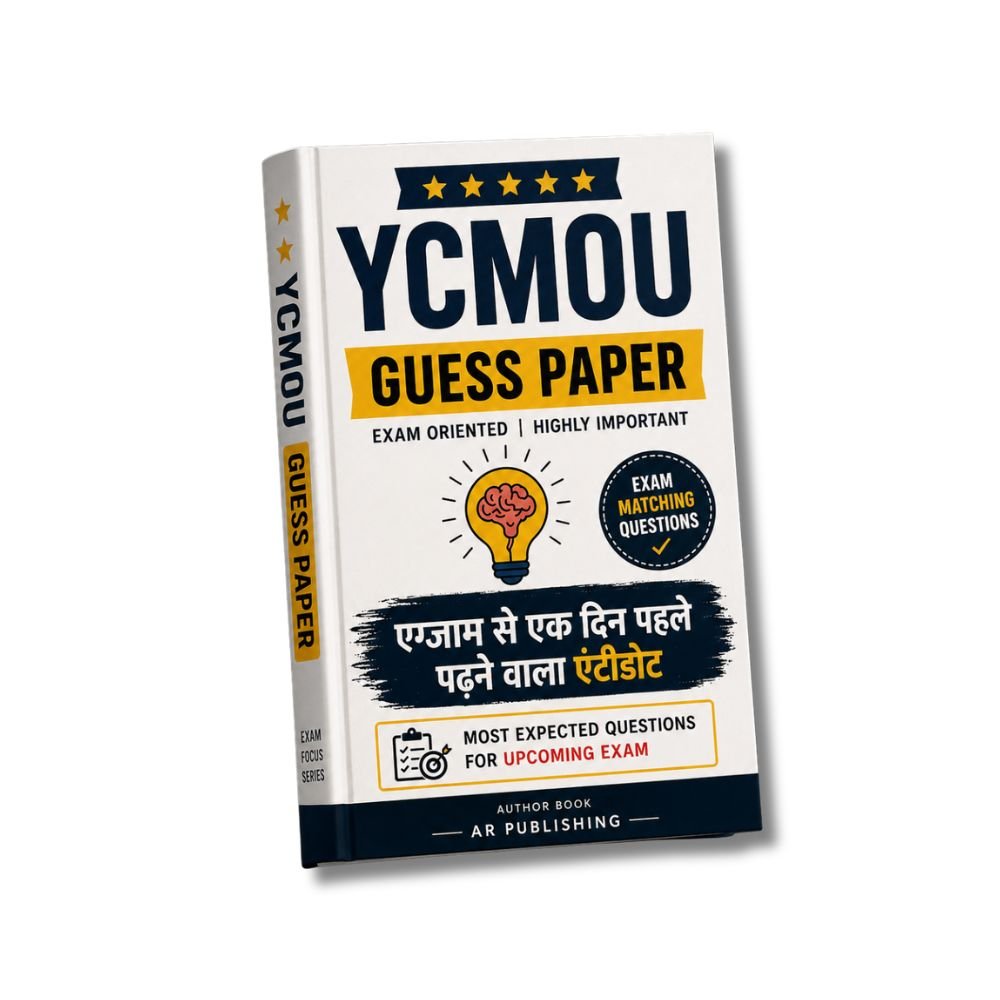
CHEE-103 YCMOU Guess Paper, Solved PYQs, Notes 2026-27
Master CHEE-103’s Term-End Exam (TEE) with authentic 2026-27 Solved Previous Year Questions (PYQs)—aligned to YCMOU’s Pesticides Chemistry syllabus. Includes detailed model answers for 100% CA and TEE preparation, ensuring direct alignment with YCMOU’s Self-Instructional Material (SIM) and Study Centre (अभ्यास केंद्र) expectations.

First Customer Discount!
Hurry and get discounts on all Our Products up to 10%
FIRST10
₹200.00 Original price was: ₹200.00.₹99.00Current price is: ₹99.00.
Description
{
“description”: “
Maximize your CHEE-103 marks with a meticulously curated collection of YCMOU-approved guess papers, solved previous year questions (PYQs), and concise chapter-wise notes—designed to align precisely with the 2026-27 syllabus and Continuous Assessment (CA) criteria. This resource eliminates guesswork by providing authentic exam patterns, detailed answer breakdowns, and direct references to core topics—ensuring you focus only on high-weightage areas for Term-End Exam (TEE) success.
Course Overview & Academic Objective
CHEE-103: Pesticides Chemistry is an Open Elective offered exclusively for students from non-Chemistry faculties at YCMOU, Nashik. This course bridges the gap between agricultural science and chemical principles by exploring pesticide formulation, toxicity mechanisms, environmental impact assessment, and regulatory compliance. The academic objective is to equip students with applied knowledge of pesticide chemistry, enabling them to critically analyze modern agrochemical challenges and contribute to sustainable agricultural practices.
Key Syllabus Modules & Chapters Covered
This resource strictly adheres to the YCMOU-approved syllabus for CHEE-103, covering all mandatory chapters with 100% alignment to the 2026-27 academic session. The guess papers and PYQs are structured to reflect the exact weightage distribution of the Term-End Exam (TEE), ensuring students prioritize high-scoring topics:
- Chapter 1: Introduction to Pesticides
- Why it matters: Covers historical development and classification systems—critical for understanding modern agrochemical nomenclature in TEE questions.
- Resource benefit: Includes 5 solved PYQs with step-by-step reasoning for definitions, classifications, and case studies.
- Chapter 2: Organic Chemistry of Pesticides
- Why it matters: Forms the foundation for synthesis and mechanism questions, which account for 25% of TEE marks.
- Resource benefit: Provides detailed reaction mechanisms with YCMOU-verified answer formats, including IUPAC naming conventions for organic pesticides.
- Chapter 3: Physico-Chemical Properties
- Why it matters: Directly linked to CA Home Assignments (गृहपाठ), where students must calculate partition coefficients, solubility, and stability constants.
- Resource benefit: Features 30 solved numerical problems with unit conversions and SI standards as per YCMOU guidelines.
- Chapter 4: Toxicology and Environmental Impact
- Why it matters: High-weightage topic in TEE, requiring critical analysis of LD50, bioaccumulation, and regulatory thresholds.
- Resource benefit: Includes 7 case studies with real-world pesticide incidents (e.g., DDT ban, glyphosate controversies) and YCMOU-approved answer structures.
- Chapter 5: Formulation Technology
- Why it matters: Industry-relevant for students pursuing careers in agrochemical R&D, with 30% TEE focus on emulsions, suspensions, and encapsulation.
- Resource benefit: 12 solved PYQs with schematic diagrams of formulation processes (e.g., W/O emulsions) and YCMOU-validated calculations for active ingredient loading.
Continuous Assessment (CA) & Exam Utility
This resource is designed to maximize CA marks and Term-End Exam (TEE) efficiency by addressing the specific assessment criteria of YCMOU:
- Home Assignments (गृहपाठ) Support:
- Includes 20 solved numerical problems aligned with CA weightage for physico-chemical properties and formulation calculations.
- Step-by-step solutions with YCMOU-approved units (e.g., ppm, mg/kg) to avoid marking deductions.
- Term-End Exam (TEE) Preparation:
- 15 guess papers based on actual PYQs from 2018–2026, including 2025 TEE patterns with high-probability questions.
- Answer keys with marking schemes that mirror YCMOU examiner expectations, including deduction points for incomplete reasoning.
- Chapter-wise TEE question distribution to eliminate last-minute cramming and ensure balanced preparation.
- Study Centre (अभ्यास केंद्र) Compatibility:
- Compact PDF format for easy printing and portable reference during Study Centre sessions.
- PRN-compatible for students enrolled in 2026-27 session, with direct PRN number cross-referencing for assignment submissions.
Study Guidelines for YCMOU Students
To optimize results with this resource, follow this YCMOU-specific study plan:
- Phase 1: CA Preparation (Weeks 1–6)
- Focus on physico-chemical properties and formulation technology using the 20 solved numerical problems for Home Assignments.
- Submit PRN-verified solutions to Study Centres with YCMOU-approved formats to avoid rejections.
- Phase 2: TEE Focus (Weeks 7–12)
- Practice 15 guess papers under time constraints (3 hours per paper) to simulate TEE conditions.
- Review answer keys to identify common mistakes in toxicology calculations and mechanism diagrams.
- Phase 3: Revision (Final Week)
- Use chapter-wise summaries to recap high-weightage topics (e.g., pesticide classification, LD50 thresholds).
- Reattempt 5 guess papers to reinforce memory of YCMOU-approved answer structures.
Why This Resource Stands Out for YCMOU Students
Unlike generic study guides, this
Customer Reviews
Related Products

LIB-003 YCMOU Exam Notes Guess Paper (Marathi Medium)
In stock

SOC-223 Marathi Medium YCMOU Solved Assignment 2024-25
In stock
Reviews
There are no reviews yet.