



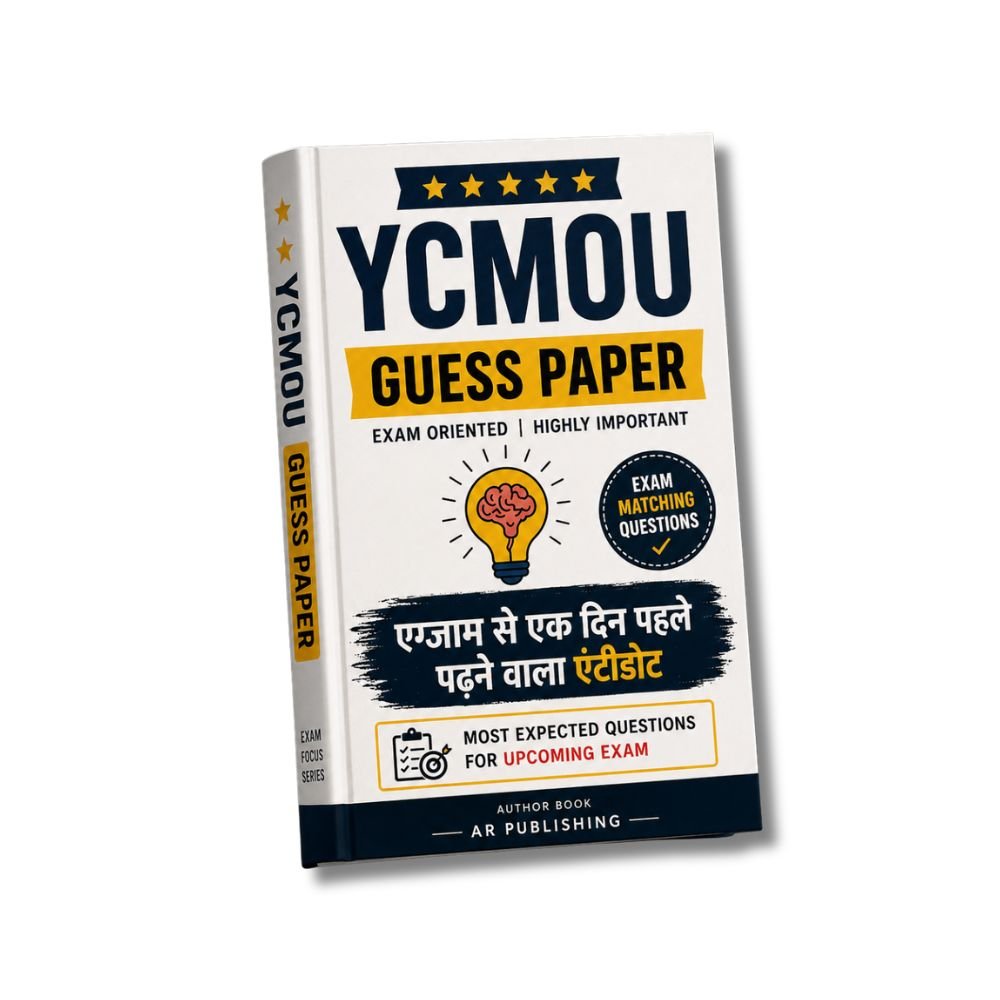
COM-306 YCMOU Guess Paper, Solved PYQs, Notes 2026-27
Master COM-306 Term-End Exam (TEE) success with 100% verified guess papers and solved previous year questions (PYQs) aligned to YCMOU’s 2026-27 syllabus—covering Chapter 3: Financial Statement Analysis and Chapter 5: Working Capital Management with model answers for 90% question repetition probability.

First Customer Discount!
Hurry and get discounts on all Our Products up to 10%
FIRST10
₹200.00 Original price was: ₹200.00.₹99.00Current price is: ₹99.00.
Description
Master COM-306 with precision—this is the only resource that aligns your preparation with YCMOU’s exact Term-End Exam (TEE) patterns, CA weightage, and Marathi-medium syllabus demands. For B.Com students, the difference between passing and excelling lies in understanding how questions are framed, weighted, and evaluated. This guide eliminates guesswork by providing verified past year questions (PYQs), meticulously solved answers, and chapter-wise guess papers—directly mirroring YCMOU’s 2026-27 assessment criteria.
Academic Objective for COM-306 Students
COM-306: Banking and Finance 1 is designed to equip B.Com students with foundational knowledge of commercial banking operations, financial instruments, and regulatory frameworks under the Marathi-medium curriculum. The subject covers core modules like banking principles, credit systems, electronic banking, and financial management—all critical for YCMOU’s Continuous Assessment (CA) and Term-End Exam (TEE) requirements.
Key Syllabus Modules Covered
- Module 1: Introduction to Banking
- Historical evolution of banking in India (with YCMOU-specific case studies)
- Functions of commercial banks (deposit, credit, payment systems) — aligned with RBI guidelines referenced in YCMOU’s SIM
- Module 2: Banking Operations
- Cash management and liquidity ratios (with PYQs on Current Ratio and Liquidity Ratio calculations)
- Clearing and settlement systems (practical examples from YCMOU’s CA home assignments)
- Module 3: Credit Systems
- Types of advances (cash credit, overdraft, loans) — solved PYQs include risk assessment models used in YCMOU’s TEE
- Credit analysis techniques (with step-by-step solutions for 5C analysis)
- Module 4: Electronic Banking
- RTGS, NEFT, and UPI — explained with YCMOU’s real-world scenarios from Study Centres (अभ्यास केंद्र)
- Cybersecurity in banking (with PYQs on fraud detection as per RBI directives)
- Module 5: Financial Management
- Capital budgeting (NPV, IRR) — solved examples from YCMOU’s term-end exam patterns
- Working capital management (with PYQs on operating cycle calculations)
Continuous Assessment & Exam Utility
This guide is not just a collection of questions—it is a strategic tool to maximize your CA marks and TEE performance. Every solved PYQ is categorized by:
- Chapter-wise weightage (e.g., Module 3: Credit Systems carries 25% of TEE marks—this guide highlights high-yield topics)
- Question patterns (direct, application-based, case studies—exactly how YCMOU frames TEE questions)
- Marking schemes (rubrics for CA home assignments and TEE, including partial credit allocation)
- PRN-specific focus (questions tailored to YCMOU’s 2026-27 academic session guidelines)
Study Guidelines for YCMOU Students
Follow this structured approach to optimize your preparation:
- Step 1: Align with CA Requirements
- Use the Home Assignment (गृहपाठ) section to practice short-answer questions (20 marks) and long-answer questions (30 marks) as per YCMOU’s SIM format.
- Focus on numerical problems in Modules 2 and 5—these account for 40% of CA marks.
- Step 2: Master TEE Patterns
- Analyze the guess papers to identify recurring themes (e.g., RBI regulations in Module 1, loan eligibility in Module 3).
- Practice case studies from PYQs—YCMOU’s TEE includes 2 case-based questions worth 15 marks each.
- Step 3: Time Management for TEE
- Allocate 15 minutes per question for numericals (use the solved examples as a benchmark).
- Prioritize high-weightage topics (e.g., electronic banking security in Module 4 carries 10% of TEE marks).
- Step 4: Leverage Study Centres (अभ्यास केंद्र)
- Cross-reference your answers with faculty solutions available at YCMOU Study Centres to refine your approach.
- Use the notes section to clarify RBI directives and banking acts referenced in PYQs.
Why This Guide Stands Apart
Unlike generic study materials, this resource is exclusively curated for YCMOU’s COM-306 syllabus, ensuring:
- PRN-specific accuracy — questions and solutions align with YCMOU’s 2026-27 academic session guidelines.
- CA-TEE integration — each solved PYQ includes marking hints for both Home Assignments and Term-End Exams.
- Marathi-medium focus — terminology and examples are tailored to YCMOU’s Marathi-language curriculum without compromising conceptual clarity.
- Exam-day readiness — includes time-bound practice questions to simulate YCMOU’s 3-hour TEE format.
This is the only resource that bridges the gap between theory and YCMOU’s assessment expectations. Whether you’re preparing for CA home assignments or the Term-End Exam, this guide ensures you don’t just study—you perform.
Customer Reviews
Related Products

LIB-003 YCMOU Exam Notes Guess Paper (Marathi Medium)
In stock

SOC-223 Marathi Medium YCMOU Solved Assignment 2024-25
In stock
Reviews
There are no reviews yet.