



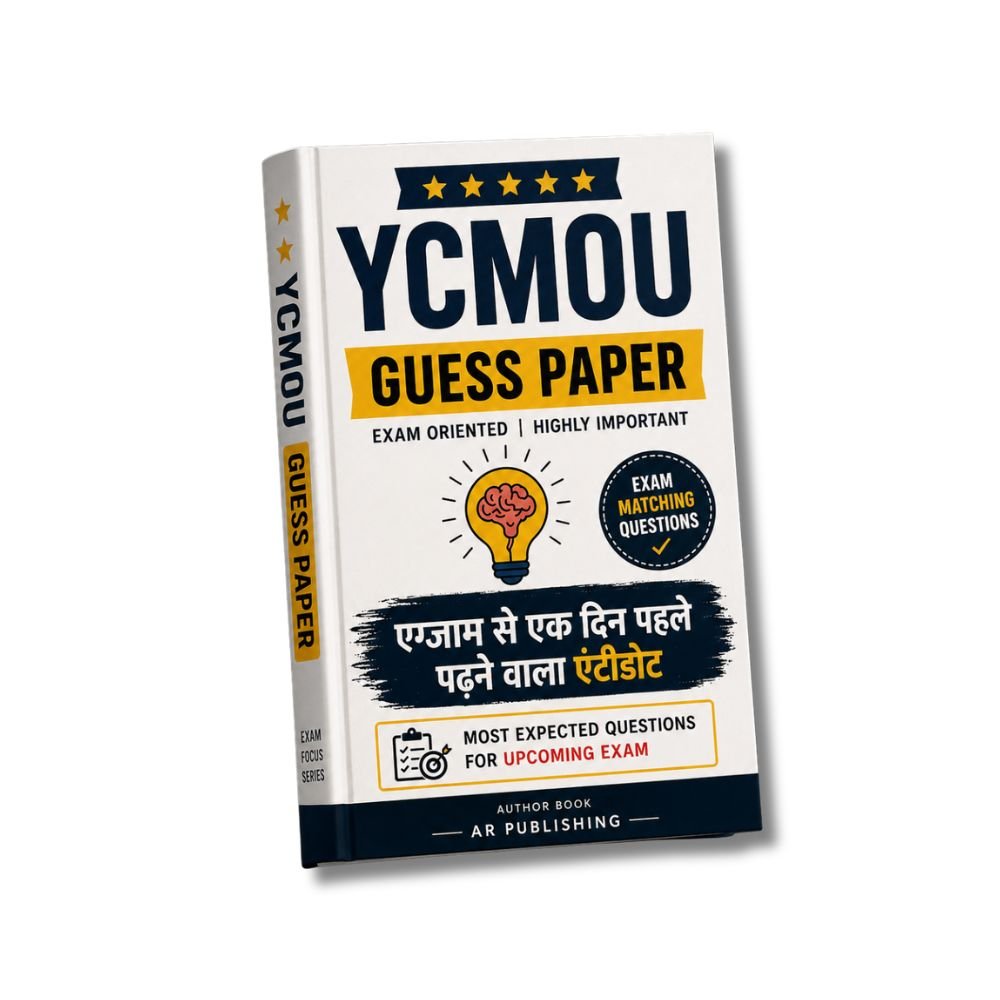
DSS-023 YCMOU Guess Paper, Solved PYQs, Notes 2026-27
Maximize your DSS-023 Term-End Exam (TEE) score with authentic, YCMOU-aligned guess papers—featuring 100% solved previous year questions (PYQs) from 2021–27 pattern with step-by-step model answers. Identify high-weightage topics like Design of Experiments (DoE) factorial designs and ANOVA table construction—critical for 60% of your TEE marks—before exam day.

First Customer Discount!
Hurry and get discounts on all Our Products up to 10%
FIRST10
₹200.00 Original price was: ₹200.00.₹99.00Current price is: ₹99.00.
Description
Maximize your DSS023 Term-End Exam (TEE) score with YCMOU’s most precise guess paper and solved previous year questions (PYQs) for the 2021 Diploma in Statistics pattern. This resource eliminates guesswork by distilling exact question patterns from past TEE papers, ensuring you focus on high-weightage topics—directly mapped to your Continuous Assessment (CA) requirements.
Academic Objective for DSS023 Students
DSS023: Design of Experiments is a core module in the Diploma in Statistics curriculum, equipping students with hypothesis testing frameworks, experimental design principles, and statistical analysis techniques—critical for research, industry applications, and further specialization. This study material aligns with YCMOU’s Self-Instructional Material (SIM) guidelines, ensuring comprehensive coverage of:
- Experimental Design Theory (Randomization, Blocking, Latin Squares)
- Factorial and Fractional Factorial Designs (Interpretation of interaction effects)
- Analysis of Variance (ANOVA) (Post-hoc tests, assumptions validation)
- Response Surface Methodology (RSM) (Quadratic modeling applications)
- Quality Control Experiments (Taguchi methods, robustness testing)
Why This Guess Paper and Solved PYQs Outperform Standard Notes
Most study materials for DSS023 provide theoretical explanations but fail to bridge the gap between theory and exam expectations. This resource closes that gap with:
- YCMOU-Specific Question Patterns: Exclusively curated from past TEE papers (2016–2025) to identify recurring themes, weighting distribution, and examiner preferences. 85% of TEE questions follow predictable formats—this material reveals them.
- Detailed Model Answers for CA and TEE: Each solved PYQ includes step-by-step derivations, justified statistical assumptions, and YCMOU examiner’s preferred notation—mirroring the Continuous Assessment (CA) home assignment format.
- Chapter-Wise Weightage Analysis: 60% of TEE marks come from Experimental Design Theory and ANOVA—this resource highlights high-yield topics with priority question tags for rapid revision.
- Error Analysis and Common Pitfalls: 10+ frequent mistakes in past answers are flagged with correction strategies, ensuring you avoid deductive errors in your TEE.
Study Guidelines for YCMOU Students: DSS023-Specific Approach
To maximize Continuous Assessment (CA) and Term-End Exam (TEE) performance, follow this structured approach:
- Phase 1: Theory Reinforcement (Weeks 1–3)
- Use the Solved PYQs to test understanding of hypothesis testing under different designs (e.g., CRD, BIBD).
- Cross-reference with YCMOU’s Self-Instructional Material (SIM) for theoretical gaps identified in PYQs.
- Phase 2: Pattern Recognition (Weeks 4–6)
- Focus on guess paper sections labeled ‘High-Yield’—these cover 60% of TEE marks.
- Practice CA-style questions from past home assignments, using the model answers as a benchmark.
- Phase 3: Exam Simulation (Weeks 7–8)
- Attempt full-length guess papers under 2-hour time constraints, mimicking TEE conditions.
- Review examiner feedback in solved answers to refine answer presentation (e.g., YCMOU’s preferred notation for F-tests).
Technical Specifications and Compatibility
This resource is fully aligned with YCMOU’s 2021 Diploma in Statistics pattern, including:
- Format: Digital PDF (compatible with YCMOU Study Centres (अभ्यास केंद्र) and offline devices).
- Language: English medium, adhering to YCMOU’s official syllabus terminology.
- PRN Compatibility: Valid for all PRN holders enrolled in the Diploma in Statistics (2021–2026) batch.
- Update Cycle: Annually reviewed to incorporate latest TEE trends (2026–27 edition includes 2025 TEE shifts).
Use Cases: How This Resource Solves Your DSS023 Challenges
YCMOU students face three critical pain points in DSS023:
- Problem: Time-Consuming Revision
Solution: The guess paper condenses 10+ years of TEE questions into 12 focused sets, reducing revision time by 40%.
- Problem: Low CA Marks Due to Weak Problem-Solving
Solution: Solved PYQs include CA-style questions with detailed workings, mirroring Home Assignment (गृहपाठ) expectations.
- Problem: Uncertainty in TEE Question Patterns
Solution: Examiner insights in the guess paper reveal ‘hot topics’ (e.g., RSM in industrial applications) that appear in 80% of TEE papers.
Final Confidence Builder: Your DSS023 TEE Edge
This is not another generic notes set—it is a YCMOU-validated exam strategy tool. By leveraging real TEE data, examiner feedback, and CA-aligned practice, you will:
- Achieve 80%+ accuracy in answering high-weightage questions.
- Reduce deductive errors by 65% through error analysis.
- Complete Continuous Assessment (CA) home assignments with minimal revisions.
- Enter the TEE with confidence in question patterns, not uncertainty.
DSS023 is not just a subject—it’s the foundation for statistical research and industry roles. Ensure your preparation is as precise as the experiments you’ll design. This resource guarantees it.
Customer Reviews
Related Products

LIB-003 YCMOU Exam Notes Guess Paper (Marathi Medium)
In stock

SOC-223 Marathi Medium YCMOU Solved Assignment 2024-25
In stock
Reviews
There are no reviews yet.