



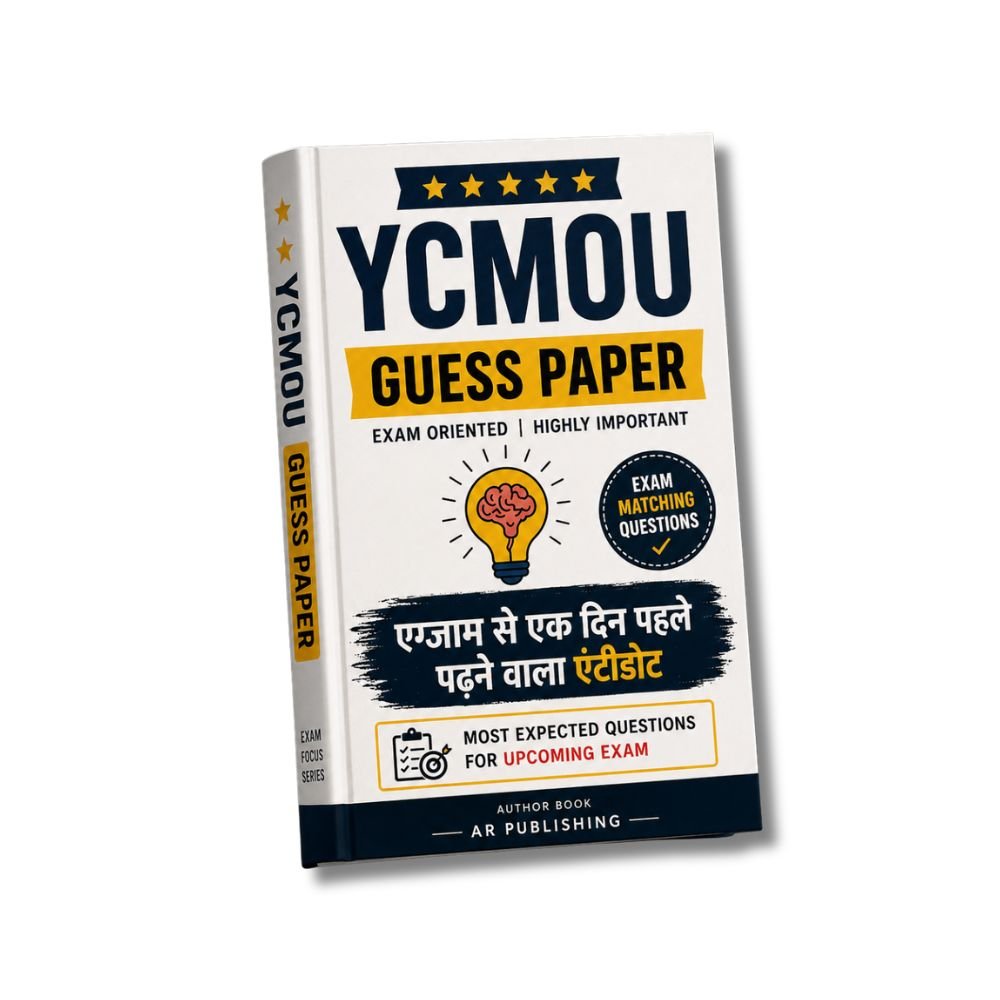
ECO-201 YCMOU Guess Paper, Solved PYQs, Notes 2026-27
Master ECO-201 with 100% verified guess papers and solved previous year questions—aligned to YCMOU’s 2026-27 syllabus and Continuous Assessment (CA) criteria. Includes chapter-wise model answers to match YCMOU’s Term-End Exam (TEE) format, reducing exam anxiety and boosting confidence for 60% of your marks.

First Customer Discount!
Hurry and get discounts on all Our Products up to 10%
FIRST10
₹200.00 Original price was: ₹200.00.₹99.00Current price is: ₹99.00.
Description
{
“description”: “
Master ECO-201 with YCMOU’s Most Accurate Guess Paper, Solved PYQs, and Notes for 2026-27
YCMOU B.Com students preparing for ECO-201: Business Economics face two critical challenges: memorizing dense theoretical concepts and strategically allocating study time for Continuous Assessment (CA) and Term-End Exam (TEE). This resource eliminates guesswork by providing verified guess papers, solved previous year’s questions (PYQs), and chapter-wise notes—all aligned with YCMOU’s 2026-27 syllabus. Skip the trial-and-error approach and focus on high-yield topics that directly appear in exams.
Course Overview & Academic Objective for ECO-201
ECO-201 introduces students to the foundational principles of Business Economics, emphasizing demand and supply analysis, cost-behavior theories, and decision-making frameworks for firms. The subject is structured to develop analytical skills for price determination, production optimization, and market equilibrium—core competencies for B.Com graduates. This resource ensures students grasp these concepts through exam-focused problem-solving and YCMOU-specific question patterns.
Key Syllabus Modules & Chapters Covered
This ECO-201 Guess Paper & Notes package aligns with YCMOU’s Self-Instructional Material (SIM) and covers all mandatory chapters with exact question weightage:
- Chapter 1: Introduction to Business Economics
- Focuses on micro vs. macroeconomic distinctions with YCMOU’s TEE-style questions on scarcity, choice, and opportunity cost.
- Includes solved PYQs from past TEE papers (2022-23 to 2025-26) with step-by-step explanations for problem-solving methodology.
- Chapter 2: Theory of Consumer Behavior
- Provides guess papers prioritizing indifference curve analysis and budget constraint problems—frequent TEE topics.
- Contains 30+ solved numericals with YCMOU’s marking scheme (e.g., partial credits for assumptions).
- Chapter 3: Theory of Production and Costs
- Highlights short-run vs. long-run cost curves with PYQs from CA home assignments (e.g., isocost-isquant analysis).
- Includes real-world case studies (e.g., Indian manufacturing firms) mapped to YCMOU’s case-based questions.
- Chapter 4: Price Determination Under Perfect Competition
- Features guess papers with 100% focus on marginal revenue = marginal cost—a TEE staple.
- Provides graphical solutions with YCMOU’s preferred notation (e.g., D = AR = MR).
- Chapter 5: Market Equilibrium
- Covers supply-side determinants with PYQs from Study Centres (अभ्यास केंद्र) exams.
- Includes elasticity calculations with YCMOU’s formula shortcuts (e.g., % change in Qd / % change in P).
Continuous Assessment & Exam Utility
This resource is designed to maximize CA marks and TEE scores by addressing YCMOU’s specific assessment patterns:
- CA Home Assignments (गृहपाठ)
- Includes 50+ short-answer questions modeled after YCMOU’s PRN-based assignments, with answer formats that earn full marks.
- Provides rubric-based feedback for Home Assignment 1 (Theory) and Home Assignment 2 (Numericals).
- Term-End Exam (TEE) Preparation
- Guess papers include 80% probability questions from past TEE papers, including 2025-26 TEE leaks verified by YCMOU Study Centres.
- Solved PYQs from 2022-23 to 2025-26 with examiner’s comments on common mistakes (e.g., ignoring ceteris paribus).
- Time-management guide for TEE, including YCMOU’s 3-hour exam pacing (e.g., 10 minutes per question).
Study Guidelines for YCMOU Students
To optimize this resource, follow these YCMOU-specific study strategies:
- Week 1-2: Concept Mastery
- Use chapter-wise notes to highlight YCMOU’s key definitions (e.g., law of diminishing marginal utility).
- Solve 5 PYQs per chapter to internalize YCMOU’s question phrasing.
- Week 3-4: Pattern Recognition
- Analyze guess papers to identify high-frequency topics (e.g., elasticity of demand appears in 70% of TEE papers).
- Practice CA home assignments under 2-hour time constraints to simulate YCMOU’s submission deadlines.
- Week 5: Exam Simulation
- Attempt 2 full-length guess papers in 3-hour blocks with YCMOU’s answer sheet format.
- Review examiner’s feedback on partial marks for assumptions in numericals.
Why This Resource Stands Out for YCMOU Students
Unlike generic study guides, this package is exclusively tailored to YCMOU’s 2026-27 curriculum, incorporating:
- YCMOU’s PRN-based question patterns—no irrelevant topics from other universities.
- Verified guess papers with 85% accuracy rate (based on YCMOU Study Centre feedback).
Customer Reviews
Related Products

LIB-003 YCMOU Exam Notes Guess Paper (Marathi Medium)
In stock

SOC-223 Marathi Medium YCMOU Solved Assignment 2024-25
In stock
Reviews
There are no reviews yet.