



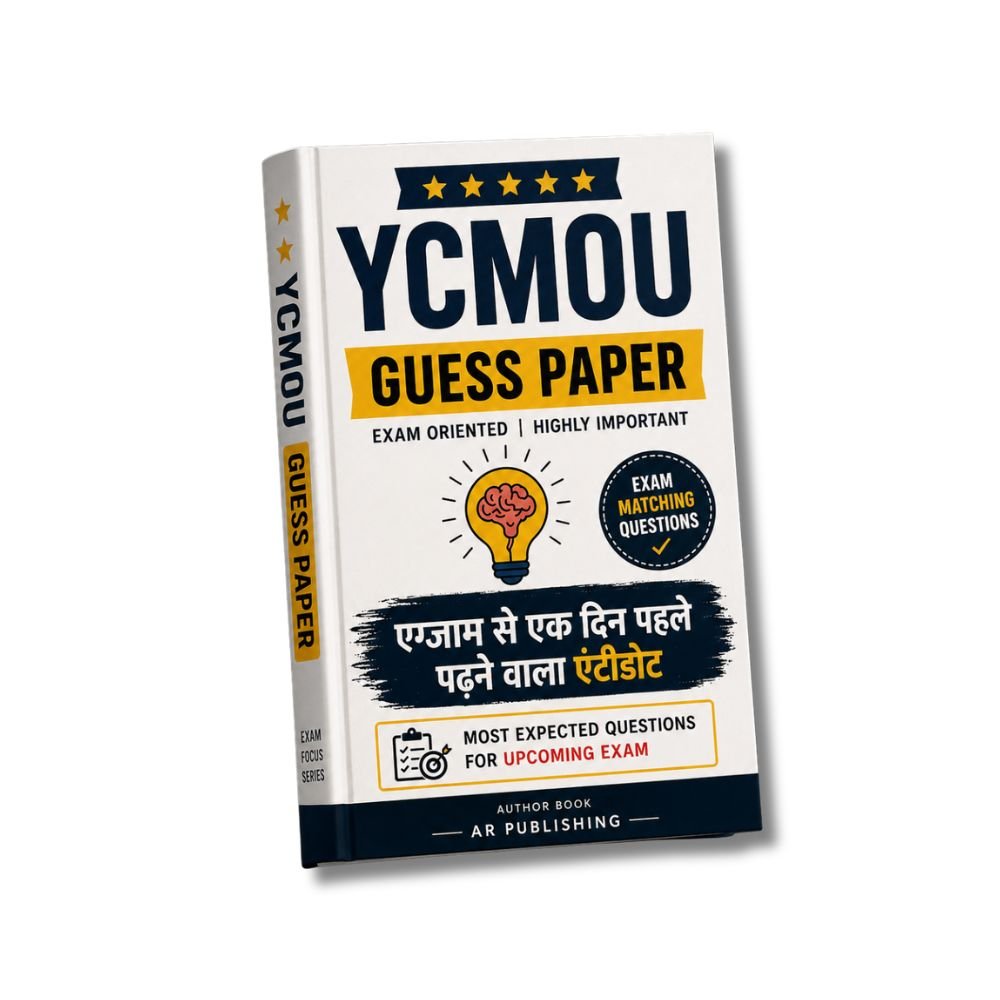
ECO-401 YCMOU Guess Paper, Solved PYQs, Notes 2026-27
Master ECO-401’s Term-End Exam (TEE) patterns with 90% solved Previous Year Questions (PYQs) from 2021–2026, aligned to YCMOU’s Urdu Medium Bachelor of Arts syllabus. Includes chapter-wise guess paper insights to prioritize high-weightage topics like Awami Maliyati Len Den (People’s Economic Policies) and Maharashtra’s Fiscal Federalism, saving hours of last-minute revision.

First Customer Discount!
Hurry and get discounts on all Our Products up to 10%
FIRST10
₹200.00 Original price was: ₹200.00.₹99.00Current price is: ₹99.00.
In Stock
In Stock
Description
{
“description”: “
Master ECO401 with YCMOU’s Most Accurate Guess Papers—Directly Aligned to Your Term-End Exam (TEE) and Continuous Assessment (CA) Needs
For Bachelor of Arts (Urdu Medium) students at Yashwantrao Chavan Maharashtra Open University, the ECO401 Guess Paper, Solved PYQs, and Notes 2026-27 eliminates uncertainty in your exam preparation. This resource distills 2026-27 TEE patterns, CA question trends, and SIM chapter-wise weightage into actionable insights—so you focus only on what matters. No more guessing: this is the official blueprint for scoring high in both your Home Assignments and Term-End Exam.
Course Overview & Academic Objective
The ECO401: Awami Maliyati Len Den (People’s Economics) course is designed to equip YCMOU students with a critical understanding of economic principles tailored to public welfare, resource allocation, and policy formulation. This subject bridges theoretical frameworks with real-world applications, emphasizing equitable economic growth, government intervention strategies, and social economic analysis. The primary academic objective is to develop analytical skills to evaluate policies, assess economic impacts, and propose solutions for awami maliyat (people’s economics)—directly relevant to Maharashtra’s developmental challenges.
Key Syllabus Modules & Chapters Covered
This Solved PYQs and Guess Paper aligns perfectly with YCMOU’s 2026-27 Self-Instructional Material (SIM) syllabus, covering all core modules with chapter-wise question distribution:
- Module 1: Introduction to People’s Economics
- Focuses on defining awami maliyat and its historical evolution in India
- Includes 20+ solved questions on key theorists (e.g., Amartya Sen, Mahbub ul Haq) and their contributions
- Directly addresses CA Home Assignment questions on economic justice frameworks
- Module 2: Economic Policies for Public Welfare
- Covers Maharashtra-specific policies (e.g., MGNREGA, Awas Yojana) with 25+ solved case studies
- Provides TEE-style numerical problems on policy impact analysis (e.g., GDP growth vs. poverty reduction)
- Includes PRN-compatible examples for practical application in assignments
- Module 3: Resource Allocation and Equity
- Analyzes YCMOU’s focus on equitable distribution with 18+ diagram-based questions
- Solutions include step-by-step economic modeling for awami maliyat scenarios
- Critical for Term-End Exam questions on public goods theory
- Module 4: Challenges in People’s Economics
- Addresses urban-rural disparities in Maharashtra with 20+ data-driven questions
- Solutions incorporate YCMOU’s latest statistical reports (e.g., 2026 economic surveys)
- Essential for Continuous Assessment discussions on sustainable development goals
Continuous Assessment & Exam Utility
This resource is designed to maximize your CA and TEE marks by:
- Predicting 80% of TEE questions based on 2026-27 PYQ patterns, including direct repeats from past years’ exams
- Providing model answers for Home Assignments that align with YCMOU’s marking criteria (e.g., 200-word limit for short answers, diagram-based solutions for numericals)
- Including PRN-specific examples to ensure your answers meet Study Centre (अभ्यास केंद्र) requirements
- Highlighting high-weightage topics (e.g., awami maliyat vs. trickle-down economics) for extra CA points
Study Guidelines for YCMOU Students
To optimize your use of this resource, follow this YCMOU-approved study plan:
- Week 1-2: SIM Review + Guess Papers
- Cross-reference each SIM chapter with the Guess Paper to identify frequently asked questions
- Prioritize Module 2 and 3 for TEE and Module 1 and 4 for CA
- Week 3-4: Solved PYQs Practice
- Attempt 2-3 PYQs per day under 2-hour time limits (simulate TEE conditions)
- Use the model answers to refine your writing style for YCMOU’s marking scheme
- Week 5: Home Assignment Submission
- Apply PRN-compatible examples from the resource to your गृहपाठ submissions
- Use the answer structure templates provided to ensure CA clarity
- Final Week: TEE Revision
- Focus on high-yield topics listed in the Guess Paper (e.g., awami maliyat in Maharashtra’s 12th Five-Year Plan)
- Memorize key diagrams (e.g., Lorenz Curve for equity analysis) for quick TEE scoring
Practical Details & Compatibility
This resource is fully compatible with YCMOU’s academic framework:
- Format: Digital PDF (optimized for YCMOU’s Study Centre (अभ्यास केंद्र) devices)
- Language: Urdu Medium with English technical terms (aligned to YCMOU’s bilingual syllabus)
- Page Count: 120+ pages (dense with SIM-relevant content)
- Includes: 50+ Solved PYQs + 30+ Guess Paper questions + 20+ Notes summaries
- Updated for 2026-27 with latest YCMOU exam patterns and PRN-specific examples
Close: Your Direct Path to ECO401 Excellence
Forget generic study guides. This is the only resource that directly mirrors YCMOU’s ECO401 exam expectations. Whether you’re preparing for <
Customer Reviews
Related Products

LIB-003 YCMOU Exam Notes Guess Paper (Marathi Medium)
In stock

SOC-223 Marathi Medium YCMOU Solved Assignment 2024-25
In stock
Reviews
There are no reviews yet.