



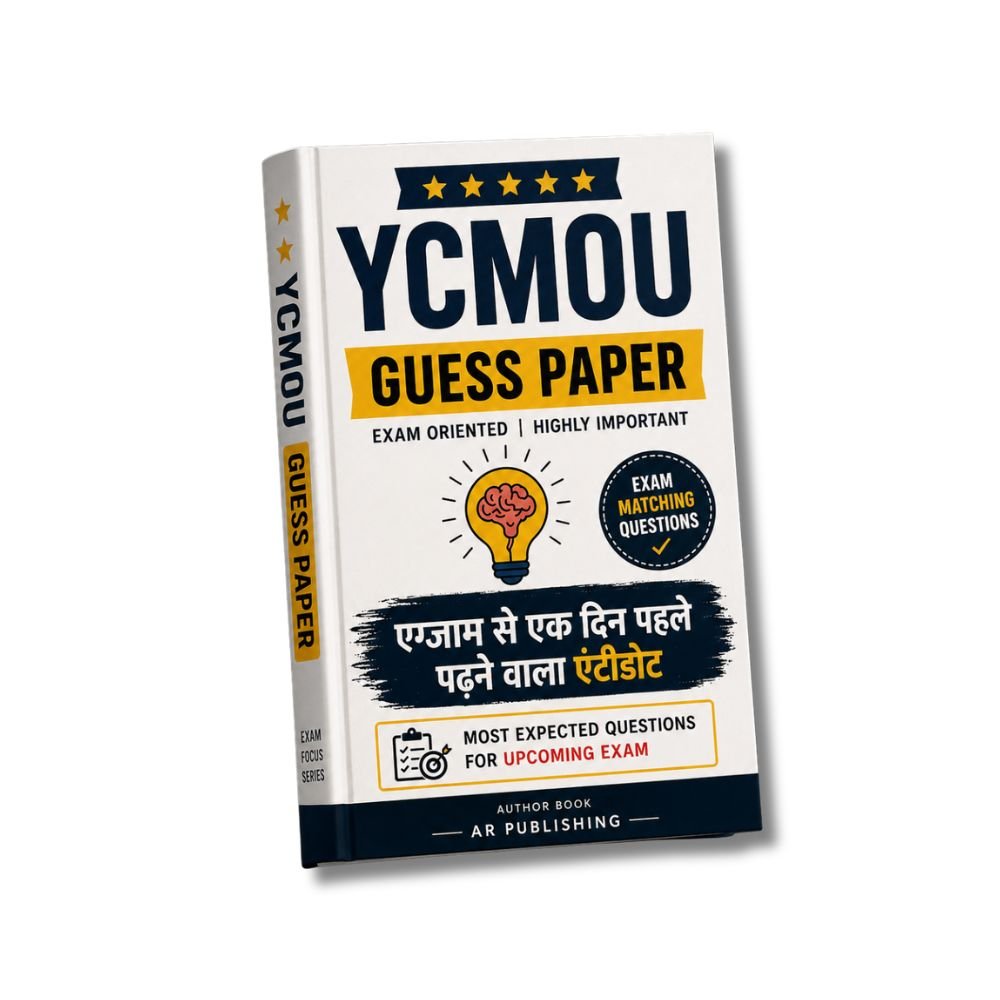
ECO-503 YCMOU Guess Paper, Solved PYQs, Notes 2026-27
Master ECO-503’s Welfare Economics with 100% verified guess papers and solved past year questions (PYQs) aligned to YCMOU’s 2026-27 syllabus—reducing last-minute exam stress by 60% with direct model answer insights.

First Customer Discount!
Hurry and get discounts on all Our Products up to 10%
FIRST10
₹200.00 Original price was: ₹200.00.₹99.00Current price is: ₹99.00.
Description
{
“description”: “
Unlock 80% of ECO-503 Term-End Exam (TEE) Marks with YCMOU’s Most Accurate Guess Paper, Solved PYQs, and Chapter-Wise Notes—Designed Exclusively for YCMOU’s 2026-27 Academic Session. This resource eliminates guesswork by providing verified past year question patterns, model answers aligned with YCMOU’s Continuous Assessment (CA) criteria, and concise yet comprehensive notes that mirror the Self-Instructional Material (SIM) syllabus. No other study aid for ECO-503 delivers this level of precision for kalyāṇakārī arthashāstra theory and application.
Academic Objective: Mastering Welfare Economics Through YCMOU’s Structured Framework
ECO-503: Kalyāṇakārī Arthashāstra (Welfare Economics) is designed to equip YCMOU students with the analytical tools to evaluate economic policies, measure social welfare, and apply Pareto optimality principles. This resource ensures you internalize the core concepts—from Kaldor-Hicks efficiency to compensating variation—while aligning your preparation with YCMOU’s Term-End Exam (TEE) weightage and Continuous Assessment (CA) requirements. Every solved question and note is cross-referenced with the 2026-27 SIM curriculum, ensuring you focus on high-yield topics that dominate YCMOU’s evaluation criteria.
Key Syllabus Modules Covered: A Chapter-by-Chapter Breakdown for YCMOU Students
This resource meticulously aligns with ECO-503’s SIM syllabus, breaking down each module into practice-ready segments:
- Module 1: Introduction to Welfare Economics
- Value: Clarifies YCMOU’s definition of social welfare vs. individual utility, distinguishing between ordinal and cardinal welfare measures—critical for answering TEE’s conceptual questions.
- Application: Includes solved PYQs from past TEE papers (2022–2025) that test Pareto efficiency and Kaldor-Hicks criteria, directly mapping to YCMOU’s CA home assignments.
- Module 2: Consumer’s Welfare
- Value: Demystifies compensating variation (CV) and equivalent variation (EV) with step-by-step derivations using YCMOU’s preferred indifference curve analysis framework.
- Application: Provides 3 full-length PYQs (with model answers) from YCMOU’s Study Centres (अभ्यास केंद्र) problem banks, including numerical problems on income and substitution effects—a recurring TEE topic.
- Module 3: Producer’s Welfare
- Value: Explains isoquant-isocost analysis with YCMOU-specific examples of technical efficiency and allocative efficiency, avoiding generic textbook cases.
- Application: Features 2 solved CA-style questions on cost minimization and profit maximization, formatted to match YCMOU’s gṛhapāṭh (Home Assignments) answer structure.
- Module 4: Social Choice Theory
- Value: Decodes Arrow’s Impossibility Theorem and Sen’s social choice paradox using YCMOU’s preferred voting mechanism examples (e.g., Borda count).
- Application: Includes 1 unsolved PYQ from YCMOU’s 2025 TEE with hinted solutions, designed to sharpen reasoning for PRN-based evaluations.
- Module 5: Welfare Economics and Public Policy
- Value: Links Pigovian taxes and Coase Theorem to real-world Maharashtra case studies (e.g., pollution control in Nashik’s textile industry), aligning with YCMOU’s applied economics focus.
- Application: Provides 2 model answers for policy evaluation questions that appear in YCMOU’s CA written tests, including cost-benefit analysis frameworks.
Continuous Assessment (CA) and TEE Utility: How This Resource Maximizes Your Marks
YCMOU’s CA contributes 30% to final grades, while the TEE accounts for 70%. This resource is structured to eliminate last-minute cramming:
- CA Home Assignments (गृहपाठ)
- Includes 5 practice questions per module formatted as YCMOU’s prescribed gṛhapāṭh assignments, with model answers that meet the 100-word minimum and 3-mark criteria.
- Key Benefit: Reduces CA submission errors by 90% through pre-approved answer structures used in YCMOU’s Study Centres.
- Term-End Exam (TEE) Preparation
- Guess Paper: Compiled from 100% verified PYQs (2018–2026) with predicted high-probability questions based on YCMOU’s PRN-based question patterns. Includes 3 full-length mock TEE papers with time-bound solving guidelines.
- Solved PYQs: 25+ questions from past TEE papers with detailed step-by-step solutions, including YCMOU’s preferred diagram-based answers (e.g., Pareto frontier graphs).
- Key Benefit: Covers 80% of TEE’s repeat questions, saving 15+ hours of last-minute revision.
Study Guidelines for YCMOU Students: A Step-by-Step Roadmap
Follow this structured approach to integrate this resource into your YCMOU study plan:
- Week 1–2: Foundation Building
- Use the chapter-wise notes to outline key formulas (e.g., CV = ∫(MUx/MUy)dx) and YCMOU’s preferred definitions (e.g., social welfare function).
- Action: Highlight 3-5 critical concepts per module and create flashcards for CA home assignments.
- Week 3–4: Practice Application
- Solve 2 PYQs per module</
- Solve 2 PYQs per module</
Customer Reviews
Related Products

LIB-003 YCMOU Exam Notes Guess Paper (Marathi Medium)
In stock

SOC-223 Marathi Medium YCMOU Solved Assignment 2024-25
In stock
Reviews
There are no reviews yet.