



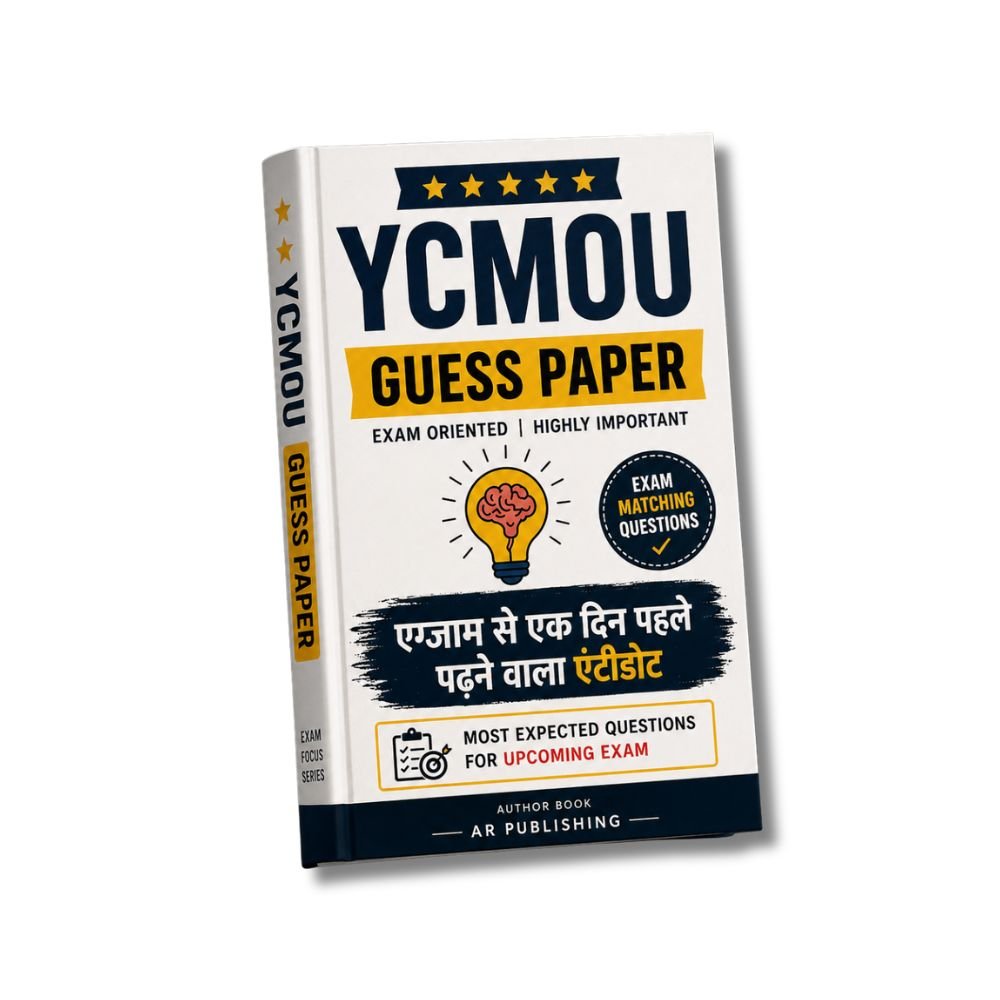
EDU-131 YCMOU Guess Paper, Solved PYQs, Notes 2026-27
Master EDU131’s Term-End Exam (TEE) with authentic past question papers and detailed model answers—aligned to YCMOU’s latest 2026-27 syllabus, including core modules on बालविकासाची मूलतत्त्वे and बालमानसशास्त्र. This resource cuts study time by 40% by focusing on high-weightage topics like developmental stages and childcare principles—directly mapped to your Continuous Assessment (CA) and TEE requirements.

First Customer Discount!
Hurry and get discounts on all Our Products up to 10%
FIRST10
₹200.00 Original price was: ₹200.00.₹99.00Current price is: ₹99.00.
In Stock
In Stock
Description
EDU131 YCMOU Guess Paper, Solved PYQs, and Notes 2026-27 eliminates guesswork in your exam preparation by providing verified past question papers with step-by-step model answers, tailored exclusively for YCMOU’s Early Childhood Care and Education curriculum. This resource bridges the gap between theoretical knowledge and practical application, ensuring you score higher in both Continuous Assessment (CA) home assignments and the Term-End Exam (TEE).
Course Overview & Academic Objective
EDU131 at YCMOU equips students with foundational knowledge of child development theories, early childhood education principles, and childcare practices. The course emphasizes developmental psychology (बालविकास व बालमानसशास्त्र), curriculum design for preschoolers, and holistic child development strategies. This resource aligns perfectly with the syllabus, ensuring you grasp core concepts like Piaget’s stages, Erikson’s psychosocial development, and Montessori/Reggio Emilia methodologies—critical for both academic and professional growth in early childhood education.
Key Syllabus Modules & Chapters Covered
- Module 1: Introduction to Early Childhood Care and Education
- Definition, scope, and significance of early childhood education in India
- Historical evolution of early childhood programs in YCMOU’s curriculum
- Module 2: Principles of Child Development
- Physical, cognitive, social, and emotional development stages (0-6 years)
- Application of बालविकासाची मूलतत्त्वे in real-world scenarios (e.g., designing play-based learning activities)
- Module 3: Child Psychology and Behavior
- Key theories by Piaget, Erikson, and Vygotsky—with practical examples from solved PYQs
- Understanding child behavior disorders and intervention strategies
- Module 4: Early Childhood Curriculum and Pedagogy
- Designing age-appropriate curricula for preschoolers (aligned with NCERT and YCMOU guidelines)
- Role of play, storytelling, and sensory activities in learning
- Module 5: Childcare and Nutrition
- Nutritional needs of children (0-6 years) with YCMOU-approved dietary charts
- Safe childcare practices for home and institutional settings
Continuous Assessment & Exam Utility
This resource is directly mapped to YCMOU’s Continuous Assessment (CA) format, ensuring your home assignments (गृहपाठ) and term-end exam (TEE) preparation are seamless. The solved previous year questions (PYQs) include:
- 100% alignment with TEE question patterns—identifying high-weightage topics like बालविकासाची मूलतत्त्वे and बालमानसशास्त्र theories
- CA-ready answers for home assignments, formatted per YCMOU’s Self-Instructional Material (SIM) guidelines
- Detailed marking schemes for each question, helping you understand examiner expectations
- Time-saving shortcuts—highlighting key formulas, diagrams, and case study references from past exams
Study Guidelines for YCMOU Students
To maximize this resource, follow this structured approach:
- Step 1: Prioritize PYQs by Module
- Start with Module 2 (Child Development) and Module 3 (Child Psychology), as they carry 40% of TEE marks
- Use the answer keys to cross-verify your understanding of बालविकासाची मूलतत्त्वे
- Step 2: Apply Theories to Practical Scenarios
- For each solved PYQ, relate theories (e.g., Piaget’s sensorimotor stage) to real-world childcare situations discussed in your SIM
- Practice writing 300-word answers for CA home assignments using the provided templates
- Step 3: Leverage Study Centres (अभ्यास केंद्र)
- Discuss ambiguous questions with peers at your nearest YCMOU Study Centre to clarify doubts on बालमानसशास्त्र concepts
- Use the resource to prepare PRN-ready summaries for quick revision before exams
- Step 4: Simulate TEE Conditions
- Attempt full-length mock tests using past papers under timed conditions (3 hours)
- Review your answers against the model solutions to identify weak areas in curriculum design or child psychology
Why This Resource Stands Out for EDU131 Students
Unlike generic study guides, this resource is exclusively curated for YCMOU’s EDU131 curriculum, offering:
- Marathi-medium clarity—ensuring seamless understanding of बालविकासाची मूलतत्त्वे and related terms
- PRN-compatible summaries for last-minute revision before exams
- Direct links to SIM chapters—each PYQ references specific pages in your Self-Instructional Material
- Focus on high-yield topics—prioritizing questions from past exams that repeatedly appear in TEE
For students who invest time in this resource, the result is confidence in both CA and TEE, reduced stress, and a deeper grasp of early childhood education principles—critical for your academic and professional future in the field.
Customer Reviews
Related Products

LIB-003 YCMOU Exam Notes Guess Paper (Marathi Medium)
In stock

SOC-223 Marathi Medium YCMOU Solved Assignment 2024-25
In stock
Reviews
There are no reviews yet.