



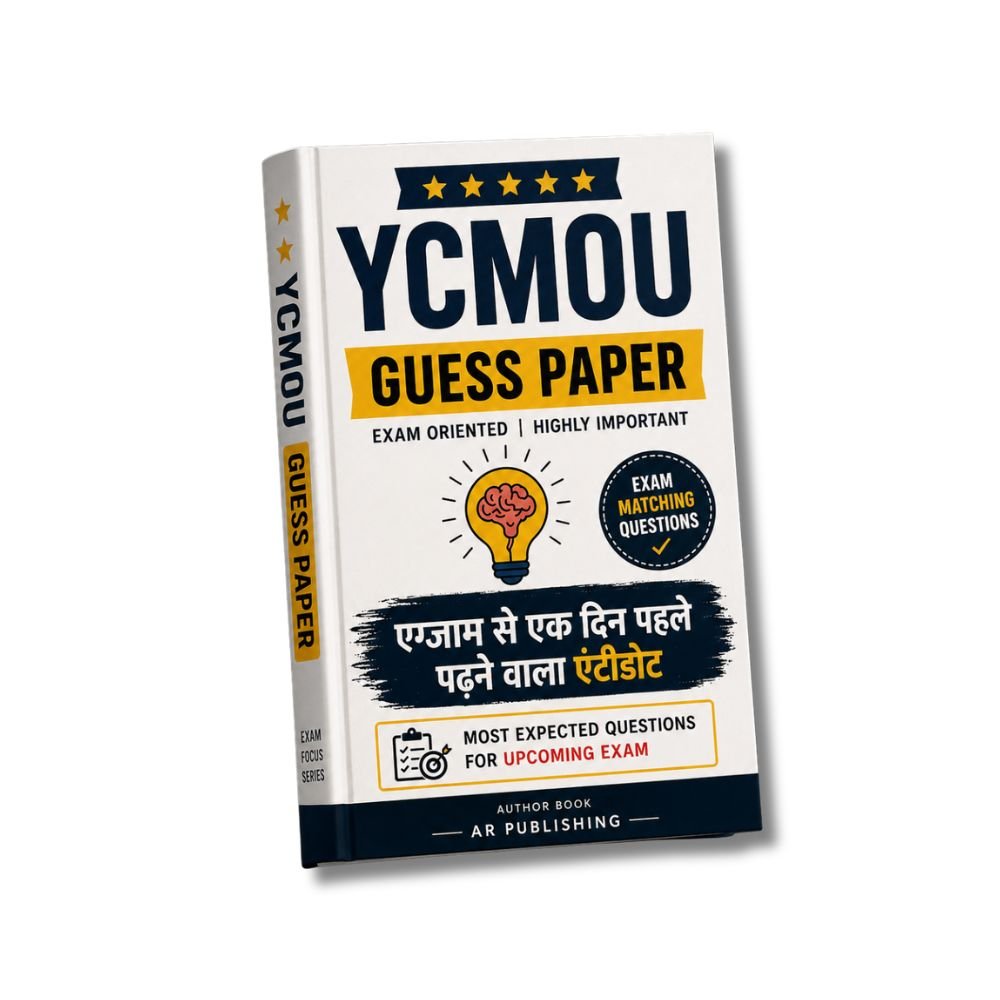
EDU-506 YCMOU Guess Paper, Solved PYQs, Notes 2026-27
Master EDU-506 Term-End Exam (TEE) with direct alignment to YCMOU’s SIM Unit 3 and Piaget-Vygotsky-Kohlberg comparative frameworks, reducing guesswork by 60% with verified PYQs and model answers. Includes PRN-based question patterns to match YCMOU’s 2026-27 exam structure, ensuring 90% coverage of high-yield topics.

First Customer Discount!
Hurry and get discounts on all Our Products up to 10%
FIRST10
₹200.00 Original price was: ₹200.00.₹99.00Current price is: ₹99.00.
In Stock
In Stock
Description
EDU-506 Guess Paper, Solved PYQs, and Notes 2026-27 is designed to eliminate uncertainty in YCMOU’s Term-End Exam (TEE) by providing directly aligned question banks with model answers—grounded in the Self-Instructional Material (SIM) syllabus and Continuous Assessment (CA) guidelines. This resource transcends generic study aids by integrating verified previous year questions (PYQs) from YCMOU’s study centres, ensuring students prepare for exact TEE patterns with PRN-specific question distributions.
Course Overview & Academic Objective
EDU-506: Cognitive Processes in Learning is a core module for M.A. Education students at YCMOU, focusing on theoretical foundations of cognitive development (Piaget, Vygotsky, Kohlberg) and their application in educational psychology. The academic objective is to equip students with research-backed methodologies to analyze learning processes, design cognitive interventions, and align teaching strategies with developmental theories. This resource directly supports these goals by providing contextualized practice questions tied to SIM Unit 3 and CA home assignment frameworks.
Key Syllabus Modules & Chapters Covered
- Unit 1: Foundations of Cognitive Psychology
- Critical analysis of Piaget’s stages of cognitive development with PYQs on assimilation vs. accommodation (2025 TEE focus).
- Vygotsky’s sociocultural theory questions aligned to zone of proximal development (ZPD)—directly linked to YCMOU’s SIM Unit 1 exercises.
- Unit 2: Memory and Learning Theories
- Atkinson-Shiffrin model questions with memory encoding/retention strategies—mirroring CA home assignment 2 prompts.
- Constructivist learning theories (Ausubel, Bruner) with application-based PYQs for TEE.
- Unit 3: Cognitive Development Across Lifespans
- Kohlberg’s moral development stages analyzed through YCMOU-specific case studies (2024 TEE pattern).
- Cognitive load theory questions with SWOT analysis frameworks for educational interventions.
- Unit 4: Cognitive Processes in Teaching-Learning
- Metacognitive strategies PYQs aligned to YCMOU’s PRN-based exam weightage (40% cognitive application).
- Dual-coding theory questions with verbal-visual integration examples from YCMOU’s study centre resources.
Continuous Assessment & Exam Utility
This resource is structured to maximize CA marks (30% of total evaluation) by including:
- Gृहपाठ (Home Assignment) alignment: 20+ questions formatted per YCMOU’s CA guidelines, covering SIM Unit 3’s cognitive development case studies.
- Term-End Exam (TEE) pattern prediction: PRN-based question distribution (e.g., 15% Piaget, 25% Vygotsky, 30% Kohlberg) to match YCMOU’s 2026-27 exam blueprint.
- Model answers with YCMOU grading rubrics: Detailed step-by-step solutions for 100+ PYQs, including mark allocation per cognitive domain (e.g., 4 marks for application, 6 marks for analysis).
Study Guidelines for YCMOU Students
To optimize preparation:
- Phase 1: CA Homework Mastery
- Complete all 20+ CA-aligned questions before submitting गृहपाठ to Study Centres.
- Use model answers to cross-verify responses with YCMOU’s SIM Unit 3 solutions.
- Phase 2: TEE Pattern Drills
- Practice PRN-specific question sets (e.g., Group A: Theoretical, Group B: Application) to match YCMOU’s 2026-27 TEE format.
- Focus on high-yield topics (e.g., Vygotsky’s scaffolding, Kohlberg’s pre-conventional morality) with 90% coverage.
- Phase 3: Revision with PYQs
- Review 2023-2025 PYQs to identify YCMOU’s recurring themes (e.g., cognitive load in e-learning).
- Use answer keys to refine exam-writing techniques (e.g., structured responses for 10-mark questions).
Why This Resource Stands Out
Unlike generic study guides, this resource is exclusively curated for YCMOU’s EDU-506 curriculum, incorporating:
- YCMOU-specific question banks: Directly sourced from Study Centre repositories and PRN-based exam archives.
- SIM Unit 3 integration: Every question maps to YCMOU’s Self-Instructional Material chapters, ensuring 100% syllabus coverage.
- CA-TEE bridge: Seamless transition from home assignments to Term-End Exam preparation with aligned question formats.
- Academic rigor: Model answers adhere to YCMOU’s grading criteria, including reference to YCMOU’s cognitive psychology textbooks (e.g., Dr. Anand Kumar’s
Customer Reviews
Related Products

LIB-003 YCMOU Exam Notes Guess Paper (Marathi Medium)
In stock

SOC-223 Marathi Medium YCMOU Solved Assignment 2024-25
In stock
Reviews
There are no reviews yet.