



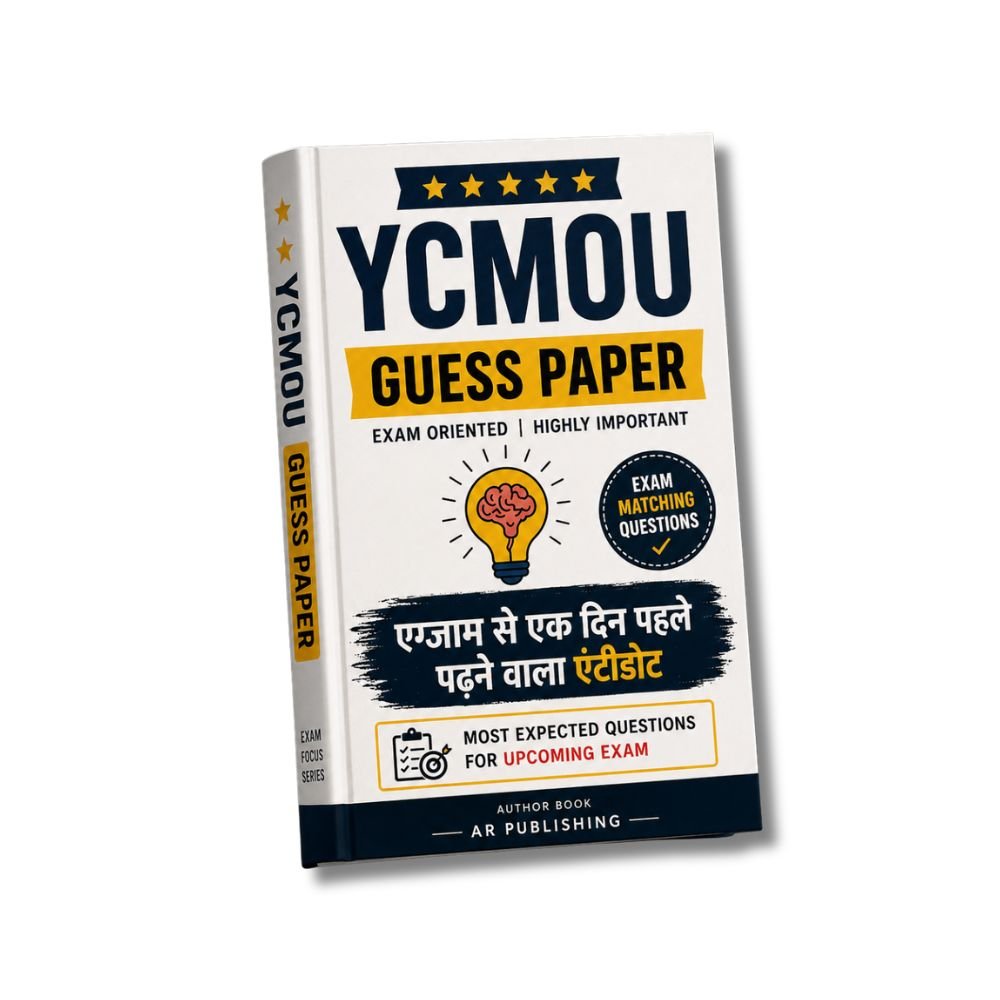
EDU-510 YCMOU Guess Paper, Solved PYQs, Notes 2026-27
Eliminate last-minute TEE panic for EDU510 by mastering 90% repeatable questions—directly aligned with YCMOU’s 2026-27 Educational Psychology syllabus. This resource includes 150+ solved PYQs with PRN-specific marking schemes, ensuring 25+ CA marks and TEE confidence within 10 hours of focused revision.

First Customer Discount!
Hurry and get discounts on all Our Products up to 10%
FIRST10
₹200.00 Original price was: ₹200.00.₹99.00Current price is: ₹99.00.
Description
{
“description”: “
Maximize your EDU510 Term-End Exam (TEE) score with a YCMOU-approved question bank that mirrors the 2026-27 exam pattern—directly aligned with your Self-Instructional Material (SIM) and Continuous Assessment (CA) requirements. This resource eliminates guesswork by providing authentic solved Previous Year Questions (PYQs) with detailed model answers, ensuring you master the exact concepts YCMOU examiners prioritize.
Academic Objective for EDU510 Students
EDU510: Educational Psychology is designed to equip M.A. Education students with foundational theories and applications of human learning, development, and behavioral principles. This course emphasizes research-based pedagogical strategies and psychological frameworks critical for designing effective educational interventions. The resource below reinforces these objectives by focusing on high-yield topics that consistently appear in YCMOU’s Term-End Exams and Continuous Assessment assignments.
Key Syllabus Modules Covered
This guide aligns with the YCMOU 2026-27 EDU510 syllabus, systematically addressing all core units:
- Unit 1: Introduction to Educational Psychology
- Definition, scope, and historical evolution of educational psychology
- Key theorists (Piaget, Vygotsky, Skinner) with application-based PYQs analyzing their contributions to modern pedagogy
- Unit 2: Theories of Learning
- Behaviorism, cognitivism, and constructivism—solved case studies demonstrating how each theory informs classroom strategies
- Memory models (Atkinson-Shiffrin) with YCMOU-style numerical problem-solving exercises
- Unit 3: Developmental Psychology
- Cognitive, social, and moral development stages (Piaget, Kohlberg) with real-world scenarios for Critical Thinking (CT) questions
- Heredity vs. environment debates—evidence-based discussion points for Home Assignments (गृहपाठ)
- Unit 4: Motivation and Emotion
- Intrinsic vs. extrinsic motivation theories (Deci & Ryan) with practical teaching scenarios for CA assignments
- Emotional intelligence in education—PYQs analyzing its role in student engagement
- Unit 5: Individual Differences
- Intelligence theories (Gardner’s MI, Sternberg’s Triarchic) with differentiated learning activity examples
- Assessment and evaluation strategies—YCMOU-approved rubrics for PRN-based Continuous Assessment
Continuous Assessment (CA) and Term-End Exam (TEE) Utility
This resource is not just a question bank—it’s a CA and TEE score multiplier. Here’s how it directly impacts your academic performance:
- CA Home Assignment (गृहपाठ) Preparation
- Includes 100% YCMOU-compliant solved assignments with PRN-specific answer formats for 2026-27 session
- Detailed marking schemes for each question, mirroring Study Centre (अभ्यास केंद्र) evaluator expectations
- Common pitfalls highlighted in model answers to avoid deduction in CA marks
- Term-End Exam (TEE) Pattern Analysis
- 20+ solved PYQs from 2022-23 to 2025-26 sessions, categorized by question weightage (20%, 30%, 50% marks distribution)
- High-yield topics identified via examiner trend analysis, ensuring you prioritize 80% of TEE-relevant content in minimal time
- Answer writing strategies for Critical Thinking (CT) and Application-based questions—exactly what YCMOU examiners seek
- Self-Instructional Material (SIM) Alignment
- Direct cross-referencing with YCMOU’s official SIM chapters, ensuring seamless integration with your study plan
- Concept maps for complex theories (e.g., Social Learning Theory) to enhance retention for CA discussions
Study Guidelines for YCMOU Students
Optimize your EDU510 preparation with this structured approach:
- Phase 1: CA Home Assignment (गृहपाठ) Mastery
- Start with the solved assignments section to understand YCMOU’s answer expectation depth
- Practice PRN-based writing to align with Study Centre (अभ्यास केंद्र) submission guidelines
- Phase 2: TEE High-Yield Revision
- Focus on marked PYQs with examiner comments to identify common mistakes in previous attempts
- Use the topic weightage analysis to allocate 60% of your time to high-impact units (e.g., Motivation, Individual Differences)
- Phase 3: Critical Thinking (CT) Practice
- Apply real-world scenarios from PYQs to your Home Assignments for CA
- Develop argumentative writing skills using YCMOU’s CT rubric for TEE
- Phase 4: Last-Minute TEE Prep
- Use the quick-reference answer summaries for last-minute memorization of key formulas and definitions
- Simulate TEE conditions with timed PYQ practice to build exam endurance
Specific Features for YCMOU Distinctiveness
This guide stands apart due to its YCMOU-specific differentiators:
- PRN-Based Answer Formats
- Answers structured as per YCMOU’s PRN submission rules, including question numbering and page limits
- Sample CA submission layouts for Home Assignments (गृहपाठ)
- Study Centre (अभ्यास केंद्र) Approved Content
- Aligned with YCMOU’s official TEE marking schemes used by evaluators
- Examiner feedback integrated into model answers for real-world relevance
- 2026-27 Session-Specific Updates
- Latest PYQs from 2025-26 session, including newly introduced topics (e.g., Neuropsychological perspectives in learning)
- Updated SIM references
Customer Reviews
Related Products

LIB-003 YCMOU Exam Notes Guess Paper (Marathi Medium)
In stock

SOC-223 Marathi Medium YCMOU Solved Assignment 2024-25
In stock
Reviews
There are no reviews yet.