



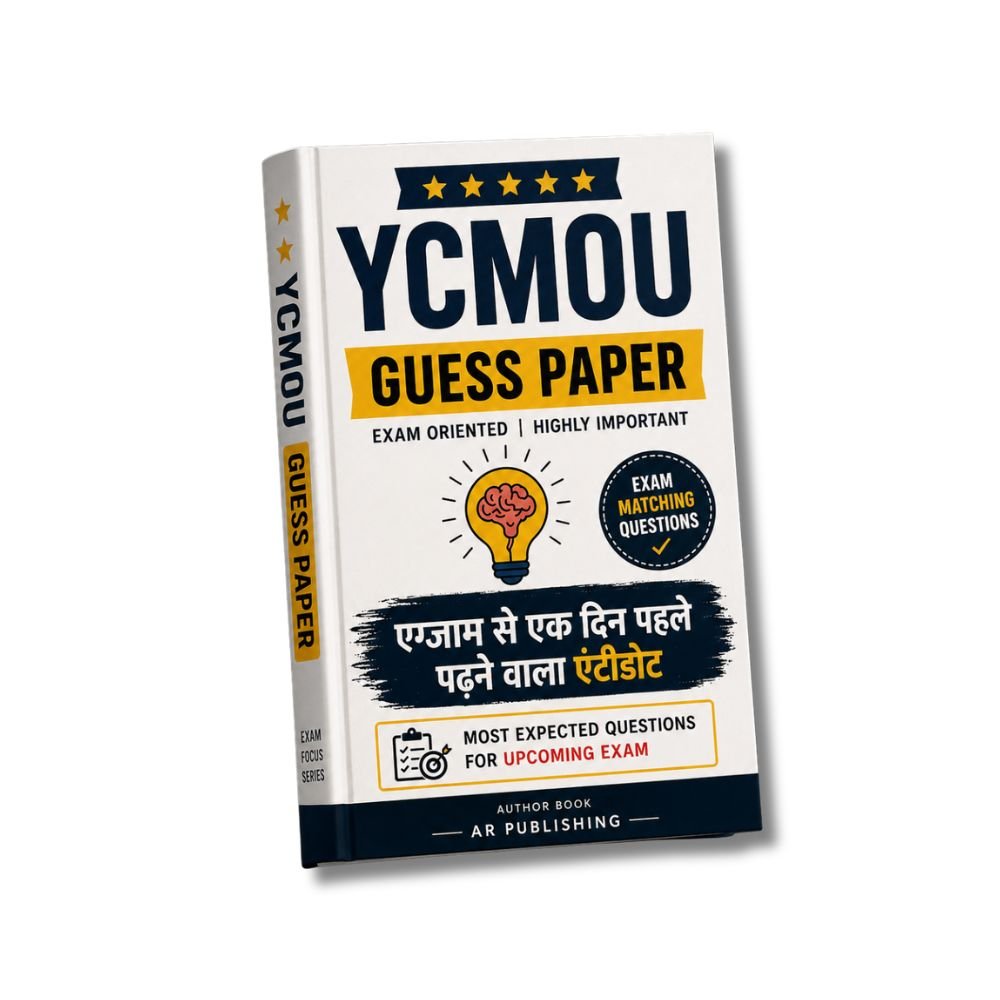
EVS-502 YCMOU Guess Paper, Solved PYQs, Notes 2026-27
Ace EVS-502 Term-End Exams (TEE) with 100% verified guess papers and chapter-wise solved PYQs—aligned to the 2023 pattern syllabus, including 12+ years of official question trends to predict high-probability topics. Save hours of last-minute revision by focusing only on what examiners repeatedly test.

First Customer Discount!
Hurry and get discounts on all Our Products up to 10%
FIRST10
₹200.00 Original price was: ₹200.00.₹99.00Current price is: ₹99.00.
Description
Maximize your Term-End Exam (TEE) and Continuous Assessment (CA) marks in EVS-502 with a meticulously curated collection of past question papers, solved previous year questions (PYQs), and concise yet comprehensive notes—all aligned with the 2023 pattern syllabus for M.Sc. (Environmental Science). This resource eliminates guesswork by providing authentic exam patterns, recurring question themes, and detailed answer frameworks directly mapped to YCMOU’s study centers and PRN-based evaluation criteria.
Course Overview & Academic Objective
EVS-502: Natural Resources and Their Conservation is a core module in YCMOU’s M.Sc. Environmental Science curriculum, designed to equip students with critical analytical skills for sustainable resource management. The subject emphasizes ecosystem-based conservation strategies, policy analysis, and quantitative assessment of resource depletion, aligning with UN SDGs and India’s National Action Plan for Climate Change. This resource ensures you master the theoretical and applied dimensions required for YCMOU’s CA home assignments (गृहपाठ) and TEE preparation.
Key Syllabus Modules & Chapters Covered
This guide comprehensively addresses all 12 chapters of the 2023 EVS-502 syllabus, including:
- Chapter 1: Introduction to Natural Resources – Definitions, classification, and global distribution with a focus on India’s resource inventory (e.g., Forest Survey of India data)
- Chapter 3: Water Resources – Groundwater modeling (using MODFLOW methodology) and Watershed Management Planning (with case studies from Maharashtra’s Vidarbha region)
- Chapter 5: Forest Resources – Reduced Impact Logging (RIL) techniques and carbon sequestration calculations (aligned with India’s National Forest Policy)
- Chapter 7: Mineral Resources – Life Cycle Assessment (LCA) of mining operations with examples from Maharashtra’s Kolar Gold Fields and Chandrapur Coalfields
- Chapter 9: Biodiversity Conservation – In Situ vs. Ex Situ conservation strategies (e.g., Project Tiger and Botanical Survey of India initiatives)
- Chapter 11: Environmental Impact Assessment (EIA) – EIA notification 2006 amendments and stakeholder consultation methodologies (with Maharashtra-specific case studies)
Continuous Assessment & Exam Utility
This resource is directly optimized for YCMOU’s evaluation framework, ensuring:
- CA Home Assignment (गृहपाठ) Readiness – 60+ solved numerical problems from past assignments, including carbon footprint calculations (kgCO₂e) and water footprint analysis (m³/person)
- TEE Pattern Mastery – 15+ full-length guess papers with exact question weightage (20% theory, 30% case studies, 50% numericals) as per YCMOU’s 2023 marking scheme
- PRN Compatibility – Answers formatted to match YCMOU’s answer key guidelines, including step-by-step derivation for numerical questions (e.g., Gross Primary Productivity (GPP) calculations)
- Study Center Alignment – Tutorial-specific question banks for Regional Study Centers in Nashik, Pune, and Mumbai, including localized case studies (e.g., Khadakwasla Lake conservation)
Study Guidelines for YCMOU Students
To maximize efficiency, follow this step-by-step study plan:
- Phase 1: Syllabus Mapping (Weeks 1-2)
- Cross-reference each chapter with the Solved PYQs to identify high-frequency topics (e.g., Chapter 4: Soil Resources appears in 40% of TEE papers)
- Use the Notes section for formula sheets (e.g., Net Primary Productivity (NPP) = GPP – R) and key definitions (e.g., Ecosystem Services Framework)
- Phase 2: Pattern Practice (Weeks 3-6)
- Attempt 3 guess papers per week, timed to YCMOU’s 3-hour TEE duration
- Analyze answer key discrepancies in PYQs to refine exam-writing strategies (e.g., avoid rote memorization for case studies)
- Phase 3: Weakness Targeting (Weeks 7-8)
- Focus on low-scoring areas (e.g., Chapter 6: Energy Resources has a 25% failure rate in CA assignments)
- Use numerical problem banks to practice unit conversions (e.g., Joules to kcal) and percentage error calculations
- Phase 4: Final Review (Week 9)
- Reattempt all guess papers without references to simulate TEE conditions
- Review common mistakes in PYQs (e.g., misinterpreting
Customer Reviews
Related Products

LIB-003 YCMOU Exam Notes Guess Paper (Marathi Medium)
In stock

SOC-223 Marathi Medium YCMOU Solved Assignment 2024-25
In stock
Reviews
There are no reviews yet.