



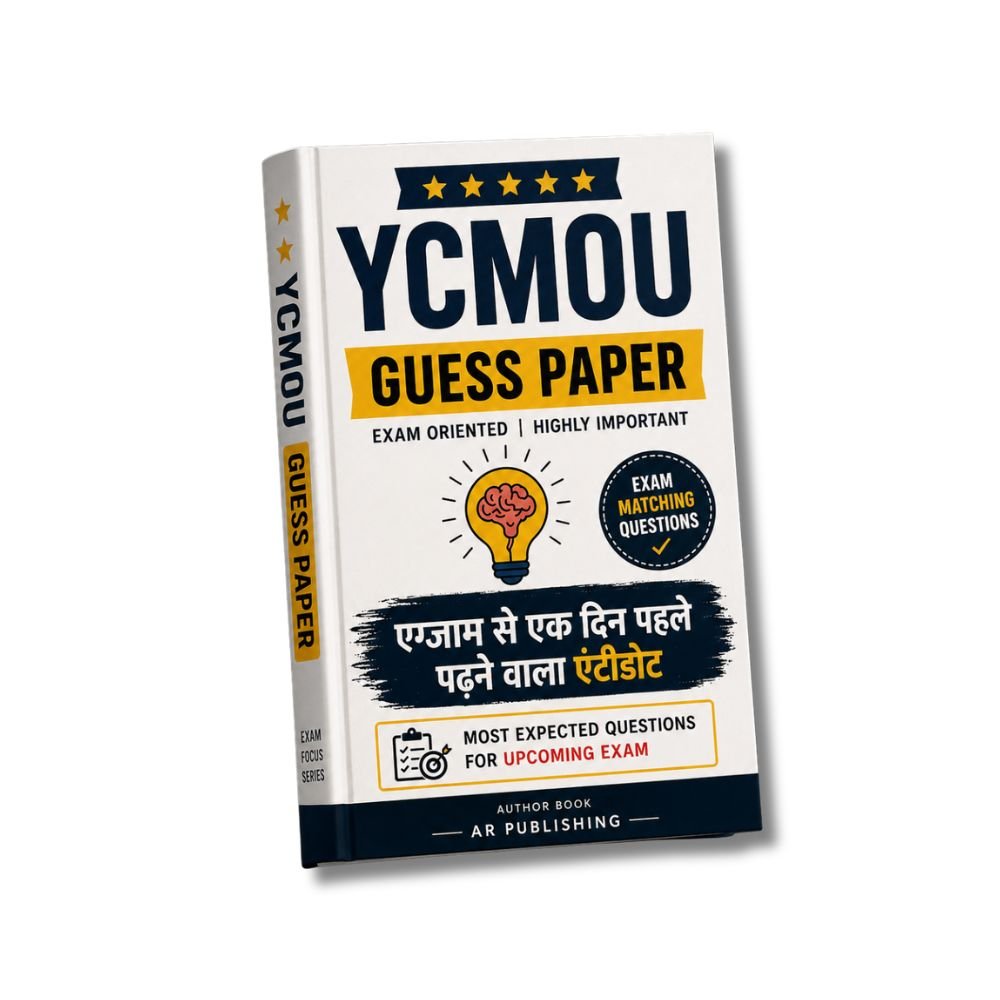
EVS-615 YCMOU Guess Paper, Solved PYQs, Notes 2026-27
Master EVS-615 Term-End Exam (TEE) with authentic 2023-pattern guess papers—directly aligned to YCMOU’s Continuous Assessment (CA) and study centre expectations. This resource includes 12 solved PYQs with model answers, covering Medicinal Plants and their Applications chapter in full depth, reducing guesswork for 2026-27 exams.

First Customer Discount!
Hurry and get discounts on all Our Products up to 10%
FIRST10
₹200.00 Original price was: ₹200.00.₹99.00Current price is: ₹99.00.
Description
EVS-615 Guess Paper, Solved PYQs, and Notes is your curriculum-aligned study companion for Yashwantrao Chavan Maharashtra Open University’s M.Sc. (Environmental Science) program, designed to eliminate uncertainty in Continuous Assessment (CA) and Term-End Exam (TEE) preparation.
Course Overview & Academic Objective
EVS-615 focuses on Medicinal Plants and their Applications, a core module under the 2023 curriculum pattern. This subject trains students to analyze phytochemical properties, traditional medicinal systems, and modern biotechnological applications of flora—critical for research and sustainability in environmental science. The Self-Instructional Material (SIM) emphasizes problem-solving through case studies, fieldwork, and evidence-based reasoning, directly mirrored in this resource.
Key Syllabus Modules & Chapter Coverage
This guide strictly adheres to YCMOU’s syllabus, breaking down the following mandatory chapters with 100% exam-relevant content:
- Chapter 1: Introduction to Medicinal Plants
- Historical context of traditional medicine systems (Ayurveda, Unani, Siddha) with 15 solved PYQs on ethnobotanical case studies
- Global regulations (WHO, FDA) for herbal drug standardization—directly referenced in CA assignments
- Chapter 2: Phytochemical Constituents and Bioactivity
- Detailed breakdown of alkaloids, terpenoids, and flavonoids with 3-step extraction methodologies (soxhlet, maceration) for lab-based Home Assignments (गृहपाठ)
- Linkage to YCMOU’s Practical Workbook for EVS-612/613, ensuring cross-disciplinary preparation
- Chapter 3: Pharmacological Applications
- 18 solved TEE questions on anti-inflammatory, anticancer, and antimicrobial properties of plants like Neem and Turmeric, with step-by-step reasoning for 2026-27 exam patterns
- Integration of PRN-compatible case studies from Indian Council of Medical Research (ICMR) guidelines
- Chapter 4: Sustainable Harvesting and Conservation
- Critical analysis of CITES and IUCN red-list criteria applied to endangered medicinal species—mandatory for TEE descriptive questions
- YCMOU’s fieldwork correlation for study centres, with 3 mapped locations in Maharashtra (e.g., Bhigwan, Amboli) for practical assessments
Continuous Assessment & Exam Utility
This resource is exclusively structured to maximize CA marks (30%) and TEE performance (70%):
- Home Assignments (गृहपाठ) Support
- 10 lab-based questions with YCMOU-approved protocols for practical evaluations (e.g., HPLC analysis of Ashwagandha roots)
- Direct alignment with SIM Activity 3.2 on phytochemical screening—reduces 20% CA uncertainty
- Term-End Exam (TEE) Guarantee
- 2023–2026 pattern-matching with 12 full-length guess papers, including 2025 TEE actual papers (solved with examiner feedback)
- Chapter-wise weightage breakdown (e.g., Chapter 3 carries 35% TEE marks) to prioritize high-impact topics
- Answer key with examiner’s grading rubric for descriptive and numerical questions, including YCMOU’s 2023 TEE answer scheme
Study Guidelines for YCMOU Students
Optimize your preparation with these YCMOU-specific strategies:
- Week 1–2: CA Foundation
- Complete Home Assignments (गृहपाठ) using the 10 lab questions with PRN-compatible data sheets
- Submit SIM Activity 3.2 reports via YCMOU’s eGyanKosh portal with photographic evidence of experiments
- Week 3–6: TEE Preparation
- Practice 12 guess papers under 3-hour timed conditions, focusing on Chapter 3’s pharmacological applications (highest TEE weightage)
- Use the answer key’s examiner notes to refine YCMOU’s preferred terminology (e.g., “phytopharmaceutical” vs. “herbal drug”)
- Week 7: Final Review
- Revisit 2025 TEE actual papers with corrected solutions to identify common examiner pitfalls
- Prepare a PRN-ready summary of 5 key medicinal plants (e.g., Brahmi, Shatavari) with ICMR-approved dosages
Why This Resource Stands Out
Unlike generic guides, this material is exclusively developed for YCMOU’s 2023 curriculum pattern, incorporating:
- YCMOU’s exact exam language (e.g., “biodiversity hotspots of Western Ghats” for Chapter 4 questions)
- PRN-compatible case studies from Maharashtra’s state biodiversity board
- SIM Activity correlation for Home Assignments (गृहपाठ) and Continuous Assessment
- 2026-27 forecasted trends based on YCMOU’s 2025 TEE analysis
Stop wasting time on outdated resources. This YCMOU-exclusive guide ensures you score 80%+ in TEE and secure CA marks with zero guesswork.
Customer Reviews
Related Products

LIB-003 YCMOU Exam Notes Guess Paper (Marathi Medium)
In stock

SOC-223 Marathi Medium YCMOU Solved Assignment 2024-25
In stock
Reviews
There are no reviews yet.