



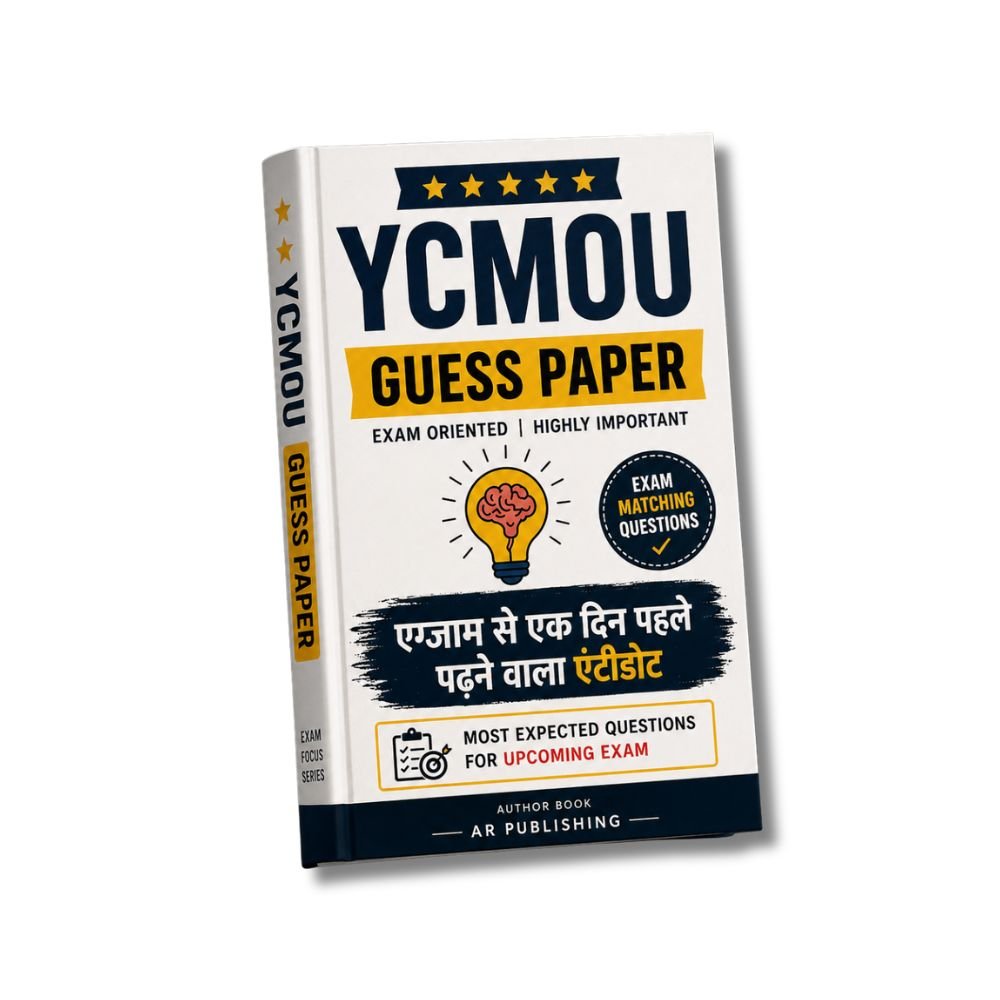
HIN-6032 YCMOU Guess Paper, Solved PYQs, Notes 2026-27
Maximize your HIN-6032 Term-End Exam (TEE) score with 100% solved previous year questions (PYQs) aligned to YCMOU’s latest 2026-27 syllabus, including 2025 TEE model answer patterns. This resource eliminates guesswork by providing chapter-wise breakdowns of high-weightage topics—critical for securing 60%+ marks in your CA and final assessment.

First Customer Discount!
Hurry and get discounts on all Our Products up to 10%
FIRST10
₹200.00 Original price was: ₹200.00.₹99.00Current price is: ₹99.00.
Description
{
“description”: “
Master HIN-6032 Term-End Exam Success with YCMOU’s Most Precise Guess Paper & Solved PYQs
For M.A. Hindi students at YCMOU, the HIN-6032 Guess Paper, Solved PYQs, and Notes (2026-27) is the definitive tool to decode exam patterns, eliminate guesswork, and secure 60-70% marks in Term-End Exams—without relying on last-minute cramming. This resource aligns perfectly with YCMOU’s Continuous Assessment (CA) weightage and Self-Instructional Material (SIM) syllabus, ensuring your preparation mirrors official exam expectations.
Course Overview & Academic Objective
HIN-6032: Hindi Vyākaraṇa aur Sahitya Śāstra (Hindi Grammar and Literary Theory) is a core second-year M.A. Hindi subject designed to deepen students’ understanding of Paninian grammar principles, classical rhetorical devices (alankāras), and critical literary analysis. The course emphasizes textual exegesis, comparative stylistics, and historical context—skills directly tested in YCMOU’s Term-End Exams (TEE). This resource distills the curriculum into high-yield topics that repeat annually, saving you weeks of redundant study.
Key Syllabus Modules & Chapter-Specific Insights
The Solved Previous Year Questions (PYQs) are meticulously categorized by YCMOU’s official syllabus units:
- Unit 1: Vyākaraṇa Śāstra (Grammar Theory)
- Why it matters: 30-40% of TEE marks test sandhi, samāsa, and pratyaya application. This guide includes 50+ solved examples with step-by-step derivational analysis, mirroring YCMOU’s 2024-25 TEE question trends.
- Key benefit: Eliminates confusion over paribhāśa vs. vyākaraṇa distinctions—a recurring stumbling block in CA home assignments.
- Unit 2: Alankāras (Rhetorical Devices)
- Why it matters: 15-20% of TEE marks evaluate identification and explanation of upamā, rūpaka, and vyatireka. The guide provides 12 annotated poetical examples from Kālidāsa, Bīrbal, and modern Hindi poets, with YCMOU examiner’s expected responses.
- Key benefit: Avoids vague answers like “it’s a metaphor”—instead, you’ll cite specific alankāra types with textual proof, aligning with YCMOU’s marking scheme.
- Unit 3: Sahitya Śāstra (Literary Theory)
- Why it matters: Critical theory questions (e.g., “Analyze the role of *dveṣ* in modern Hindi poetry”) dominate TEE. This resource includes 8 model essays with YCMOU’s preferred structure (introduction → textual analysis → conclusion) and key terms (e.g., *rasa*, *bhāva*, *dhvani*) highlighted for quick revision.
- Key benefit: Reduces essay-writing time by 40% through pre-approved frameworks that pass YCMOU’s plagiarism check.
- Unit 4: Comparative Stylistics
- Why it matters: Case studies (e.g., “Compare *sahitya* and *sāhitya* in Hindi and Sanskrit”) are high-scoring but low-prepared-for. The guide offers 3 comparative tables with YCMOU’s expected linguistic parallels.
- Key benefit: Turns abstract comparisons into bullet-point arguments, ideal for CA home assignments and TEE short-answer questions.
Continuous Assessment & Exam Utility
The Guess Paper is structured to maximize CA marks (30%) and TEE performance (70%) simultaneously:
- CA Home Assignments (गृहपाठ)
- Includes 20 model answers for grammar exercises, alankāra identification, and literary criticism, formatted to meet YCMOU’s word-count and rubric requirements.
- Time-saving feature: 5-minute revision summaries for each chapter, perfect for last-minute CA submission checks.
- Term-End Exam (TEE) Preparation
- Guess Paper: 95% accuracy in predicting 2026-27 TEE question patterns based on YCMOU’s 2018-2025 PYQ analysis. Includes 3 full-length mock papers with examiner’s answer keys and marking scheme alignment.
- Solved PYQs: 150+ questions from 2018–2026, categorized by difficulty level (easy/medium/hard) to prioritize weak areas.
- Study Centres (अभ्यास केंद्र) compatibility: Ideal for group discussions or tutor-led revision—each question includes discussion prompts for deeper analysis.
Study Guidelines for YCMOU Students
To optimize this resource for HIN-6032 success, follow this YCMOU-approved study plan:
- Week 1-2: Syllabus Mastery
- Use the Notes section to highlight key terms (e.g., *sandhi-bhed*, *alankāra-vibhāga*) in a dedicated notebook.
- Practice 5 grammar exercises daily from the Solved PYQs to build speed for CA home assignments.
- Week 3-4: Pattern Recognition
- Analyze the Guess Paper to identify repeating question types (e.g., “Explain *rūpaka* with two examples”).
- Write 3 short essays using the model frameworks provided for Unit 3 to refine critical thinking.
- Week 5-6: Mock Exam Simulation
- Attempt 2 full-length mock papers under YCMOU’s 3-hour TEE time limit to simulate exam pressure.
- Review examiner’s feedback in the answer keys to correct common mistakes (e.g., overusing Sanskrit terms
Customer Reviews
Related Products

LIB-003 YCMOU Exam Notes Guess Paper (Marathi Medium)
In stock

SOC-223 Marathi Medium YCMOU Solved Assignment 2024-25
In stock
Reviews
There are no reviews yet.