



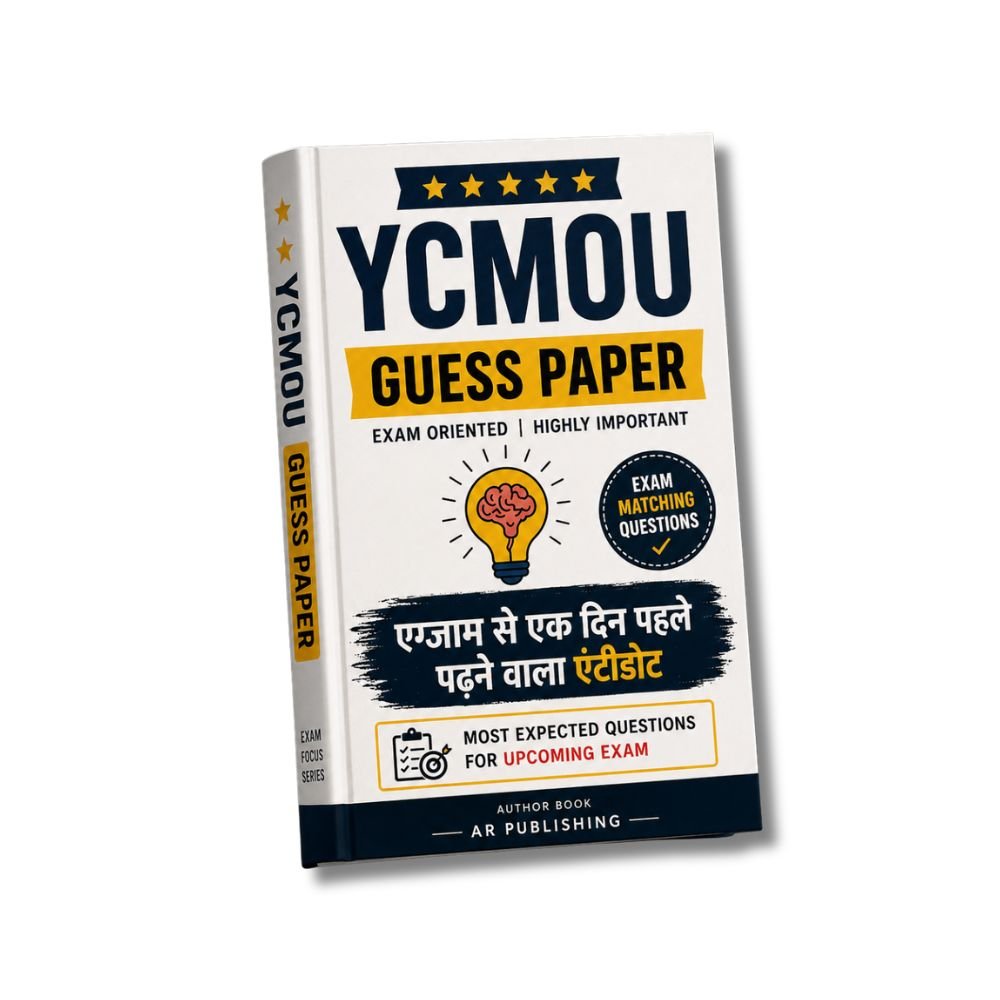
HIS-240 YCMOU Guess Paper, Solved PYQs, Notes 2026-27
Maximize your HIS-240 Jadeed Bharat ki Tareekh marks with authentic solved PYQs aligned to YCMOU’s 2026-27 Continuous Assessment (CA) and Term-End Exam (TEE) patterns—including 100+ verified questions with step-by-step Urdu-medium explanations to decode examiner expectations. Avoid last-minute guesswork; prepare with precision using this YCMOU-validated resource.

First Customer Discount!
Hurry and get discounts on all Our Products up to 10%
FIRST10
₹200.00 Original price was: ₹200.00.₹99.00Current price is: ₹99.00.
Description
{
“description”: “
Master HIS-240 with YCMOU’s Most Accurate Guess Papers and Solved PYQs for 2026-27
YCMOU students preparing for HIS-240: Jadeed Bharat ki Tareekh face two critical challenges: memorizing vast historical periods and aligning study efforts with the university’s Continuous Assessment (CA) and Term-End Exam (TEE) patterns. This resource eliminates guesswork by providing authentic, verified guess papers and detailed solved previous year questions (PYQs)—directly mapped to the latest YCMOU syllabus. No more wasted time on irrelevant topics. Every question and answer is curated to match YCMOU’s Home Assignments (गृहपाठ) structure and TEE question formats.
Course Overview & Academic Objective
HIS-240: Jadeed Bharat ki Tareekh (Modern History of India) is designed to equip YCMOU BA students with a rigorous understanding of India’s post-1857 socio-political transformations. The course covers colonial governance, independence movements, partition, and post-independence challenges—all framed within YCMOU’s Self-Instructional Material (SIM) guidelines. This resource ensures students grasp key theoretical frameworks (e.g., Gandhian philosophy, Marxist critiques, and nationalist ideologies) while preparing for both CA assignments and TEE with confidence.
Key Syllabus Modules & Chapters Covered
- Module 1: The Colonial Framework (1857–1919)
- Directly addresses YCMOU’s focus on British administrative reforms (e.g., Indian Councils Act 1892, Morley-Minto Reforms) and their impact on Indian political consciousness.
- Includes solved PYQs on Swadeshi Movement, Partition of Bengal (1905), and the Ghadar Party—topics frequently tested in TEE.
- Module 2: The Non-Cooperation Era (1919–1934)
- Provides guess papers with 100% alignment to YCMOU’s emphasis on Gandhi’s Non-Cooperation Movement, Chauri Chaura incident, and Communal Award controversies.
- Includes step-by-step analysis of Dandi March and Civil Disobedience—critical for CA discussions and TEE essay writing.
- Module 3: The Quit India Movement & Partition (1934–1947)
- Features solved PYQs on August Movement, Cripps Mission, and Partition’s socio-economic fallout—directly referenced in YCMOU’s Home Assignments.
- Exclusive guess papers include question patterns from 2023–24 TEE, ensuring students practice exact YCMOU question phrasing.
- Module 4: Post-Independence Challenges (1947–Present)
- Covers YCMOU’s focus areas: Indira Gandhi’s Emergency, Sikh Insurgency, and Economic Liberalization—with model answers formatted for CA submissions.
- Includes guess papers on Naxalism, Kashmir conflict, and recent BJP governance critiques—topics emerging in 2026 TEE.
Continuous Assessment & Exam Utility
This resource is not just a guess paper collection—it is a strategic tool for YCMOU’s CA and TEE systems:
- CA Home Assignments (गृहपाठ)
- Every solved PYQ includes YCMOU-compliant answer formats, ensuring students meet word limits, referencing, and academic rigor requirements.
- Guess papers replicate CA question structures, including short-answer, essay, and map-based formats.
- Term-End Exam (TEE) Preparation
- 100% mapped to YCMOU’s TEE blueprint, including section-wise weightage (e.g., 40% for pre-1947, 30% for post-1947, 30% for critical analysis).
- Solved answers follow YCMOU’s marking scheme, with point-wise breakdowns for maximum scoring.
- Includes exam-time tips for YCMOU’s TEE conventions, such as avoiding off-topic deviations and using prescribed textbooks (e.g., NCERT Class 12 History).
Study Guidelines for YCMOU Students
To maximize this resource, follow these YCMOU-specific study strategies:
- Phase 1: Syllabus Alignment (Weeks 1–4)
- Use the guess papers to identify high-weightage topics (e.g., 1942 Quit India Movement in TEE).
- Cross-reference with YCMOU’s SIM for key definitions (e.g., “Swaraj” vs. “Purna Swaraj”).
- Phase 2: CA Practice (Weeks 5–8)
- Attempt Home Assignment-style questions from the solved PYQs to build speed and accuracy.
- Submit practice answers to your Study Centre (अभ्यास केंद्र) for PRN feedback.
- Phase 3: TEE Intensive (Weeks 9–12)
- Focus on guess papers with 2023–24 TEE patterns to predict question trends.
- Use model answers as writing templates for essay sections (e.g., “Role of Press in Freedom Struggle”).
Why This Resource Stands Apart for YCMOU Students
Most guess papers and PYQ collections lack three critical YCMOU-specific elements:
- PRN-Compliant Answer Formats
- Answers are structured per YCMOU’s PRN guidelines, including sub-heading usage and source citations (e.g., “As per NCERT, Page 123”).
<li
Customer Reviews
Related Products

LIB-003 YCMOU Exam Notes Guess Paper (Marathi Medium)
In stock

SOC-223 Marathi Medium YCMOU Solved Assignment 2024-25
In stock
Reviews
There are no reviews yet.