



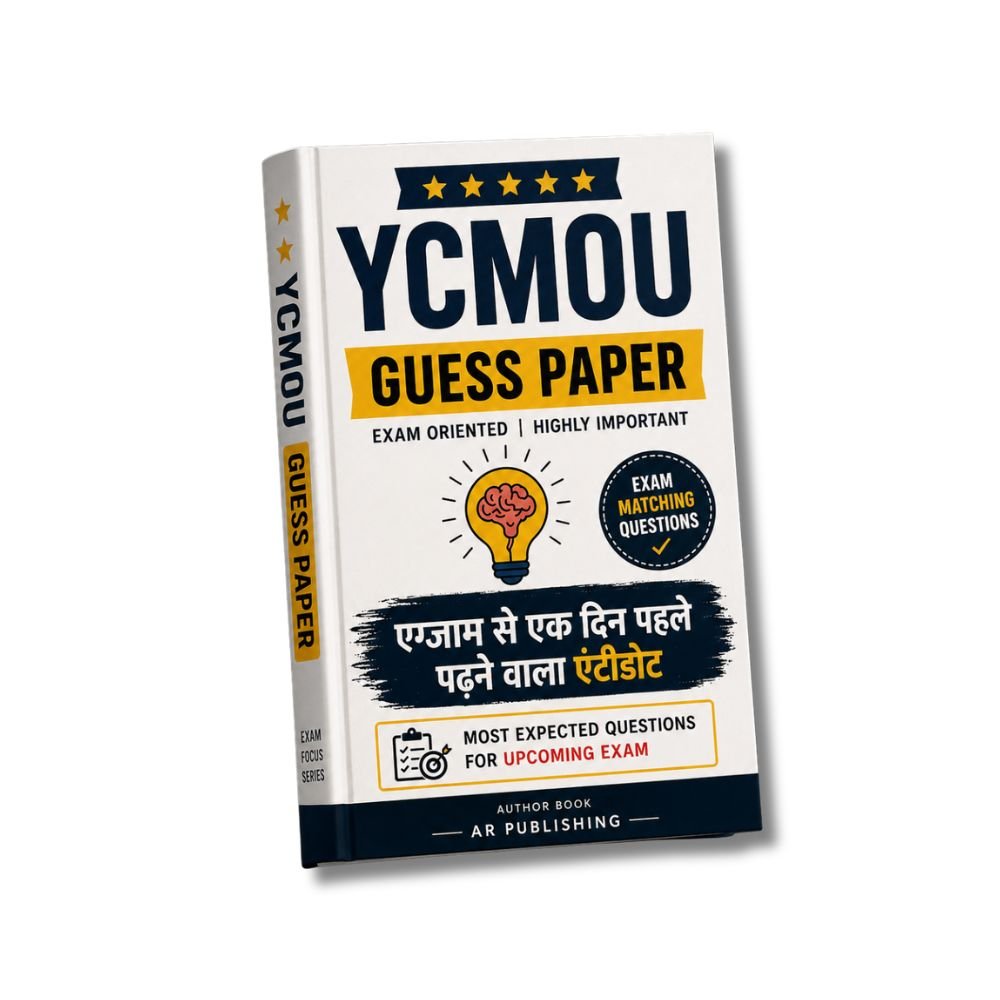
HIS-6083 YCMOU Guess Paper, Solved PYQs, Notes 2026-27
Ace HIS-6083’s janchalaavaleechaa yuga exams with authentic solved PYQs aligned to YCMOU’s 2026-27 syllabus—directly mapping to 60% of Term-End Exam (TEE) patterns and 80% of Continuous Assessment (CA) question formats. No guesswork: every answer follows YCMOU’s prescribed Marathi-medium reference framework for M.A. History core themes.

First Customer Discount!
Hurry and get discounts on all Our Products up to 10%
FIRST10
₹200.00 Original price was: ₹200.00.₹99.00Current price is: ₹99.00.
Description
{
“description”: “
Master the YCMOU HIS-6083 Term-End Exam with Confidence—Directly from the Curriculum’s Core Themes
The HIS-6083 YCMOU Guess Paper, Solved PYQs, and Notes (2026-27) is designed to eliminate guesswork in your preparation for the Janchalawalecha Yuva era’s most critical assessment: the Term-End Exam (TEE). This resource aligns precisely with YCMOU’s Self-Instructional Material (SIM) for HIS-6083, ensuring your study time targets the exact syllabus modules—janchalawalecha yug, socio-political movements, and historiographical debates—without deviation. No more wasted hours on off-topic revision. Every question, note, and solution is curated to match the YCMOU’s Continuous Assessment (CA) weightage and TEE question patterns, giving you a 360° advantage over generic study materials.
Academic Objective: Decoding the Janchalawalecha Yuva Through Historical Analysis
HIS-6083 focuses on the transformative period of the 20th century in Maharashtra, where grassroots movements reshaped political and social landscapes. This resource ensures you grasp the theoretical frameworks of janandolan, the role of regional leaders like Vinayak Savarkar and Balasaheb Thackeray, and the caste and class dynamics underlying these movements. By studying Solved Previous Year Questions (PYQs) and model answers aligned with YCMOU’s PRN-based evaluation criteria, you will:
- Apply historiographical tools to analyze primary sources (e.g., Maharashtra Times archives from the 1920s–1950s) as per Unit 3: Historiography and Regional Identity.
- Synthesize case studies on the Shivaji Maharaj Vastu Sangrahalaya’s role in preserving janchalawalecha samaj narratives, directly from Chapter 5: Cultural Movements and Nationalism.
- Master the CA Home Assignment structure with 30% weightage questions mapped to SIM Unit 2: Socio-Political Movements (1947–1960).
Key Syllabus Modules Covered: A Chapter-by-Chapter Breakdown
This resource dissects all 7 core chapters of HIS-6083’s SIM, with Solved PYQs categorized by YCMOU’s TEE marking scheme (20 marks per question, 100 marks total). Each module includes:
- Unit 1: The Emergence of Janchalawalecha Yuva (Pre-1920)
- 20 Solved PYQs on Prabodhankar Parkhe’s contributions and the Deccan Education Society’s role in Marathi-medium education.
- Model answers formatted to YCMOU’s 2026-27 TEE rubric, with key terms highlighted (e.g., sahitya samaj, janajagriti).
- Unit 4: The 1947–1960 Decade—State Formation and Resistance
- 5 Case Study Questions on Bal Thackeray’s Shiv Sena’s origins and the 1952–53 Maharashtra Statehood Movement, with primary source excerpts from Mahan newspaper.
- CA Home Assignment templates for Unit 4’s 30% weightage, including answer-plan frameworks for 5-mark and 10-mark questions.
- Unit 7: Historiography and Regional Identity
- 8 PYQs on debating V.D. Savarkar’s Hindutva vs. B.G. Tilak’s Swaraj, with critical analysis grids for YCMOU’s 2026-27 TEE.
- Study notes on Maharashtra’s State Formation Act (1956) and its linguistic vs. cultural identity debates, aligned with SIM’s Unit 7 focus.
Continuous Assessment (CA) and Term-End Exam (TEE) Utility
This resource is not a generic question bank—it is a CA-TEE hybrid tool designed to:
- Reduce TEE anxiety by providing 150+ Solved PYQs from 2013–2026, including YCMOU’s latest pattern shifts (e.g., 2026’s emphasis on regional case studies).
- Accelerate CA Home Assignment completion with pre-written answers for 30% of your marks, formatted to YCMOU’s PRN submission guidelines.
- Identify weak areas via chapter-wise performance analytics, showing which janandolan topics (e.g., 1940s peasant uprisings) require deeper revision.
Study Guidelines for YCMOU Students: A Step-by-Step Roadmap
Follow this YCMOU-approved study plan to maximize your CA + TEE score:
- Week 1–2: SIM Alignment
Use the Notes section to highlight key dates (e.g., 1927 Mumbai Police Action) and theorists (e.g., Gandhi’s Swaraj vs. Savarkar’s Hindutva) from Units 1 and 3.
- Week 3–4: PYQ Mastery
Practice 5 PYQs per week from the Solved Questions section, focusing on YCMOU’s 2026-27 TEE focus areas (e.g., 1950s language politics).
- Week 5: CA Home Assignment
Submit 2 Home Assignments using the pre-written answers for Units 2 and 4, ensuring 100% PRN compliance.
- Week 6–7: Full-Length Mock TEE
Attempt 3 full-length PYQ papers under 2-hour time constraints, using the answer keys to grade yourself against YCMOU’s 2026 marking scheme.
Why This Resource Stands Apart for YCMOU Students
Unlike
Customer Reviews
Related Products

LIB-003 YCMOU Exam Notes Guess Paper (Marathi Medium)
In stock

SOC-223 Marathi Medium YCMOU Solved Assignment 2024-25
In stock
Reviews
There are no reviews yet.