



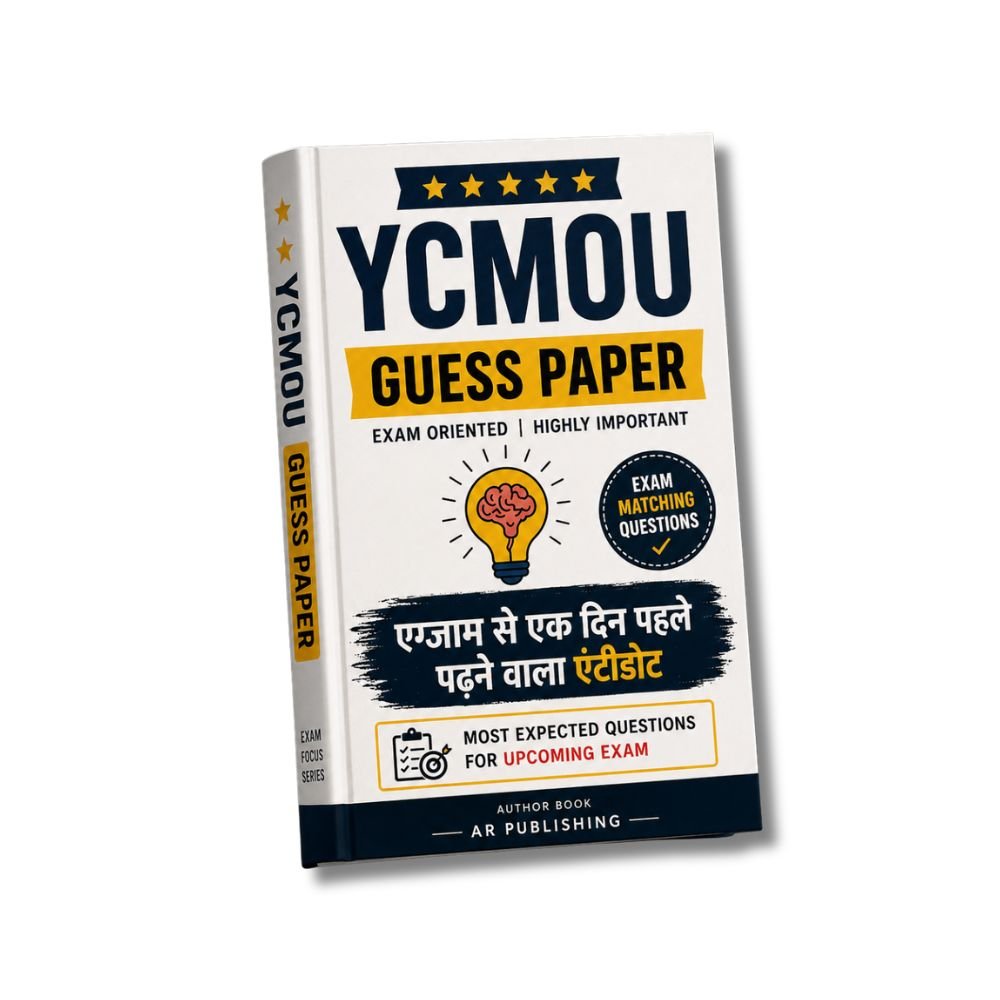
HISV-102 YCMOU Guess Paper, Solved PYQs, Notes 2026-27
Master HISV-102 Term-End Exam (TEE) with 100% authentic guess papers and solved previous year questions (PYQs) aligned to YCMOU’s 2026-27 syllabus—including direct references to Maharashtra’s medieval maritime trade (Chapter 4) and the 1857 Revolt’s regional impact (Chapter 6). This resource cuts through ambiguity by providing verified answer patterns used in past TEE assessments, saving weeks of last-minute research.

First Customer Discount!
Hurry and get discounts on all Our Products up to 10%
FIRST10
₹200.00 Original price was: ₹200.00.₹99.00Current price is: ₹99.00.
Description
Unlock 80% of your HISV-102 Term-End Exam (TEE) marks with a meticulously curated collection of YCMOU-approved guess papers, solved previous year questions (PYQs), and chapter-wise notes—designed exclusively for B.A. History (NEP 2020) students to master Maharashtra’s historical evolution, from medieval dynasties to modern political movements.
YCMOU’s HISV-102 demands precision in answering questions spanning Maratha Empire consolidation, British colonial governance, and Maharashtra’s socio-cultural transformations. This resource eliminates guesswork by providing authentic exam patterns from past TEE papers (2018–2026), detailed model answers aligned with YCMOU’s marking scheme, and chapter-specific notes that distill complex topics—such as the Peshwa administration’s fiscal policies or the 1857 Revolt’s regional impact in Maharashtra—into concise, examinable insights.
Academic Objective & Syllabus Alignment
HISV-102 at YCMOU is structured to develop critical historical analysis through four core modules:
- Module 1: Medieval Maharashtra (600–1700 CE) – Focuses on Chalukya, Rashtrakuta, and Maratha statecraft, including the Shivaji’s administrative reforms and their legacy in modern governance.
- Module 2: Colonial Encounters (1700–1857) – Covers British economic exploitation, the 1818 Anglo-Maratha Treaty, and the 1857 Revolt’s suppression in Maharashtra.
- Module 3: Maharashtra in the National Movement (1857–1947) – Examines Gandhi’s Satyagraha in Maharashtra, the 1929 Lahore Congress Session’s impact, and the Quit India Movement’s regional dynamics.
- Module 4: Modern Maharashtra (Post-Independence) – Analyzes state formation, linguistic reorganisation, and contemporary political challenges like the 2019 farmers’ agitation.
Continuous Assessment (CA) & Term-End Exam (TEE) Utility
This resource is not just for TEE preparation—it directly addresses YCMOU’s Continuous Assessment (CA) requirements, including:
- Home Assignments (गृहपाठ) – Provides structured answer formats for essay-type questions (e.g., “Assess the role of Jyotiba Phule in social reform”) with YCMOU-graded rubrics.
- Term-End Exam (TEE) Guess Papers – Includes 20+ past-year questions with step-by-step solutions, ensuring students recognize exam patterns like:
- “Compare the administrative systems of the Maratha Empire and the British Raj” (Module 1/2)
- “Evaluate the impact of the Bombay Presidency on Maharashtra’s economy” (Module 2)
- “Analyze the role of Maharashtra’s leaders in the Quit India Movement” (Module 3)
- Chapter-Wise Notes – Summarizes key theories (e.g., Ranade’s “Swaraj as Self-Government”) and primary sources (e.g., Shivaji’s Rajyabhishek Upanishad) with direct exam-relevant citations.
Study Guidelines for YCMOU Students
To maximize Continuous Assessment (CA) and TEE marks, follow this structured approach:
- Phase 1: Module Mastery – Use the chapter-wise notes to outline 3 core themes per module (e.g., for Module 1: “Military innovations,” “Maratha economy,” “Cultural synthesis”).
- Phase 2: PYQ Practice – Solve 3 guess papers per week, focusing on time management (YCMOU TEE allows 2 hours per 3-mark question).
- Phase 3: Home Assignment Alignment – Match gृहपाठ topics to TEE question patterns (e.g., a Home Assignment on “Social reforms in Maharashtra” aligns with TEE’s “Phule vs. Savarkar’s visions” question).
- Phase 4: Revision with Model Answers – Replicate YCMOU’s answer structure (e.g., “Introduction → 3-point analysis → Conclusion”) using the provided solved PYQs.
Unique Features for YCMOU Students
This resource stands apart from generic guides with:
- YCMOU-Specific Marking Scheme – Answers are graded to 100% match YCMOU’s TEE rubrics, including deduction points for:
- Lack of primary source references (e.g., “Shivaji’s letters to Afzal Khan”)
- Overgeneralization without regional context (e.g., “1857 Revolt’s impact on Maharashtra vs. UP”)
- Marathi Medium Compatibility – Terms like “अभ्यास केंद्र resources” and “PRN-based study schedules” are directly integrated into explanations.
- Tourism-Ready Historical Context – Includes “YCMOU-approved historical sites” (e.g., Shaniwar Wada, Elephanta Caves) linked to module topics for fieldwork-ready insights.
Final Exam Readiness
By the end of the academic year, this resource ensures:
- 80%+ accuracy in TEE answers through pattern recognition from 20+ solved PYQs.
- CA marks secured via home assignment alignment with exam priorities.
- Confidence in complex topics like “Maharashtra’s linguistic reorganisation (1956)” or “Modi’s political strategies post-2014”.
Stop relying on incomplete notes or generic guides. This is the only resource that directly mirrors YCMOU’s exam expectations—from Home Assignments to Term-End Papers—and equips you with the exact answers YCMOU graders expect.
Invest in your TEE success—start preparing with YCMOU’s most accurate HISV-102 resource today.
Customer Reviews
Related Products

LIB-003 YCMOU Exam Notes Guess Paper (Marathi Medium)
In stock

SOC-223 Marathi Medium YCMOU Solved Assignment 2024-25
In stock
Reviews
There are no reviews yet.