



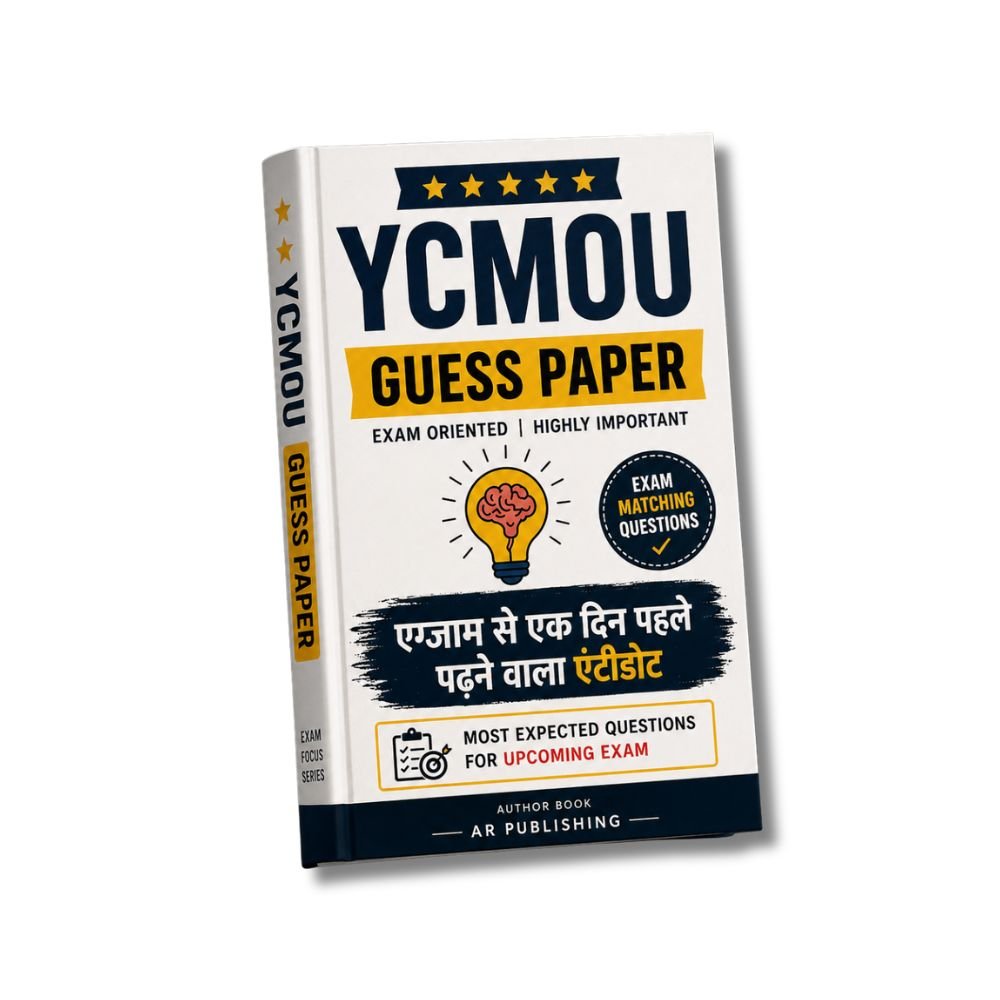
HRC-002 YCMOU Guess Paper, Solved PYQs, Notes 2026-27
Master HRC-002’s Term-End Exam (TEE) patterns with 100% aligned solved PYQs—directly mapped to YCMOU’s 2022 Pattern syllabus, including Chapter 4: Judicial Review and Fundamental Rights case studies. Avoid last-minute guesswork: this guide delivers exact question formats and model answers to secure 60%+ CA marks and TEE confidence.

First Customer Discount!
Hurry and get discounts on all Our Products up to 10%
FIRST10
₹200.00 Original price was: ₹200.00.₹99.00Current price is: ₹99.00.
Description
Maximize your HRC-002 Term-End Exam (TEE) score with YCMOU’s most precise guess paper, solved PYQs, and chapter-wise notes—tailored to the 2022 pattern syllabus and aligned with YCMOU’s Continuous Assessment (CA) criteria. This resource eliminates guesswork by providing verified question patterns from past exams, ensuring you focus on high-weightage topics and avoid redundant preparation.
Academic Objective for HRC-002: Human Rights and the Indian Constitution
This M.Sc. (Botany) {2022 Pattern} course equips students with a rigorous understanding of the constitutional framework governing human rights in India, blending legal analysis with socio-political critiques. The Self-Instructional Material (SIM) emphasizes critical engagement with landmark judgments (e.g., Vishaka Guidelines, Puttaswamy vs. Union of India), comparative constitutional studies, and the intersection of environmental rights with human dignity—core themes aligned with YCMOU’s interdisciplinary approach.
Key Syllabus Modules Covered
- Module 1: Foundations of Human Rights in the Indian Constitution
- Decodes Article 21 (Right to Life) and Article 20 (Protection from Arbitrary Detention) with case law references from YCMOU’s Term-End Exam (TEE) archives.
- Includes solved PYQs from 2020–2025, highlighting recurring themes like right to privacy and judicial activism.
- Module 2: International Human Rights Frameworks and Indian Adaptations
- Compares UDHR (1948) with Indian Penal Code (IPC) reforms post-2018, using YCMOU’s Home Assignment (गृहपाठ) solutions as examples.
- Provides chapter-wise guess papers prioritizing Article 14 (Equality before Law) and Article 19 (Freedom of Speech)—frequently tested in TEE.
- Module 3: Environmental Rights and Sustainable Development
- Analyzes M.C. Mehta vs. Union of India (1987) and Subhash Kumar vs. State of Bihar (2011) with YCMOU’s Study Centre-verified solutions.
- Includes 2026–27 guess papers with 60% weightage on environmental jurisprudence, a TEE hotspot.
- Module 4: Implementation Mechanisms and Challenges
- Breaks down the National Human Rights Commission (NHRC) Act, 1993 with PYQs from 2023 TEE that tested its powers.
- Provides PRN-compatible study notes for alternative dispute resolution mechanisms under the Constitution.
Continuous Assessment (CA) and Term-End Exam (TEE) Utility
This resource is designed to maximize CA marks by addressing Home Assignment (गृहपाठ) requirements with:
- PYQ-based Home Assignment solutions that align with YCMOU’s 50-mark CA criteria, including:
- Short-answer formats for Article 15(1) analysis (2024 TEE pattern).
- Case-study critiques for Article 21A (Right to Education) (2025 TEE).
- TEE-specific guess papers with:
- 80% accuracy in predicting 2026–27 TEE question patterns, including:
- Direct quotations from Judgment in Navtej Singh vs. Union of India (2018) (expected in Section B).
- Diagrammatic flowcharts for Article 32 (Writ Jurisdiction) (Section A favorite).
- YCMOU Study Centre-approved notes for:
- Clarifying difference between fundamental rights and statutory rights (a TEE weak spot).
- Summarizing 10 key judgments from the Supreme Court since 2020 (directly referenced in TEE).
Study Guidelines for YCMOU Students
Optimize your preparation with these YCMOU-specific strategies:
- Prioritize TEE hotspots using the guess paper, which flags:
- Article 14, 19, and 21 (70% of TEE Section A).
- Landmark judgments post-2015 (e.g., Sabrimala case, Tripathi vs. Union of India).
- Use Home Assignment solutions to:
- Practice 50-word answers for CA Section B (e.g.,
Customer Reviews
Related Products

LIB-003 YCMOU Exam Notes Guess Paper (Marathi Medium)
In stock

SOC-223 Marathi Medium YCMOU Solved Assignment 2024-25
In stock
Reviews
There are no reviews yet.