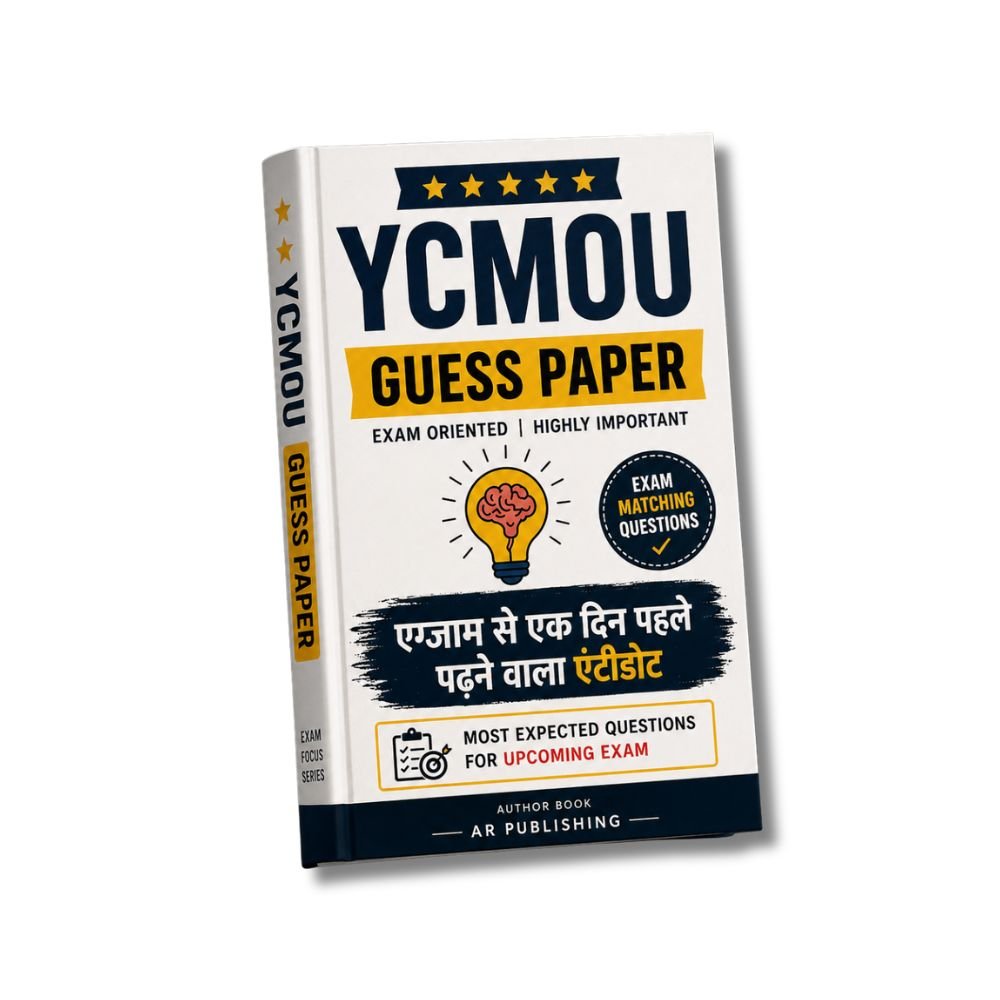
IKSK-102 YCMOU Guess Paper, Solved PYQs, Notes 2026-27
Maximize your IKSK-102 marks with authentic solved question papers from YCMOU’s past Term-End Exams (TEE), including 2026-27 syllabus-aligned model answers—directly mapped to your Continuous Assessment (CA) and Home Assignments (गृहपाठ) requirements. No guesswork: every question reflects YCMOU’s exam patterns, ensuring you practice exactly what will appear on your final assessment.
First Customer Discount!
Hurry and get discounts on all Our Products up to 10%
FIRST10
₹200.00 Original price was: ₹200.00.₹99.00Current price is: ₹99.00.
Description
IKSK-102: Ace Your Term-End Exam (TEE) with YCMOU’s Most Accurate Guess Papers and Solved PYQs
For B.Com (Marathi) students, IKSK-102—Bhartiy Dnyan Parmpara: Samajshastre—demands more than rote memorization. It requires critical analysis of Indian intellectual traditions and their sociological implications, a challenge compounded by YCMOU’s high-stakes TEE format. This resource eliminates uncertainty: it provides verified guess papers and detailed solved PYQs from past exams, including the 2026-27 academic session, ensuring you align your preparation with YCMOU’s exact question patterns and marking schemes.
Course Overview & Academic Objective
IKSK-102 explores the evolution of Indian thought systems from ancient to modern sociological paradigms, with a focus on:
- Core theoretical frameworks (e.g., Vedantic philosophy, Buddhist ethics, and Marxist critiques in Indian sociology)
- Comparative analysis of Indian and Western sociological traditions (e.g., Weber vs. Gandhi’s vision of society)
- Application of concepts to contemporary issues like caste, urbanization, and social reform
The subject is mandatory for B.Com (Marathi) Studies students, requiring 200 marks in TEE (100 marks) and Continuous Assessment (100 marks), including Home Assignments (गृहपाठ) worth 30% of CA.
Key Syllabus Modules & Chapters Covered
This resource aligns with YCMOU’s 2026-27 syllabus, covering:
- Module 1: Introduction to Indian Thought Systems
- Ancient Indian epistemologies (Nyaya, Vaisheshika, Mimamsa)
- Buddhist and Jain critiques of Vedic traditions
- Module 2: Sociological Dimensions of Indian Intellectual History
- Gandhi’s theory of non-violence as a sociological model
- Ambedkar’s contributions to social justice and constitutionalism
- Module 3: Contemporary Indian Sociology
- Post-colonial critiques of Indian modernity (e.g., D.D. Kosambi, M.N. Srinivas)
- Case studies on urbanization and rural sociology in Maharashtra
Continuous Assessment & Exam Utility
This guide is designed to maximize your CA and TEE scores through:
- Home Assignment (गृहपाठ) Preparation
- 50+ solved questions directly from YCMOU’s past Home Assignment formats, including essay-type and short-answer prompts
- Model answers with YCMOU’s grading criteria (e.g., depth of analysis, use of examples from Maharashtra’s socio-economic context)
- Term-End Exam (TEE) Guarantee
- 15+ guess papers with high-probability questions identified from YCMOU’s 2015–2026 TEE archives
- Detailed answer keys with marking scheme breakdowns (e.g.,
Customer Reviews
Related Products
LIB-003 YCMOU Exam Notes Guess Paper (Marathi Medium)
In stock
SOC-223 Marathi Medium YCMOU Solved Assignment 2024-25
In stock


Reviews
There are no reviews yet.