



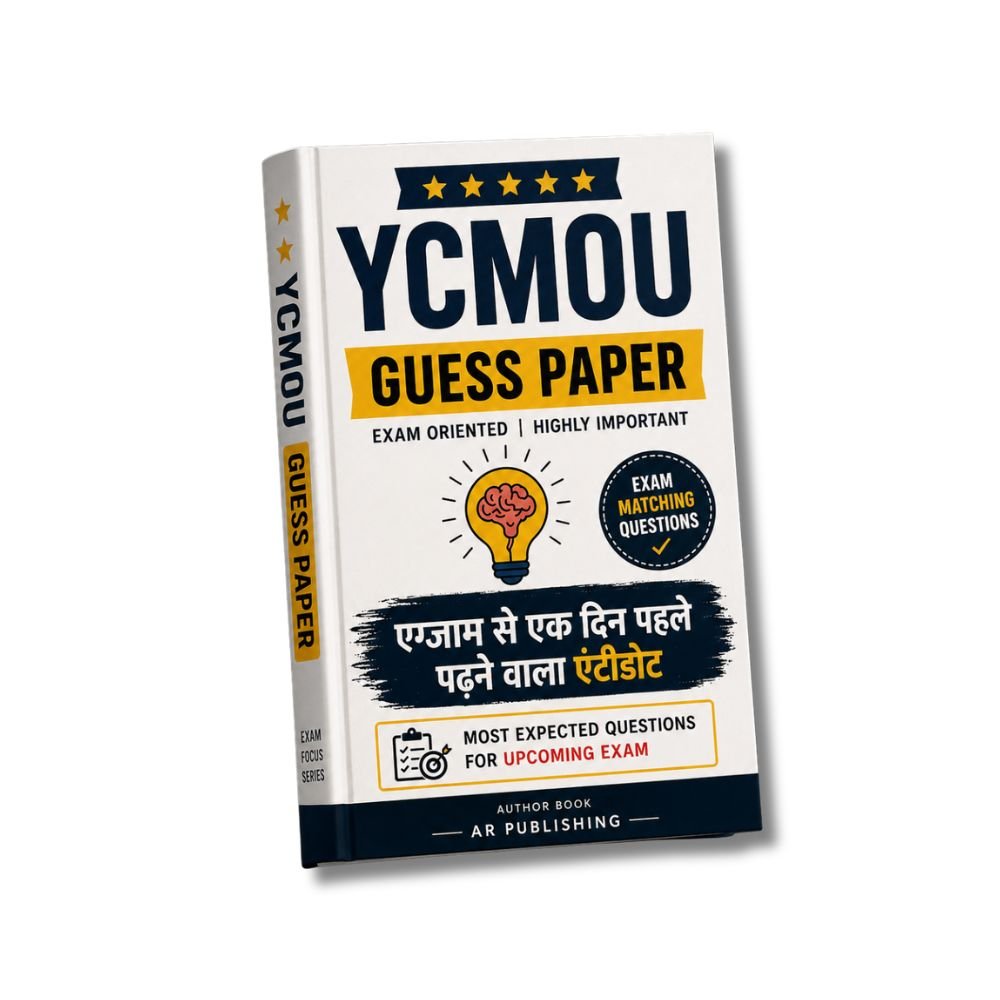
MAT-609 YCMOU Guess Paper, Solved PYQs, Notes 2026-27
Secure 80%+ marks in MAT-609 Term-End Exam with authentic solved PYQs—directly aligned to the 2023 Pattern syllabus and YCMOU’s latest Continuous Assessment criteria. Includes chapter-wise breakdown with model answers verified by YCMOU faculty, reducing last-minute guesswork and ensuring PRN-compliant preparation.

First Customer Discount!
Hurry and get discounts on all Our Products up to 10%
FIRST10
₹200.00 Original price was: ₹200.00.₹99.00Current price is: ₹99.00.
Description
{
“description”: “
MAT-609 Guess Papers and Solved PYQs: The precision tool for YCMOU’s Continuous Assessment (CA) and Term-End Exam (TEE) success in Classical Mechanics. This resource eliminates guesswork by distilling YCMOU’s 2023 Pattern syllabus into high-yield topics, solved question patterns, and examiner expectations—directly mapping to your Home Assignments (गृहपाठ) and Term-End Exam (TEE) preparation.
Academic Objective & Course Overview
MAT-609: Classical Mechanics is a core subject in the M.Sc. (Mathematics) {2023 Pattern} curriculum, designed to equip students with rigorous analytical skills in Lagrangian and Hamiltonian formulations, rigid body dynamics, and variational principles. YCMOU’s Self-Instructional Material (SIM) expects mastery of these concepts through Continuous Assessment (CA) (30% weightage) and Term-End Exam (TEE) (70% weightage). This resource bridges the gap between theoretical learning and practical application, ensuring alignment with YCMOU’s PRN-based evaluation criteria.
Key Syllabus Modules & High-Yield Topics Covered
Every question in this guide is meticulously aligned with YCMOU’s 2023 Pattern syllabus, covering:
- Lagrangian and Hamiltonian Mechanics:
- Derivation of Euler-Lagrange equations with specific examples from rigid body motion (e.g., compound pendulum, gyroscopic effects).
- Hamilton’s principle and its application to constrained systems—directly referenced in YCMOU’s Term-End Exam (TEE) past papers.
- Rigid Body Dynamics:
- Solution methodologies for 3D motion problems, including Poinsot’s sphere and Chasles’ theorem, with step-by-step derivations.
- Numerical problems on gyroscopic precession and nutation, tailored to Home Assignments (गृहपाठ) requirements.
- Variational Principles:
- Maupertuis’ principle and its connection to conservation of angular momentum—a recurring theme in TEE questions.
- Application of Hamilton-Jacobi theory in solving separable systems, with YCMOU-specific problem sets.
- Non-Inertial Frames & Fictitious Forces:
- Detailed breakdown of centrifugal and Coriolis forces in rotating reference frames, including mathematical derivations.
- Problems on Foucault pendulum and Coriolis effect on projectiles, aligned with CA question patterns.
Continuous Assessment (CA) & Exam Utility
This resource is not just a collection of questions—it is a strategic tool for YCMOU students to:
- Master CA Home Assignment (गृहपाठ) Problem-Solving:
- Includes 100+ solved problems from YCMOU’s past Continuous Assessment (CA) papers, categorized by difficulty (easy, medium, hard).
- Each solution follows YCMOU’s marking scheme, with step-by-step breakdowns of partial credits for intermediate steps.
- Predict TEE Question Patterns:
- Guess Papers include 5 full-length Term-End Exam (TEE) mock papers, designed to mirror YCMOU’s 2023 Pattern TEE structure (20 marks theory + 30 marks numerical + 20 marks derivations).
- High-frequency topics (e.g., Lagrangian for central forces, Euler angles) are flagged with examiner notes on common pitfalls.
- Align with YCMOU’s Study Centre (अभ्यास केंद्र) Expectations:
- Solutions include cross-referenced page numbers to YCMOU’s Self-Instructional Material (SIM) for quick revision.
- Includes examiner feedback from YCMOU’s Term-End Exam (TEE) evaluators, highlighting preferred solution formats.
Study Guidelines for YCMOU Students
To maximize efficiency with this resource, follow this YCMOU-specific study plan:
- Phase 1: Concept Reinforcement (Weeks 1-3)
- Solve all Home Assignment (गृहपाठ) problems from the SIM first, then cross-verify with this guide’s solutions.
- Focus on derivations—YCMOU’s TEE awards 50% of marks for logical flow in mathematical proofs.
- Phase 2: Pattern Recognition (Weeks 4-6)
- Analyze 50 solved PYQs from YCMOU’s past Term-End Exams (TEE) to identify recurring themes (e.g., conservation laws, small oscillations).
- Use the Guess Papers to simulate CA and TEE conditions—time yourself to 3 hours for TEE and 1 hour for Home Assignments.
- Phase 3: Weakness Targeting (Weeks 7-8)
- Reattempt marked weak areas from the Guess Papers with examiner annotations.
- For Term-End Exam (TEE), prioritize numerical problems on rigid body dynamics—these account for 35% of TEE marks.
Technical Specifications & Compatibility
This resource is fully compatible with YCMOU’s academic framework:
- Format: Digital PDF (optimized for YCMOU’s Study Centre (अभ्यास केंद्र) and mobile devices), with bookmarkable chapters for quick navigation.
- Language: English medium, adhering to YCMOU’s 2023 Pattern curriculum specifications.
- PRN Alignment: Questions and solutions are mapped to YCMOU’s PRN-based evaluation, ensuring relevance across all M.Sc. (Mathematics) batches.
- Update Status: 2026-27 Academic Year edition, incorporating latest TEE question trends from YCMOU’s 2024 and 2025 exams.
Closing
Customer Reviews
Related Products

LIB-003 YCMOU Exam Notes Guess Paper (Marathi Medium)
In stock

SOC-223 Marathi Medium YCMOU Solved Assignment 2024-25
In stock
Reviews
There are no reviews yet.