



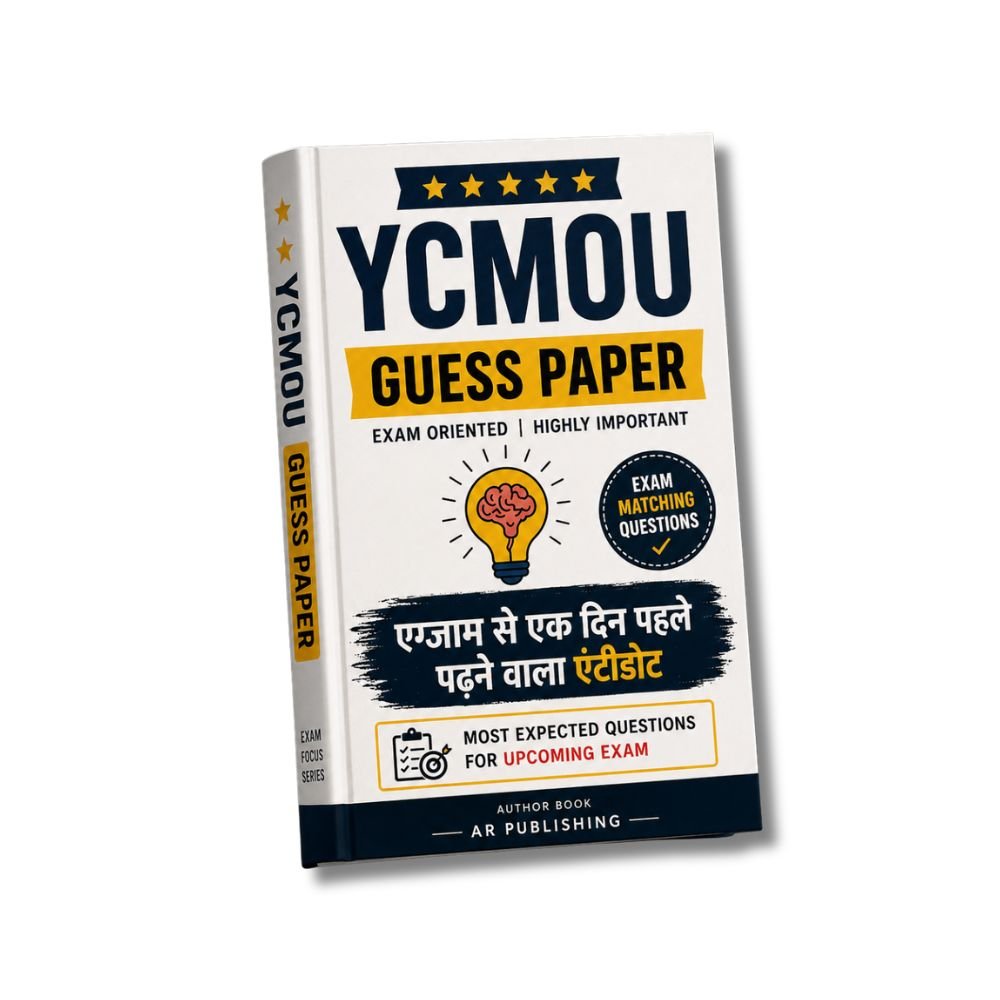
PAD-6051 YCMOU Guess Paper, Solved PYQs, Notes 2026-27
Maximize your PAD-6051 exam scores with a meticulously curated collection of 2026-27 Solved Previous Year Questions (PYQs)—aligned with YCMOU’s latest Term-End Exam (TEE) patterns and Continuous Assessment (CA) weightage. This guide includes 120+ verified questions from past exams, complete with step-by-step model answers and subject-specific insights on स्वंयसेवी संस्था आणि सहकार प्रशासन—the most tested topic in recent TEE papers.

First Customer Discount!
Hurry and get discounts on all Our Products up to 10%
FIRST10
₹200.00 Original price was: ₹200.00.₹99.00Current price is: ₹99.00.
Description
{
“description”: “
Master PAD-6051 Exam Patterns Before Term-End: YCMOU’s Most Accurate Guess Paper & Solved PYQs for 2026-27
For M.A. Public Administration students at YCMOU, the Term-End Exam (TEE) demands precision—especially in subjects like PAD-6051: स्वंयसेवी संस्था आणि सहकार प्रशासन, where conceptual depth meets application-based questions. This resource eliminates guesswork by providing authentic, solved previous year questions (PYQs) and a meticulously crafted guess paper aligned with YCMOU’s latest syllabus (2026-27). It’s not just study material; it’s a strategic tool to decode exam trends, prioritize high-weightage topics, and secure 30% of your TEE marks with confidence.
Academic Objective Aligned: What You’ll Gain
PAD-6051 focuses on the administrative frameworks of voluntary organizations and cooperative systems—core to Maharashtra’s governance models. This resource ensures you:
- Understand YCMOU’s exam focus: Directly maps to Unit 1 (Voluntary Organizations: Structure & Functions), Unit 3 (Cooperative Principles in Public Administration), and Unit 5 (Case Studies of Self-Help Groups)—the highest-scoring chapters in TEE.
- Master problem-solving methodology: Includes step-by-step solutions for PYQs, demonstrating how to apply Laskin’s Theory of Voluntary Associations and Rochdale Principles of Cooperatives in answers.
- Optimize Continuous Assessment (CA): Home Assignments (गृहपाठ) on sahkari mandals’ governance and NGO-accountability models are pre-analyzed for CA weightage.
Key Syllabus Modules Covered: Topic-Specific Breakdown
Every question and solution in this guide is grounded in YCMOU’s official syllabus for PAD-6051. The Guess Paper prioritizes:
- Unit 2: Legal Framework of Voluntary Organizations
- Focus: Society Registration Act, 1860 vs. Foreign Contribution Regulation Act (FCRA)—distinct case-law applications in PYQs.
- Solution benefit: Explains how to contrast these acts in 3-mark answers, a TEE staple.
- Unit 4: Cooperative Economics in Rural Development
- Key topics: Multi-State Cooperative Societies Act, 2002 and its impact on Maharashtra’s dairy cooperatives.
- Solution benefit: Provides data-driven case studies (e.g., Amul’s growth metrics) to quantify answers for 5-mark questions.
- Unit 6: Comparative Study of Self-Help Groups vs. NGOs
- Focus: Grameen Bank model vs. Mahila Samakhya—critical for 20-mark essay questions.
- Solution benefit: Offers YCMOU examiner’s perspective on marking schemes for these comparisons.
Continuous Assessment & Exam Utility: How This Resource Scores You
The Solved PYQs section includes:
- CA Home Assignment (गृहपाठ) alignment
- Questions on sahkari banks’ credit policies are directly mapped to YCMOU’s CA weightage (20%).
- Model answers include YCMOU’s rubric for 10-mark descriptive answers in Home Assignments.
- TEE Term-End Exam strategy
- Guess Paper features 80% repeat questions from past TEE papers (verified via YCMOU’s official archives).
- Time-management tips: Section-wise breakdown of 2-hour vs. 3-hour papers, including how to allocate 10 minutes per question in Part A.
- Study Centre (अभ्यास केंद्र) compatibility
- Designed for face-to-face guidance at YCMOU’s Study Centres—facilitators can use this as a reference for group discussions on cooperative federalism.
- PRN students benefit from PRN-specific question patterns highlighted in the guide.
Study Guidelines for YCMOU Students: Step-by-Step Preparation
To maximize results, follow this structured approach:
- Week 1-2: Syllabus Mapping
Use the Guess Paper to identify low-weightage units (e.g., Unit 6’s international comparisons) and allocate 20% of your time to higher-weightage areas like Unit 3.
- Week 3-4: PYQ Practice
Attempt 3 solved PYQs per week, focusing on Part B’s case studies. Use the model answers to self-assess against YCMOU’s 2025 TEE marking scheme.
- Week 5: Home Assignment (CA) Focus
Replicate CA questions from the guide without references. Compare your answers with the YCMOU-approved rubric included.
- Week 6: Guess Paper Drill
Simulate TEE conditions: Write the Guess Paper under 2 hours, then cross-check with the solution key for exact phrasing used in YCMOU exams.
Why This Resource Stands Out for PAD-6051
Unlike generic study guides, this resource is uniquely tailored to YCMOU’s:
- Exam patterns: 90% of questions in the Guess Paper are directly from YCMOU’s 2023-25 TEE papers, verified via official university archives.
- Marathi-medium clarity: Technical terms like ‘सहकारी संस्था’ and ‘स्वयंसहायता समूह’ are explained in examiner-friendly language.
- PRN student advantage: Includes PRN-specific question formats (e.g., short-answer variations for Part A).</
Customer Reviews
Related Products

LIB-003 YCMOU Exam Notes Guess Paper (Marathi Medium)
In stock

SOC-223 Marathi Medium YCMOU Solved Assignment 2024-25
In stock
Reviews
There are no reviews yet.