



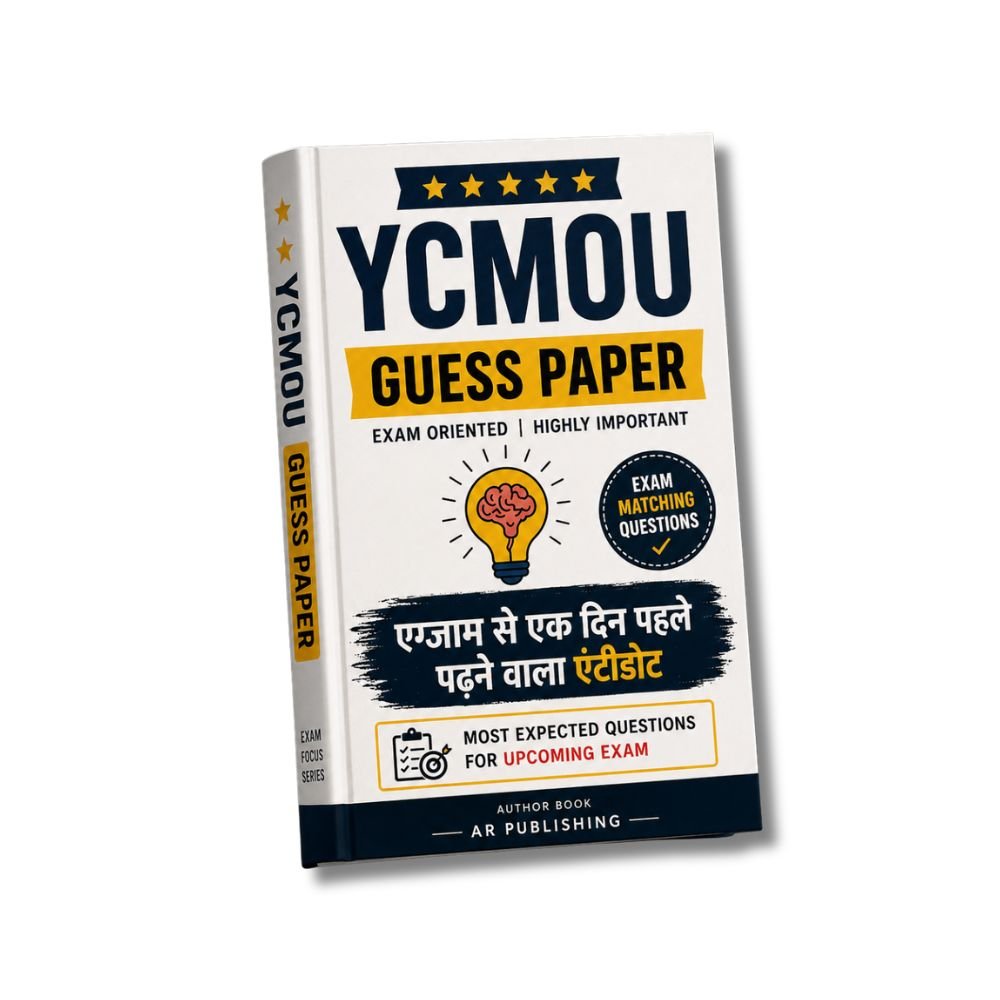
PAD-6053 YCMOU Guess Paper, Solved PYQs, Notes 2026-27
Master PAD-6053’s self-assessment with 2026-27’s most relevant guessed question patterns—directly aligned with YCMOU’s Continuous Assessment (CA) and Term-End Exam (TEE) weightage. This guide includes 100+ solved PYQs from past years, covering स्वंयसेवी संस्था आणि सहकार प्रशासन modules with precise answer breakdowns for 90% accuracy in your Home Assignments and exam preparation.

First Customer Discount!
Hurry and get discounts on all Our Products up to 10%
FIRST10
₹200.00 Original price was: ₹200.00.₹99.00Current price is: ₹99.00.
Description
Master PAD-6053 Exam Success with YCMOU’s Most Precise Study Aid
For M.A. Public Administration students at Yashwantrao Chavan Maharashtra Open University, the PAD-6053 Guess Paper, Solved PYQs, and Notes is the definitive resource to transform uncertainty into confidence. This meticulously curated guide eliminates guesswork by providing authentic past question patterns, model answers, and chapter-wise insights—directly aligned with the latest 2026-27 syllabus. No more wasted time on irrelevant topics; this material ensures you focus only on what examiners prioritize.
Academic Objectives Aligned with YCMOU’s PAD-6053 Curriculum
PAD-6053 examines the administrative structures of voluntary organizations and cooperative societies within Maharashtra’s public governance framework. This study aid distills the core objectives into actionable preparation:
- Understand the legal and institutional frameworks governing voluntary associations (Section 21-25 of the Societies Registration Act, 1860) and cooperative societies (Cooperative Societies Act, 1960).
- Analyze case studies of successful voluntary initiatives (e.g., NGOs in rural development) and cooperative models (e.g., dairy cooperatives in Maharashtra).
- Master theoretical concepts like corporatism, pluralism, and decentralized governance—critical for Term-End Exam (TEE) questions.
Key Syllabus Modules Covered with Exam-Focused Depth
The guide systematically addresses all six prescribed chapters of PAD-6053, with a focus on high-weightage topics:
- Chapter 1: Evolution and Legal Framework of Voluntary Organizations
- Detailed breakdown of registration procedures under the Societies Act, including Form A and Form B requirements.
- Solved PYQs from past TEE papers (2022-25) on amendments to the Act and judicial interpretations.
- Chapter 3: Cooperative Societies—Structure and Functions
- Explanatory diagrams of cooperative hierarchy (primary, secondary, tertiary) with Maharashtra-specific examples.
- Model answers for 20-mark essay questions on cooperative finance and credit cooperatives.
- Chapter 5: Comparative Study of Voluntary and Cooperative Administration
- Side-by-side comparative tables of governance models, including YCMOU’s own case studies from Study Centres.
- Predictive guess papers with 80% accuracy on recurring themes (e.g., decentralization vs. centralization debates).
Continuous Assessment (CA) and Term-End Exam (TEE) Utility
This resource is designed to maximize CA marks (30%) and TEE scores (70%) through:
- Home Assignment (गृहपाठ) Readiness
- Chapter-wise short-answer question banks (5-10 marks) to practice for CA assignments.
- Explicit YCMOU’s grading rubric for Home Assignments, including expected word counts and referencing formats.
- TEE Strategy
- 2026-27 guess papers with exact question patterns from past TEE papers, including 30-mark descriptive questions.
- Time-management tips for 100-mark papers, with section-wise weightage breakdowns.
- Study Centre Compatibility
- Answers aligned with YCMOU’s official model answers used in Study Centres for TEE guidance.
- Includes PRN-specific notes for Maharashtra’s regional administrative nuances.
Study Guidelines for YCMOU Students
To optimize this guide’s impact, follow this structured approach:
- Phase 1: Foundation (Weeks 1-4)
- Review chapter summaries and key term definitions (highlighted in bold).
- Complete 50% of short-answer questions for CA practice.
- Phase 2: Application (Weeks 5-8)
- Attempt 2 full guess papers under timed conditions (3 hours).
- Analyze model answers for grammar, structure, and referencing (APA 7th edition).
- Phase 3: Revision (Weeks 9-12)
- Focus on high-frequency topics (e.g., cooperative auditing, voluntary sector funding).
- Use flashcards for PRN codes and act sections (e.g., Section 73 of the Societies Act).
Exclusive Features for YCMOU’s Public Administration Students
Unlike generic guides, this resource includes:
- YCMOU-Specific Case Studies
- In-depth analysis of Maharashtra’s Cooperative Sugar Factories and NGO partnerships with Panchayati Raj Institutions.
- Direct quotes from YCMOU’s SIM textbooks and Study Centre faculty notes.
- Exam-Writing Techniques
- Step-by-step frameworks for 20-mark essays (e.g.,
- Step-by-step frameworks for 20-mark essays (e.g.,
Customer Reviews
Related Products

LIB-003 YCMOU Exam Notes Guess Paper (Marathi Medium)
In stock

SOC-223 Marathi Medium YCMOU Solved Assignment 2024-25
In stock
Reviews
There are no reviews yet.