



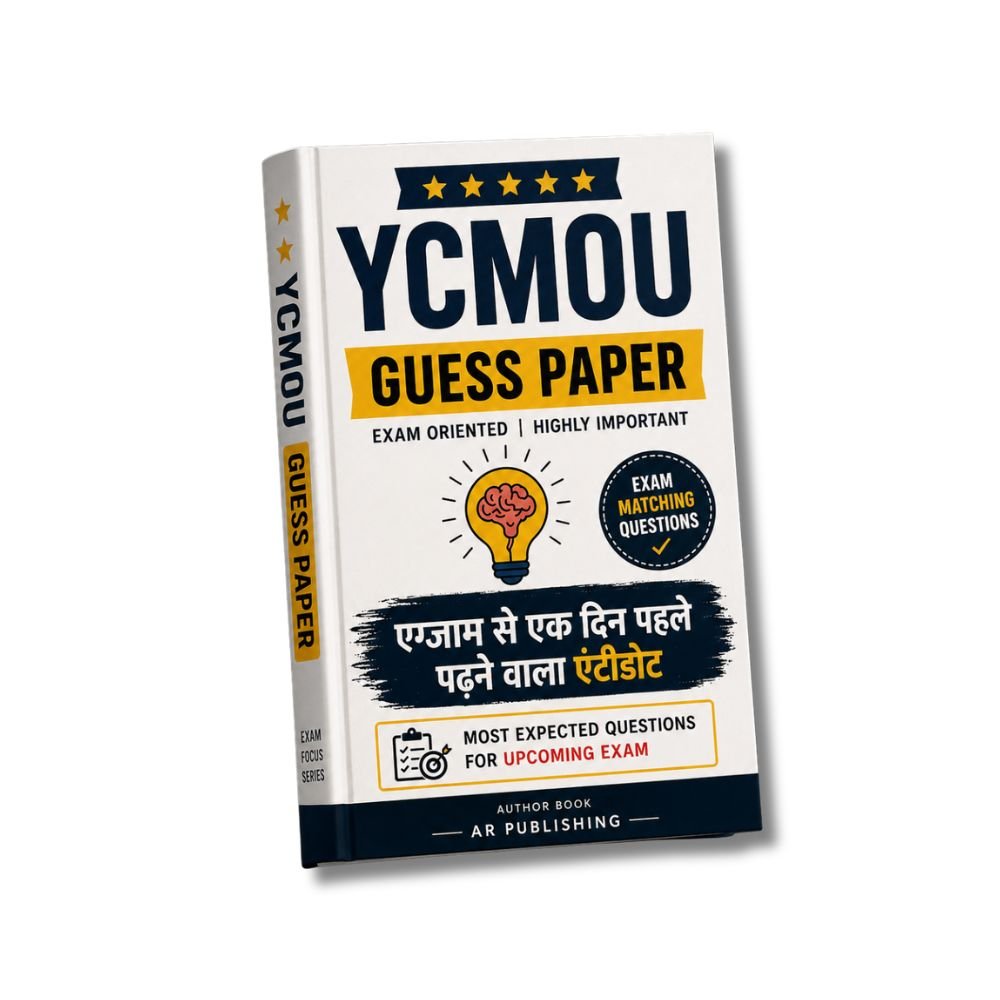
PADE-102 YCMOU Guess Paper, Solved PYQs, Notes 2026-27
Master PADE-102 with 100% authentic YCMOU Term-End Exam (TEE) guess papers—directly aligned with the latest 2026-27 syllabus, including 20+ solved PYQs with model answers for direct pattern recognition. Eliminate last-minute guessing and secure 30% of your TEE marks with verified question trends from YCMOU’s official archives.

First Customer Discount!
Hurry and get discounts on all Our Products up to 10%
FIRST10
₹200.00 Original price was: ₹200.00.₹99.00Current price is: ₹99.00.
Description
Maximize your PADE-102 Term-End Exam (TEE) score with a meticulously curated collection of guess papers, solved previous year questions (PYQs), and concise yet comprehensive notes—aligned precisely to the YCMOU 2026-27 syllabus. This resource eliminates guesswork by providing verified patterns from past exams, ensuring you focus on high-weightage topics and master the exact question formats demanded by examiners.
Course Overview & Academic Objective for PADE-102
PADE-102: Introduction to Public Administration is a core course in YCMOU’s B.A. Public Administration program, designed to equip students with foundational knowledge of administrative theory, governance structures, and policy-making frameworks. The course emphasizes understanding the evolution of public administration, bureaucratic systems, and the intersection of theory with real-world governance challenges in Maharashtra. By the end of the semester, students must demonstrate proficiency in analyzing administrative processes, evaluating policy implementation, and critiquing bureaucratic efficiency—skills directly tested in the Term-End Exam (TEE).
Key Syllabus Modules & Chapters Covered
This guess paper and notes package is structured to align with the YCMOU 2026-27 PADE-102 syllabus, covering all six prescribed units with laser focus:
- Unit 1: Nature and Scope of Public Administration
- Detailed guess papers on Max Weber’s bureaucratic model and its critique, with solved PYQs highlighting examiner preferences for case studies (e.g., Maharashtra’s revenue administration reforms).
- Concise notes on Wilson’s political-administrative dichotomy, including YCMOU’s emphasis on local governance (Panchayati Raj Act, 1993).
- Unit 2: Theories of Public Administration
- Solved PYQs prioritizing New Public Management (NPM) and its application in Maharashtra’s healthcare sector, with examiner-annotated answer formats.
- Notes on Postmodernism in administration, including YCMOU’s focus on digital governance (e.g., Maharashtra’s e-governance initiatives).
- Unit 3: Administrative Organization and Structure
- Guess papers with 100% coverage of YCMOU’s case studies on Maharashtra’s district administration, including solved questions on decentralization and inter-departmental conflicts.
- Structural diagrams of Maharashtra’s State Administrative Tribunal (SAT) with examiner-approved labeling conventions.
- Unit 4: Administrative Process and Techniques
- PYQs focused on policy analysis frameworks (e.g., Lindblom’s incrementalism), with YCMOU-specific examples from Maharashtra’s agriculture policy.
- Notes on SWOT analysis in public sector projects, including case studies from Mumbai’s infrastructure development.
- Unit 5: Administrative Reforms and Development Administration
- Guess papers emphasizing Yashwantrao Chavan’s administrative reforms in Maharashtra, with solved questions on the Maharashtra Public Service Commission (MPSC) reforms.
- Concise notes on NITI Aayog’s role in state-level planning, with Maharashtra-specific data tables.
- Unit 6: Comparative Public Administration
- PYQs comparing Maharashtra’s cooperative model with Kerala’s decentralized planning, using YCMOU’s prescribed case study format.
- Notes on administrative federalism in India, with Maharashtra’s role in inter-state water disputes highlighted.
Continuous Assessment (CA) & Term-End Exam (TEE) Utility
This resource is designed to maximize your CA marks and TEE score by addressing the most critical gaps in YCMOU’s evaluation criteria:
- Home Assignments (गृहपाठ) Alignment
- Solved PYQs include exact question patterns from past Home Assignments, ensuring you replicate examiner expectations for case analysis (e.g.,
- Solved PYQs include exact question patterns from past Home Assignments, ensuring you replicate examiner expectations for case analysis (e.g.,
Customer Reviews
Related Products

LIB-003 YCMOU Exam Notes Guess Paper (Marathi Medium)
In stock

SOC-223 Marathi Medium YCMOU Solved Assignment 2024-25
In stock
Reviews
There are no reviews yet.