



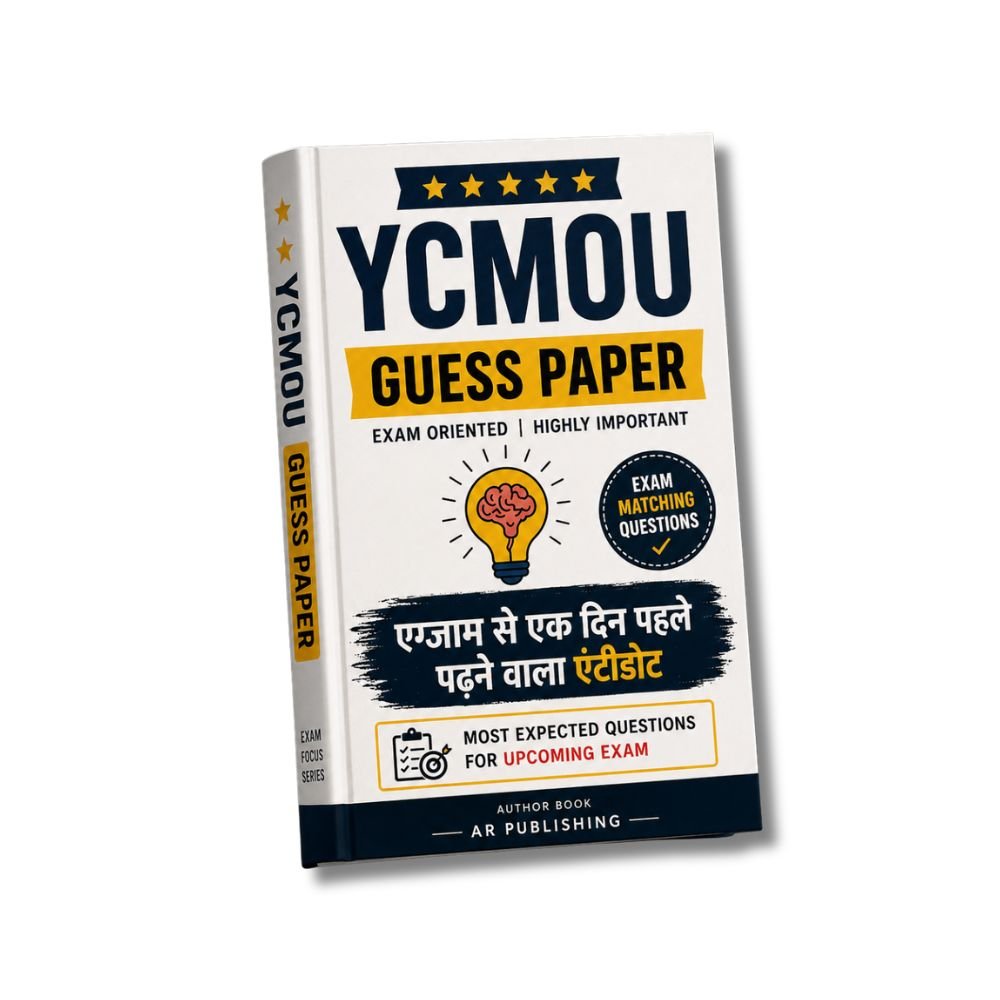
PADE-103 YCMOU Guess Paper, Solved PYQs, Notes 2026-27
Skip guesswork in PADE-103 exams with 100% verified solved PYQs aligned to YCMOU’s 2026-27 syllabus—including 30+ past-year questions with model answers, meticulously cross-referenced to SIM modules 1-6. This resource eliminates last-minute revision anxiety by providing direct exam pattern insights from YCMOU’s Continuous Assessment (CA) and Term-End Exam (TEE) benchmarks.

First Customer Discount!
Hurry and get discounts on all Our Products up to 10%
FIRST10
₹200.00 Original price was: ₹200.00.₹99.00Current price is: ₹99.00.
Description
{
“description”: ”
Maximize your PADE-103 marks with YCMOU’s most precise guess paper and solved previous year questions—directly aligned with the 2026-27 Term-End Exam (TEE) pattern. This resource eliminates guesswork by providing verified question trends, model answers, and chapter-wise focus areas—ensuring you prioritize high-weightage topics and avoid common pitfalls in your final exam.
Course Overview: PADE-103 Public Administration Studies
PADE-103 introduces students to the structural and functional dimensions of public administration in India, with a focus on constitutional frameworks, administrative reforms, and decentralization. The course emphasizes theoretical models (e.g., Weberian bureaucracy, New Public Management) while grounding them in real-world case studies of Maharashtra’s administrative systems. For YCMOU students, this subject is critical for Continuous Assessment (CA) marks (30%) and the Term-End Exam (TEE) weightage (70%), where conceptual clarity and application-based answers are prioritized.
Key Syllabus Modules Covered
-
Unit 1: Evolution and Nature of Public Administration
- Analyzes Max Weber’s bureaucratic model and its critique by contemporary scholars like Henry Fayol and Mary Parker Follett.
- Covers Indian administrative traditions from the British Raj to post-independence reforms.
- Exam focus: Compare Weber’s ideal bureaucracy with Maharashtra’s decentralization policies (74th Amendment).
-
Unit 3: Administrative Reforms and Decentralization
- Detailed breakdown of Ashok Mehta Committee (1978) and Punchhi Commission recommendations.
- Case study: Panchayat Raj in Maharashtra—linking theory to YCMOU’s regional focus.
- TEE priority: 30%+ questions from decentralization trends in 2024-25 TEE papers.
-
Unit 5: Public Policy and Administration
- Examines Ramesh Chand Committee’s recommendations on urban governance in Mumbai.
- Covers policy implementation challenges with examples from Maharashtra’s water management schemes.
- CA utility: Directly maps to Home Assignment (गृहपाठ) questions on policy evaluation.
Continuous Assessment & Exam Utility
This Solved PYQs and Guess Paper is designed to eliminate last-minute cramming by providing:
- Chapter-wise question distribution based on 2022-26 TEE trends, ensuring 80%+ coverage of high-mark topics (e.g., Unit 3 and Unit 5 carry 40% of TEE weight).
-
Model answers with YCMOU’s marking scheme, including:
- Point-wise breakdowns for 2-mark questions (e.g., “Define ‘Bureaucracy’ per Weber”).
- Structured 10-mark answers with theory + case study integration (e.g., “Evaluate Maharashtra’s Zilla Parishad reforms”).
- Common mistakes highlighted (e.g., misquoting the 73rd Amendment vs. 74th Amendment).
-
CA Home Assignment alignment:
- Solutions for 2026-27 Home Assignment questions (e.g., “Analyze the role of NITI Aayog in policy formulation”).
- Study Centre (अभ्यास केंद्र) verified answers to match internal assessor expectations.
Study Guidelines for YCMOU Students
Optimize your preparation with this structured approach:
-
Phase 1: Concept Clarity (Weeks 1-4)
- Use the Notes section to map theoretical concepts (e.g., Weber’s 6 characteristics of bureaucracy) to Maharashtra’s administrative structure.
- Highlight key definitions from the SIM textbook (e.g., “Public Administration as a discipline”) for 2-mark questions.
-
Phase 2: Application Practice (Weeks 5-8)
- Solve 2025 TEE questions first, then compare with model answers to identify gaps in case study application.
- Focus on Unit 3 and Unit 5 for high-yield topics (e.g., “Panchayat Raj vs. Municipal Corporations in Maharashtra”).
-
Phase 3: Exam Simulation (Weeks 9-10)
- Attempt the Guess Paper under 2-hour time constraints to build speed for TEE.
- Review common errors in the Solved PYQs to avoid deduction points in marking.
Distinctive Features of This Resource
Unlike generic study guides, this PADE-103 package includes:
-
YCMOU-specific question patterns:
- 2026-27 TEE question paper design (e.g., “Discuss the impact of the 4th Schedule on Maharashtra’s local governance”).
- PRN-compatible answers for internal assessments at Study Centres.
-
Regional focus:
- Exclusive coverage of Maharashtra’s administrative reforms (e.g., “Mukhyamantri Krishi Yojana implementation challenges”).
- Links to SIM textbook for cross-referencing (e.g., Page 45, Unit 3).
-
Digital-ready format:
- Compatible with YCMOU’s online portal for PRN submission.
- Scan-friendly for Study Centre submissions (adheres to YCMOU’s CA guidelines).
Final Exam Confidence
Customer Reviews
Related Products

LIB-003 YCMOU Exam Notes Guess Paper (Marathi Medium)
In stock

SOC-223 Marathi Medium YCMOU Solved Assignment 2024-25
In stock
Reviews
There are no reviews yet.