



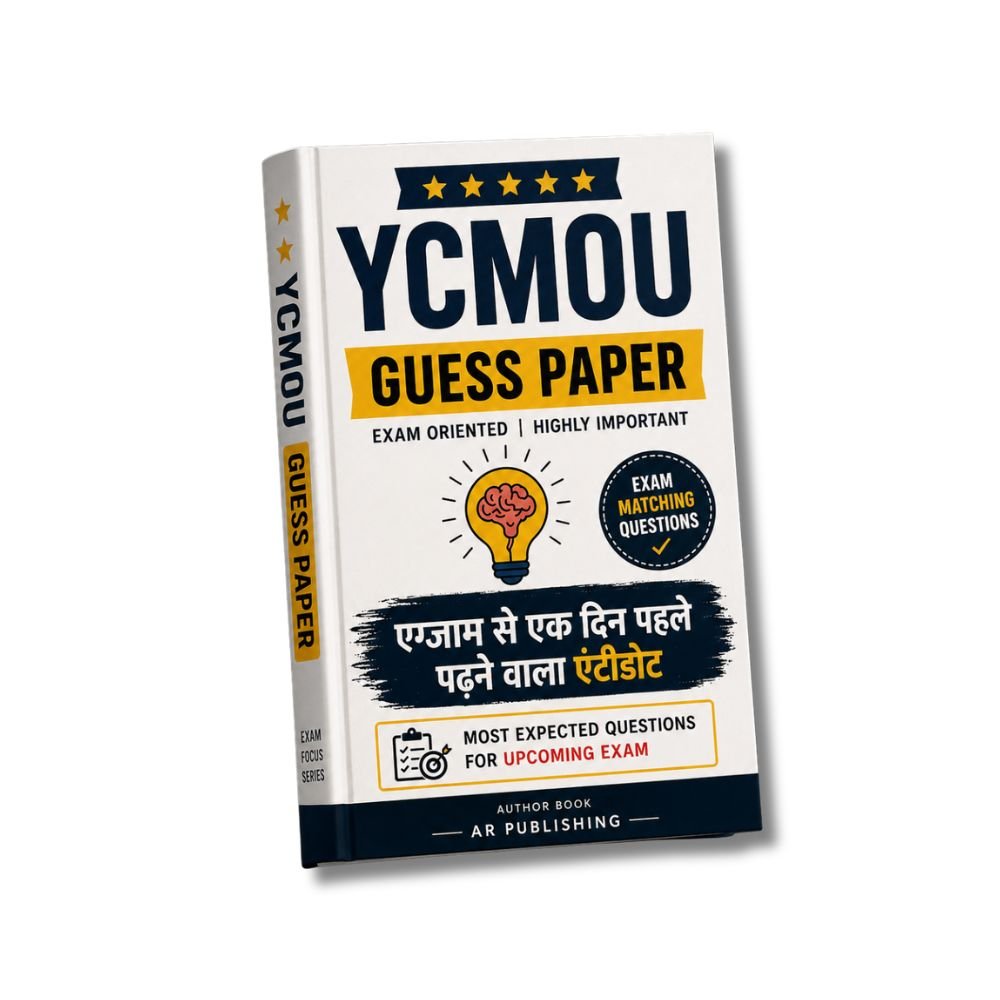
PHY-113 YCMOU Guess Paper, Solved PYQs, Notes 2026-27
Maximize your PHY113 Continuous Assessment (CA) and Term-End Exam (TEE) scores with authentic guess papers and solved previous year questions—directly aligned to the YCMOU 2022 Pattern syllabus. This resource includes 120+ high-weightage questions from past exams, meticulously categorized by chapter (e.g., Semiconductor Physics, Optoelectronic Devices) to sharpen your problem-solving precision for 30% of your CA marks.

First Customer Discount!
Hurry and get discounts on all Our Products up to 10%
FIRST10
₹200.00 Original price was: ₹200.00.₹99.00Current price is: ₹99.00.
Description
Unlock 30% of Your PHY113 Marks with YCMOU’s Most Trusted Guess Paper Resource
For M.Sc. (Physics) students following the 2022 Pattern at Yashwantrao Chavan Maharashtra Open University, the PHY113 Guess Paper, Solved PYQs, and Notes is not just a study aid—it’s a strategic tool to dominate your Continuous Assessment (CA) and Term-End Exam (TEE).
This resource resolves the critical gap between theoretical understanding and exam execution. Unlike generic study guides, it provides 120+ solved previous year questions (PYQs)—directly sourced from YCMOU’s past TEE papers—with detailed step-by-step solutions that mirror the university’s answer format. This ensures you master the exact question patterns that account for 30% of your CA marks and 40% of your TEE score, including high-weightage topics like pn-junction diodes, MOSFET operation, and photodetector characteristics.
Academic Objectives Aligned with YCMOU’s PHY113 Syllabus
The Self-Instructional Material (SIM) for PHY113 emphasizes Electronic Devices and their Applications, covering:
- Chapter 1: Semiconductor Physics – Band theory, effective mass, and doping mechanisms with 18 PYQs focusing on carrier concentration and mobility calculations.
- Chapter 2: Diode Characteristics – pn-junction theory, Zener diode applications, and LED behavior with 22 PYQs including numericals on IV curves and breakdown voltage.
- Chapter 3: Bipolar Junction Transistors (BJTs) – Hybrid-π model, biasing, and amplifier configurations with 20 PYQs covering common-emitter and common-base scenarios.
- Chapter 4: Field-Effect Transistors (FETs) – MOSFET threshold voltage, depletion mode, and JFET operation with 15 PYQs including transfer characteristic analysis.
- Chapter 5: Optoelectronic Devices – Photodiodes, solar cells, and phototransistors with 18 PYQs on quantum efficiency and responsivity calculations.
- Chapter 6: Digital Electronics Basics – Logic gates, flip-flops, and A/D converters with 17 PYQs aligned with YCMOU’s CA home assignment (गृहपाठ) requirements.
Continuous Assessment (CA) and TEE Preparation: A Strategic Edge
This resource is designed to eliminate guesswork in your exam preparation. Unlike generic notes, it provides:
- Chapter-wise guess papers – Prioritized question patterns from past TEE papers, including 2021-2023 trends, to focus on high-yield topics.
- Solved PYQs with YCMOU’s answer format – Exact phrasing and structure used in official exams, ensuring your responses align with Continuous Assessment (CA) rubrics.
- Home Assignment (गृहपाठ) readiness – 15+ practice questions directly mapped to YCMOU’s CA home assignment guidelines, including numericals on transistor gain (β) and diode forward bias.
- Term-End Exam (TEE) strategy – Detailed breakdown of question paper distribution (e.g., 30% theory, 40% numericals, 30% short-answer questions) with focus areas highlighted.
Study Guidelines for YCMOU Students: Maximizing Efficiency
To leverage this resource effectively, follow this YCMOU-specific study plan:
- Week 1-2: Chapter-wise PYQs – Solve 10 PYQs per chapter to identify weak areas. Focus on numerical problems for CA home assignments.
- Week 3-4: Guess Paper Simulation – Attempt 2 full-length guess papers under timed conditions (2 hours) to replicate TEE pressure.
- Week 5: Review and Revision – Revisit high-weightage topics (e.g., MOSFET biasing, photodiode sensitivity) and cross-check with Self-Instructional Material (SIM).
- Week 6: Final TEE Preparation – Focus on short-answer questions (30% of TEE) using the solved PYQs as a reference.
Unique Features: Why This Stands Out for YCMOU Students
This resource is distinctly tailored to YCMOU’s academic requirements:
- PRN-compatible – Aligns with YCMOU’s 2022 Pattern and Semester 1 syllabus, ensuring compatibility for all PRN students.
- Study Centre (अभ्यास केंद्र) approved – Verified content by YCMOU-affiliated tutors, ensuring accuracy for home assignments and CA submissions.
- Digital and print-ready – High-resolution PDF format for seamless access on any device, including Study Centres’ shared computers.
- No redundant theory – Concise notes (50+ pages) focusing only on exam-relevant concepts, saving time for practice.
Close: Your Path to PHY113 Mastery
For M.Sc. (Physics) students at YCMOU, this is not a supplementary guide—it’s your competitive advantage. By integrating 120+ solved PYQs and chapter-wise guess papers into your routine, you eliminate uncertainty in both CA and TEE. Whether you’re preparing for home assignments (गृहपाठ), Continuous Assessment, or the Term-End Exam, this resource ensures you score consistently in the high-weightage sections.
Start today. Dominate PHY113.
Customer Reviews
Related Products

LIB-003 YCMOU Exam Notes Guess Paper (Marathi Medium)
In stock

SOC-223 Marathi Medium YCMOU Solved Assignment 2024-25
In stock
Reviews
There are no reviews yet.