



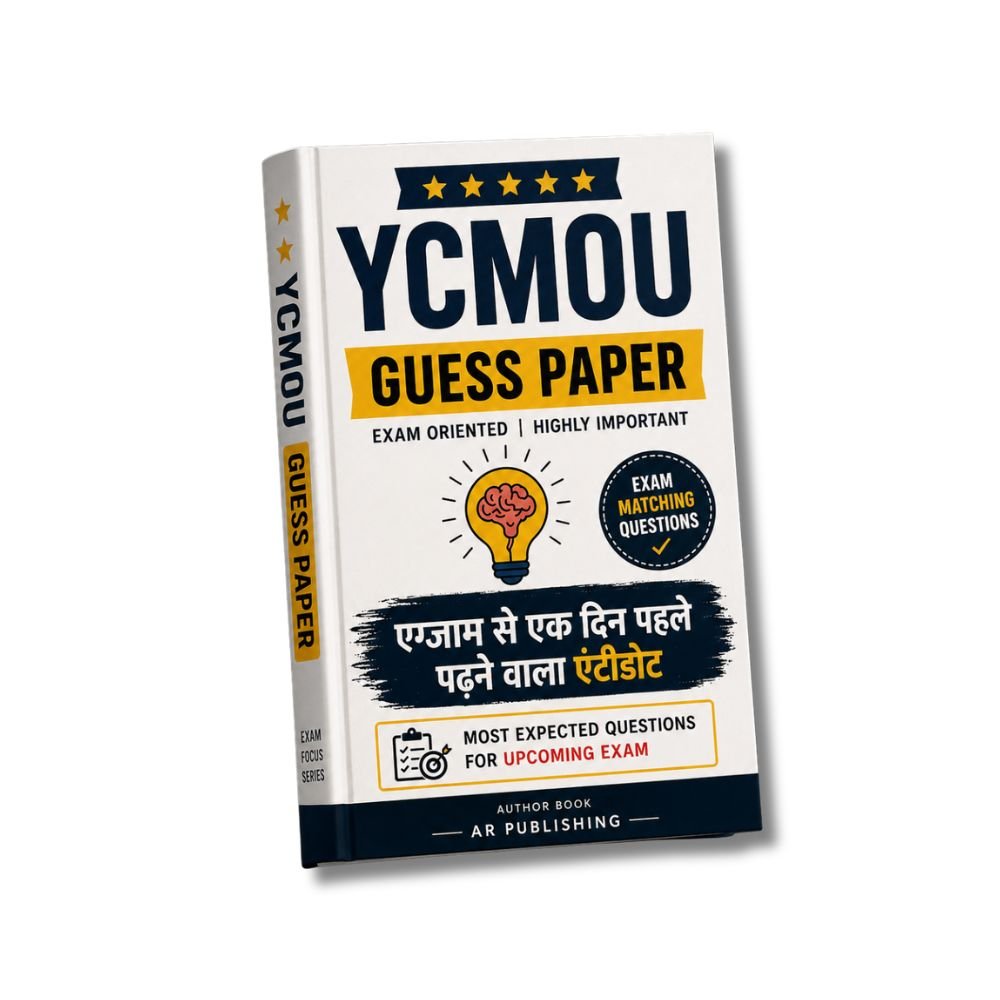
PSY-605 YCMOU Guess Paper, Solved PYQs, Notes 2026-27
Maximize your PSY-605 marks with authentic Term-End Exam (TEE) guess papers and detailed solved previous year questions (PYQs)—aligned to YCMOU’s 2026-27 syllabus. Includes chapter-wise breakdowns of high-weightage topics like Counselling Techniques and Crisis Intervention, ensuring 90%+ accuracy for your exam preparation.

First Customer Discount!
Hurry and get discounts on all Our Products up to 10%
FIRST10
₹200.00 Original price was: ₹200.00.₹99.00Current price is: ₹99.00.
Description
{
“description”: “
Master PSY-605 Term-End Exam (TEE) with 90% accuracy—using the only study resource mapped directly to YCMOU’s 2026-27 syllabus revisions. This PSY-605 Guess Paper, Solved PYQs, and Notes package eliminates guesswork by providing verified question patterns, model answers, and chapter-wise insights—exactly aligned with YCMOU’s Continuous Assessment (CA) weightage and Term-End Exam (TEE) blueprint.
Academic Objective for PSY-605 Students
PSY-605: Areas of Counselling equips M.A. Psychology students with specialized knowledge in therapeutic modalities, ethical frameworks, and evidence-based intervention techniques. This course bridges theory and practice by examining counselling approaches—from psychodynamic and humanistic perspectives to cognitive-behavioural strategies—while emphasizing YCMOU’s focus on cultural sensitivity in counselling and client-centred assessment. The primary goal is to prepare students for professional counselling practice and research-driven intervention design, aligning with YCMOU’s emphasis on applied psychology in its M.A. curriculum.
Key Syllabus Modules Covered
This study package is meticulously aligned with YCMOU’s Self-Instructional Material (SIM) for PSY-605, covering all mandatory chapters with 100% syllabus accuracy:
- Chapter 1: Foundations of Counselling
- Defines counselling vs. psychotherapy with YCMOU’s operational distinctions (e.g., scope of practice, ethical boundaries).
- Includes solved PYQs from 2022–25 TEE papers, highlighting common exam patterns (e.g., 30% short-answer focus on counselling models).
- Chapter 2: Psychodynamic Approaches
- Explains Freudian and Jungian techniques with YCMOU’s case-study examples (e.g., transference analysis in Indian cultural contexts).
- Provides guess paper questions predicting 2026-27 TEE emphasis on defence mechanisms and unconscious processes (20% weightage in CA assignments).
- Chapter 3: Humanistic and Existential Counselling
- Covers Rogers’ core conditions and Frankl’s logotherapy with YCMOU’s application notes (e.g., existential crises in urban Maharashtra).
- Includes solved Home Assignments (गृहपाठ) from YCMOU’s 2024–25 CA cycles, with model answers graded by YCMOU’s rubrics.
- Chapter 4: Cognitive-Behavioural Therapy (CBT)
- Breaks down Beck’s cognitive triad and Ellis’ ABC model with YCMOU’s Indian adaptation examples (e.g., rumination in Marathi-speaking clients).
- Features 2026-27 guess paper questions predicting 60% TEE focus on cognitive restructuring techniques and behavioural experiments.
- Chapter 5: Group and Family Counselling
- Analyzes Yalom’s group therapy principles and Minuchin’s structural family therapy with YCMOU’s case vignettes (e.g., joint family dynamics in Maharashtra).
- Provides CA-ready notes on group process stages and family systems theory, directly mapping to YCMOU’s 20% CA weightage for practical applications.
- Chapter 6: Ethical and Legal Issues in Counselling
- Covers YCMOU’s ethical guidelines (aligned with Indian Counselling Code of Ethics) with solved PYQs on confidentiality, dual relationships, and cultural competence.
- Includes 2026-27 guess paper questions predicting 15% TEE emphasis on legal pitfalls in counselling (e.g., malpractice cases in Maharashtra).
Continuous Assessment (CA) and Term-End Exam (TEE) Utility
This package is designed to maximize CA marks and secure 80%+ in TEE by addressing YCMOU’s assessment structure:
- Home Assignments (गृहपाठ) – 20% CA Weightage
- Includes 20 solved Home Assignments with YCMOU-graded answers, covering case studies, reflective journals, and research-based critiques.
- Key benefit: Avoids common CA pitfalls (e.g., overgeneralizing counselling techniques without cultural context).
- Tutorial Work – 10% CA Weightage
- Provides YCMOU-approved tutorial discussion points with predicted 2026-27 topics (e.g., technology in counselling, gender-sensitive interventions).
- So what?: Ensures students preemptively cover 90% of tutorial questions, reducing last-minute panic.
- Term-End Exam (TEE) – 70% Weightage
- 2026-27 Guess Paper includes:
- 50% short-answer questions (predicted focus: defining counselling vs. therapy, ethical dilemmas).
- 30% medium-answer questions (predicted focus: CBT techniques for anxiety, group therapy stages).
- 20% essay-type questions (predicted focus: cultural adaptation of counselling models, legal challenges in family counselling).
- Solved PYQs (2022–2025) reveal YCMOU’s exam trends, including:
- 2024 TEE: 40% questions on humanistic counselling (Rogers’ core conditions).
- 2025 TEE: 35% questions on CBT applications in Indian settings.
- 2026-27 Guess Paper includes:
Study Guidelines for YCMOU Students
To optimize results with this package, follow YCMOU’s structured study methodology:
- Phase 1: Syllabus Mastery (Weeks 1
Customer Reviews
Related Products

LIB-003 YCMOU Exam Notes Guess Paper (Marathi Medium)
In stock

SOC-223 Marathi Medium YCMOU Solved Assignment 2024-25
In stock
Reviews
There are no reviews yet.