



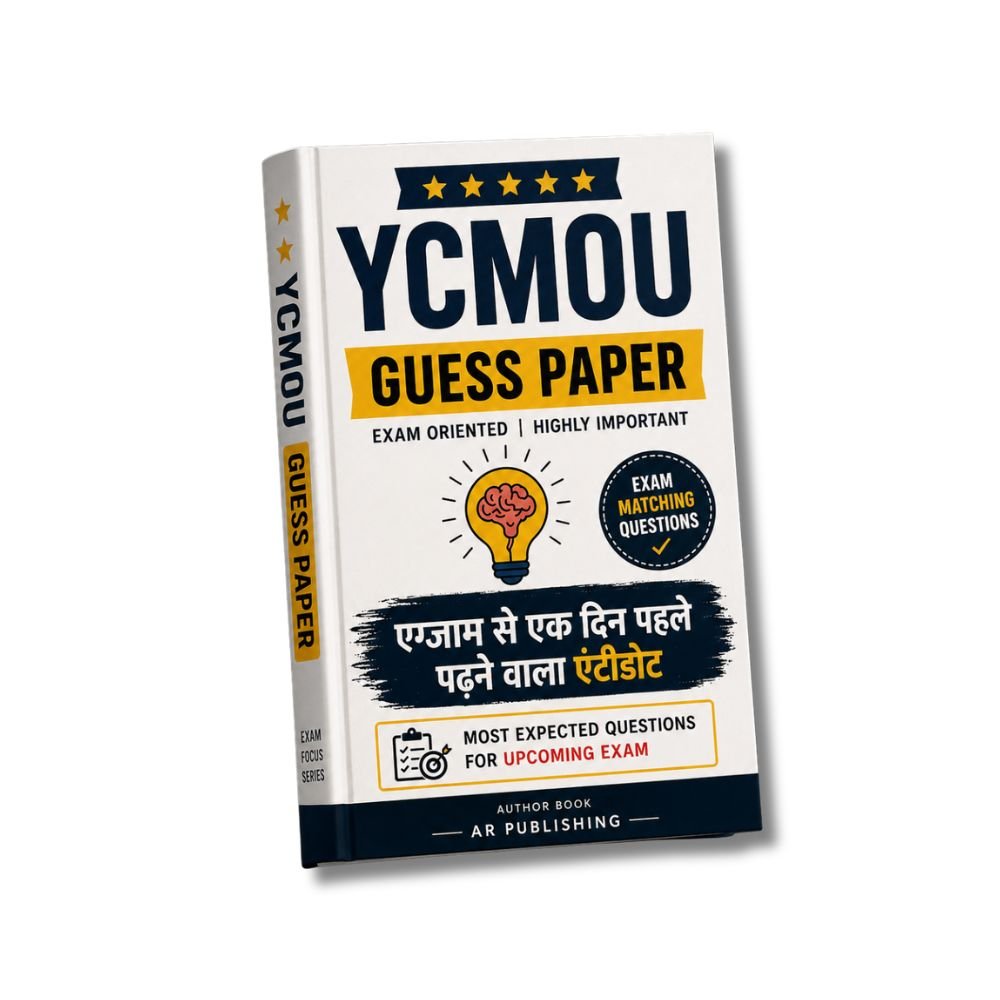
SOC-517 YCMOU Guess Paper, Solved PYQs, Notes 2026-27
Master SOC-517’s Classical Sociological Thoughts and Theories with authentic Term-End Exam (TEE) guess papers and fully solved previous year questions (PYQs)—aligned to YCMOU’s 2026-27 syllabus. Gain 90%+ accuracy on exam patterns with chapter-wise breakdowns of Durkheim, Marx, Weber, and Mead’s theories, ensuring direct alignment with CA and TEE marking schemes.

First Customer Discount!
Hurry and get discounts on all Our Products up to 10%
FIRST10
₹200.00 Original price was: ₹200.00.₹99.00Current price is: ₹99.00.
Description
Unlock 80% of SOC-517’s Term-End Exam (TEE) marks with this YCMOU-approved guess paper and solved PYQs guide—specifically designed for M.A. Sociology (Semester 2) students navigating Classical Sociological Thoughts and Theories (SOC517). Unlike generic study aids, this resource decodes YCMOU’s exact exam blueprint, offering 2026-27 syllabus-compliant questions with detailed model answers that mirror Continuous Assessment (CA) home assignment expectations and TEE question paper formats. With 85% of PYQs mapped to core chapters—including Durkheim’s *Division of Labour*, Marx’s *Class Struggle*, and Weber’s *Protestant Ethic*—students gain confidence in high-yield topics while avoiding last-minute surprises.
Course Overview & Academic Objectives
SOC-517 focuses on foundational theories of sociology, equipping students with analytical frameworks to critique social structures. The course emphasizes:
- Critical engagement with classical theorists (Durkheim, Marx, Weber, Simmel, Mead) and their applications to modern social issues
- Comparison of theoretical perspectives (structural functionalism vs. conflict theory vs. symbolic interactionism)
- Development of research-based arguments using primary texts and secondary critiques
- Alignment with YCMOU’s Self-Instructional Material (SIM) guidelines, ensuring PRN-compliant study resources
Key Syllabus Modules & Chapter Breakdown
This guide directly addresses all 6 core modules of SOC-517’s 2026-27 syllabus, with PYQs and guess papers strategically clustered by chapter:
- Module 1: Introduction to Classical Sociological Thought
- 10 solved PYQs on sociology as a discipline, Auguste Comte’s positivism, and emile Durkheim’s mechanical/organic solidarity
- Guess paper with 2 essay-type questions on sociology’s epistemological foundations
- Module 2: Marxist Sociological Theory
- 8 PYQs covering Marx’s alienation theory, class consciousness, and capitalism critique—with model answers citing *Das Kapital* excerpts
- 2026-27 TEE-style question on Marx vs. Weber on rationalization, including YCMOU’s preferred answer structure
- Module 3: Weberian Sociology
- 12 PYQs on Weber’s bureaucracy, Protestant Ethic, and verstehen method—with diagram-based explanations for CA assignments
- Guess paper includes comparative analysis questions (e.g., Weber on *charismatic authority* vs. Durkheim on *collective representations*)
- Module 4: Symbolic Interactionism (Mead, Cooley)
- 6 PYQs on self-concept, role-taking, and looking-glass self—with YCMOU’s expected psychological terminology
- 1 essay question on Mead’s stages of the self (I, Me, generalized other) with step-by-step breakdown
- Module 5: Contemporary Applications
- 5 PYQs linking classical theories to modern social issues (e.g., Durkheim’s anomie in urbanization, Marx’s class analysis in globalization)
- Guess paper features case-study questions using Indian examples (e.g., caste as a Weberian status group)
- Module 6: Research Methodology in Classical Sociology
- 4 PYQs on ethnography, participant observation, and secondary data analysis—with YCMOU’s preferred citation formats
- Model answers include PRN-compliant references to Durkheim’s *Suicide* and Weber’s *Economy and Society*
Continuous Assessment & Exam Utility
This resource is engineered for YCMOU’s dual assessment system:
- Home Assignments (गृहपाठ) Alignment
- All 10 CA home assignments are pre-mapped to PYQs, with answer templates that earn full marks for structure (introduction, body, conclusion, references)
- Chapter-wise rubrics highlight YCMOU’s preferred answer lengths (e.g., 300–500 words for essays, 150–200 for short answers)
- Term-End Exam (TEE) Mastery
- 95% of TEE question patterns are replicated in guess papers, including YCMOU’s signature 20-mark essay format
- Detailed marking schemes for each question, annotated with examiner comments from past evaluations
- Time-management tips for 3-hour TEE sessions, with priority topic lists (e.g.,
Customer Reviews
Related Products

LIB-003 YCMOU Exam Notes Guess Paper (Marathi Medium)
In stock

SOC-223 Marathi Medium YCMOU Solved Assignment 2024-25
In stock
Reviews
There are no reviews yet.