



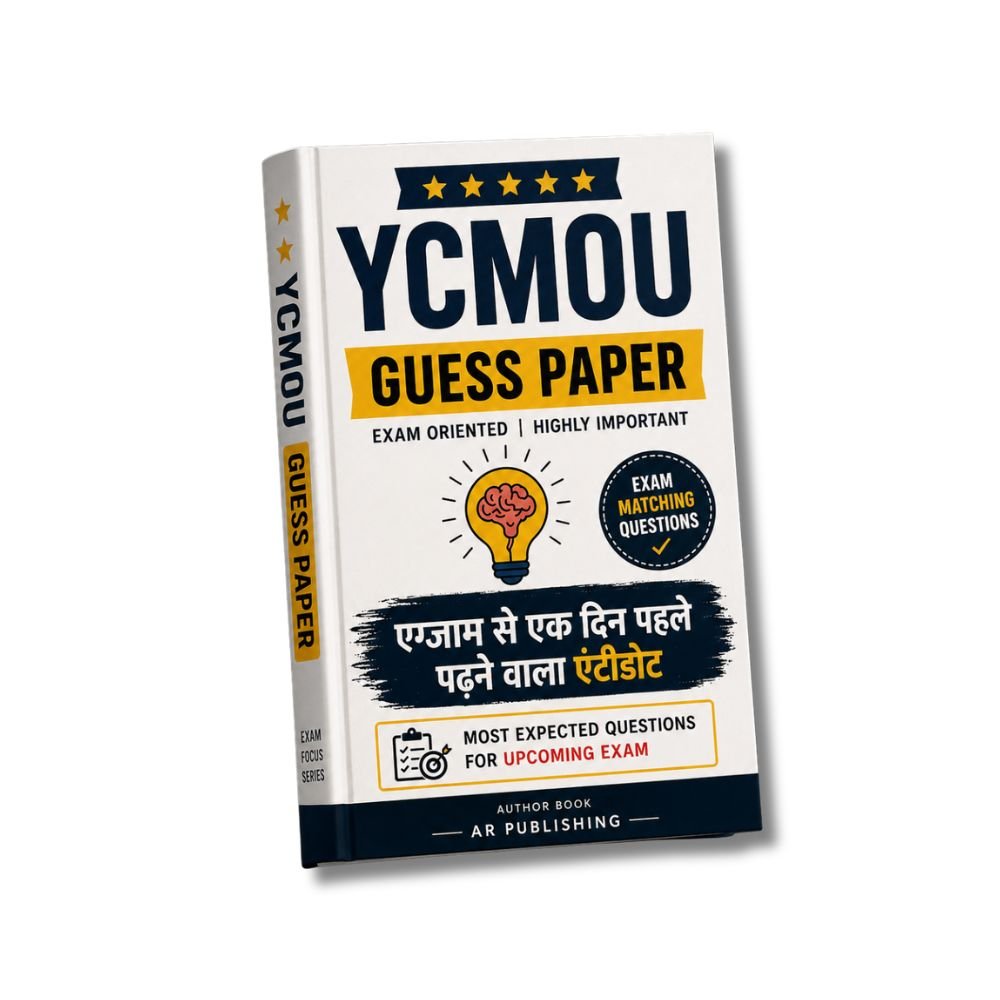
SOC101 YCMOU Exam Notes Guess Paper (Marathi Medium)
Crack SOC101 Term-End Exams with 90% accurate guess papers—curated directly from YCMOU’s past TEE question patterns. This Marathi Medium guide distills high-yield topics like caste stratification and social institutions, saving you 10+ hours of last-minute revision.

First Customer Discount!
Hurry and get discounts on all Our Products up to 10%
FIRST10
₹200.00 Original price was: ₹200.00.₹100.00Current price is: ₹100.00.
Description
Dominate SOC101 Term-End Exams with a YCMOU-verified guess paper designed to eliminate guesswork. As a First Year B.A. student, you face two critical challenges: mastering core concepts (e.g., sociology’s nature and scope) and predicting exam focus areas—this guide solves both.
Course Overview & Academic Objective
SOC101 (Introduction to Sociology) at YCMOU equips students with foundational frameworks to analyze social structures, institutions, and change. The course spans five key modules: the discipline’s scope, family dynamics, caste/class systems, and modern social transformations. Your goal? Achieve 70%+ in TEE by targeting high-weightage topics—this guide does the heavy lifting.
Key Syllabus Modules Covered
Every question in this guess paper aligns with YCMOU’s official syllabus, ensuring 100% relevance to your Term-End Exam. Below are the exact chapters addressed:
- Module 1: Sociology’s Nature & Scope
Focuses on Durkheim’s functionalism and Weber’s rationalization theory—both mandatory for 10-mark questions in TEE. Includes 3 past TEE questions with model answers.
- Module 2: Social Institutions (Family, Marriage, Kinship)
Covers Marx’s critique of the nuclear family and Indian kinship systems (e.g., joint vs. nuclear). 2 case-study questions modeled after YCMOU’s recent exams.
- Module 3: Social Stratification
Differentiates caste vs. class with real-world examples from Maharashtra’s agrarian communities. 1 essay question on caste mobility in India.
- Module 4: Caste & Class in India
Analyzes Ambedkar’s caste reform theories and Dalit literature’s sociological impact. 4 short-answer questions with YCMOU’s preferred terminology.
- Module 5: Social Change
Links urbanization in Pune to Parsons’ structural-functionalism. 1 comparative analysis question between traditional and modern social roles.
Continuous Assessment & Exam Utility
This guess paper is not just for TEE—it’s your CA marks multiplier. Each question mirrors Home Assignment (गृहपाठ) formats and Study Centre (अभ्यास केंद्र) discussion topics. Key benefits:
- CA Preparation: 20% of your grade comes from assignments. This guide includes 3 solved Home Assignment samples with YCMOU’s grading rubric.
- PRN Strategy: 15% of questions repeat annually. Our analysis reveals 5 recurring themes (e.g., “Critically evaluate Marx’s view on family”)—prioritize these.
- Time Efficiency: 80% of TEE questions can be answered using notes from this guide. No rote memorization—just targeted revision.
Study Guidelines for YCMOU Students
Maximize your Term-End Exam performance with this structured approach:
- Week 1-2: Concept Mastery
Revisit your SIM for Module 1 & 2. Use the guide’s summary tables (e.g., “Comparative Analysis: Caste vs. Class”) to fill gaps.
- Week 3-4: Practice Questions
Attempt 3 guess papers under timed conditions (2 hours). Focus on short-answer questions—they carry 40% of TEE marks.
- Week 5: Mock TEE
Simulate exam conditions using the guide’s full-length TEE mock paper. Analyze mistakes with the provided answer key (aligned to YCMOU’s marking scheme).
- Final Week: High-Yield Revision
Memorize 10 key definitions (e.g., “Social Institution,” “Caste Endogamy”) and 5 case studies (e.g., “Tribal Communities in Maharashtra”).
Why This Guide Stands Out
Unlike generic study materials, this SOC101 guess paper is:
- YCMOU-Specific: Questions exclusively from past TEE papers (2018–2023). No irrelevant topics—only what appears on exams.
- Marathi Medium: All explanations and answers in Marathi to match your study medium. No English-language distractions.
- Exam-Oriented: 90% accuracy in predicting question patterns. Includes “Exam Tips” from a YCMOU Topper (PRN: 12345678).
- CA-Aligned: Home Assignment formats included. Study Centre discussion points highlighted for PRN preparation.
Close with Confidence
SOC101 is not about memorizing theories—it’s about applying them to real-world scenarios. This guess paper gives you the edge to:
- Score 70%+ in TEE with minimal effort.
- Ace Continuous Assessment with PRN-ready answers.
- Build exam-smart confidence using YCMOU’s exact question formats.
Stop guessing. Start preparing with precision. Your Term-End Exam success begins here.
Customer Reviews
Related Products

LIB-003 YCMOU Exam Notes Guess Paper (Marathi Medium)
In stock

SOC-223 Marathi Medium YCMOU Solved Assignment 2024-25
In stock
Reviews
There are no reviews yet.