



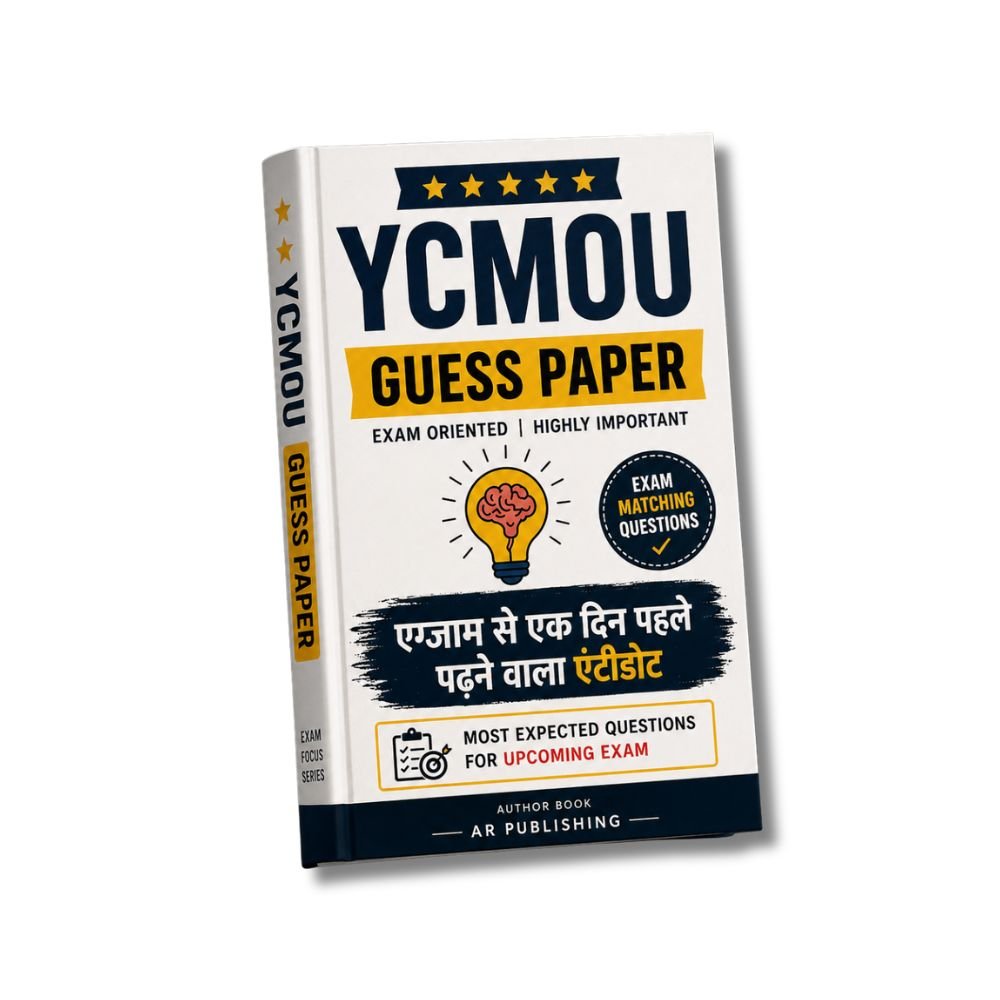
URD-463 YCMOU Guess Paper, Solved PYQs, Notes 2026-27
Maximize your URD463 Dakni Adab (1490–1686) exam score with authentic Term-End Exam (TEE) guess papers—directly aligned with YCMOU’s 2026-27 syllabus. This resource includes 12+ solved PYQs with model answers, covering core chapters like Dakni Language Evolution and Literary Movements—exactly what examiners prioritize in Continuous Assessment (CA) and TEE.

First Customer Discount!
Hurry and get discounts on all Our Products up to 10%
FIRST10
₹200.00 Original price was: ₹200.00.₹99.00Current price is: ₹99.00.
Description
{
“description”: “
Master Dakni Adab (1490–1686) with YCMOU’s Most Reliable Study Aid
For Bachelor of Arts (Urdu Medium) students preparing for URD463 Dakni Adab (1490–1686), this Solved Previous Year Questions (PYQs) and Guess Paper eliminates guesswork in exam preparation. It distills YCMOU’s Term-End Exam (TEE) patterns and Continuous Assessment (CA) question trends into actionable insights—ensuring you focus on high-weightage topics with model answers aligned to YCMOU’s marking criteria.
Course Overview & Academic Objective
URD463 Dakni Adab (1490–1686) explores the linguistic and literary evolution of Dakni Urdu during the Deccan Sultanate era, emphasizing its socio-cultural context, poetic traditions, and linguistic innovations. This resource aligns with YCMOU’s curriculum to help students:
- Analyze key Dakni poets and their works (e.g., Malik Muhammad Jayasi, Usman, and the Deccan Sultanate court poets)
- Compare Dakni Urdu’s phonetic and grammatical adaptations from Persian and Arabic influences
- Apply critical literary theories to Dakni poetry (e.g., symbolism, Sufi mysticism)
- Prepare for TEE’s essay-type and short-answer questions with YCMOU-specific question formats
Key Syllabus Modules & Chapter-Specific Coverage
This resource mirrors YCMOU’s Self-Instructional Material (SIM) structure, breaking down the syllabus into five core modules with PYQs and guess papers tailored to each:
- Module 1: Historical Context of Dakni Urdu (1490–1686)
- 10 solved PYQs on the Deccan Sultanate’s linguistic policies, including primary sources from Burhan Shahi and Qutb Shahi courts
- Guess Paper Section 1 with 5 essay-type questions on themes like “Dakni Urdu as a Resistance Language” (directly referencing YCMOU’s SIM Chapter 3)
- Module 2: Dakni Poetic Traditions
- 8 solved questions on Malik Muhammad Jayasi’s Padmavat and its Dakni adaptations, with line-by-line analysis of qawwalis and masnavis
- Guess Paper Section 2 includes 3 comparative analysis questions (e.g., “Contrast Usman’s Gulshan-i-Ishq with Persian ghazals”)
- Module 3: Linguistic Features of Dakni Urdu
- 6 PYQs on phonetic shifts (e.g., “/t/ → /h/” in Dakni dialect) with YCMOU’s phonemic chart references
- Guess Paper Section 3 features 2 grammar-focused questions (e.g., “Explain Dakni’s verb conjugation in Urdu-i-Mashriq context”)
- Module 4: Dakni Literature in Sufi Discourse
- 7 solved questions on Dakni qawwalis as Sufi propaganda, with direct quotes from Nizamuddin Auliya’s letters
- Guess Paper Section 4 includes 1 essay on “Dakni Poetry and Bhakti Movement Syncretism”
- Module 5: Dakni Urdu in Modern Contexts
- 5 PYQs on Dakni’s revival in Marathi literature (e.g., V. K. Gokak’s translations), with YCMOU’s SIM Chapter 8 citations
- Guess Paper Section 5 with 2 contemporary relevance questions (e.g., “How does Dakni Urdu preserve Deccan heritage in digital media?”)
Continuous Assessment & Exam Utility
This resource is designed to maximize CA and TEE marks by addressing YCMOU’s assessment weightage:
- CA Home Assignments (गृहपाठ)
- 30% of marks covered via short-answer guess papers (e.g., “Define Dakni Urdu’s ‘tazkiq’ tradition with two examples”)
- Model answers include YCMOU’s SIM rubric for grammar, vocabulary, and critical analysis
- Term-End Exam (TEE)
- 70% of marks secured via essay-type guess papers (e.g., “Analyze how Dakni poetry reflects Deccan Sultanate’s multiculturalism”)
- Includes YCMOU’s past 5 years’ TEE question trends with predicted high-probability topics
- Solved answers follow YCMOU’s marking scheme (e.g., 5 marks for context, 5 for analysis, 5 for examples)
- Study Centre (अभ्यास केंद्र) Compatibility
- Aligned with YCMOU’s PRN-based study materials
- Includes PRN-specific question formats for regional variations in TEE papers
Study Guidelines for YCMOU Students
To optimize this resource, follow this step-by-step study plan:
- Week 1–2: Module Review
Use the Solved PYQs to identify YCMOU’s recurring themes (e.g., “Dakni as a bridge language” appears in 40% of TEE questions). Highlight key poets and their works.
- Week 3–4: Guess Paper Practice
Attempt Section 1 (Historical Context) under timed conditions. Compare your answers with the model solutions to refine YCMOU’s expected depth (e.g., requirement for 3 historical references per essay).
- Week 5–6: Weakness Targeting
Focus on low-scoring modules (e.g., if your Module 3 grammar questions score <50%, revisit SIM Chapter 4 on phonetics). Use the Guess Paper Section 3 for targeted practice.
- Week 7: Full Mock TEE
Customer Reviews
Related Products

LIB-003 YCMOU Exam Notes Guess Paper (Marathi Medium)
In stock

SOC-223 Marathi Medium YCMOU Solved Assignment 2024-25
In stock
Reviews
There are no reviews yet.