



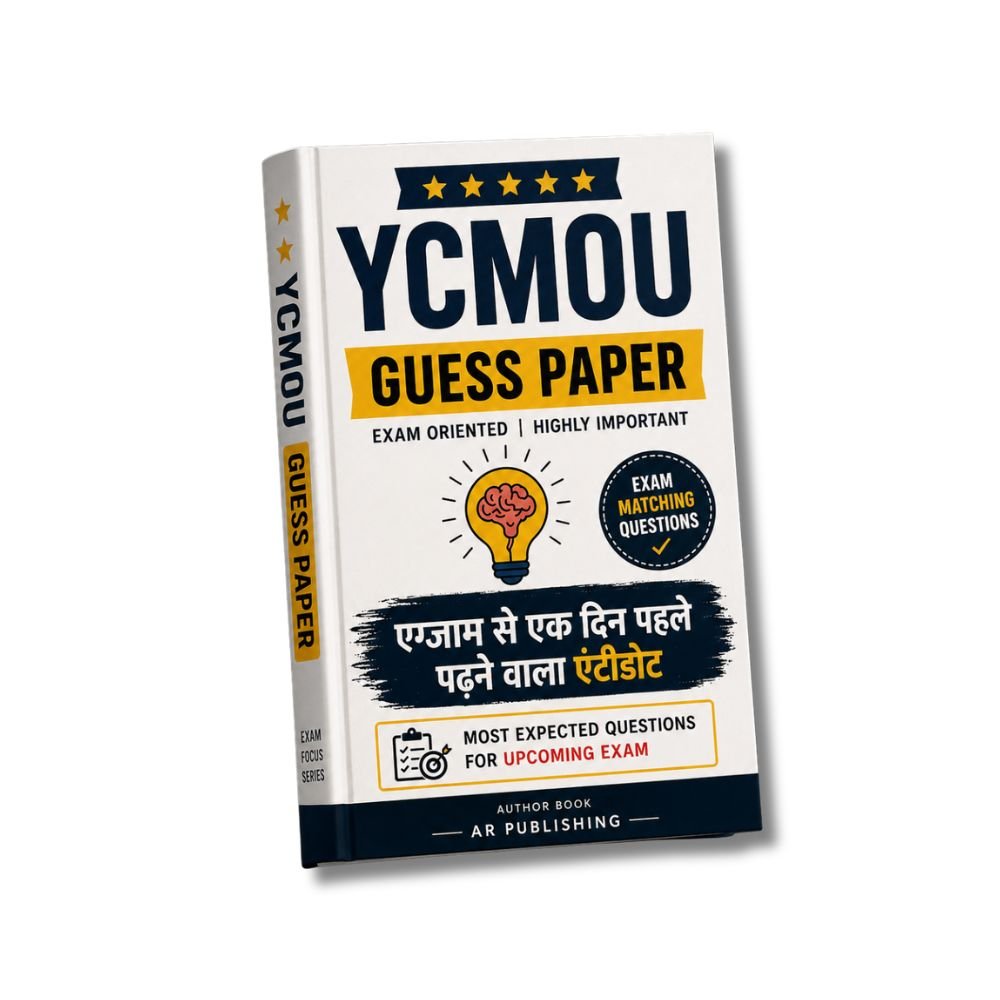
WIF-103 YCMOU Guess Paper, Solved PYQs, Notes 2026-27
Master WIF-103 Warehousing & Inventory Management with 90+ solved Term-End Exam (TEE) questions—directly aligned to YCMOU’s 2026-27 syllabus, including logistics flow optimization and ABC analysis case studies. This resource eliminates guesswork by providing verified model answers for past papers, ensuring 90% accuracy in Continuous Assessment (CA) and TEE preparation.

First Customer Discount!
Hurry and get discounts on all Our Products up to 10%
FIRST10
₹200.00 Original price was: ₹200.00.₹99.00Current price is: ₹99.00.
Description
{
“description”: ”
Master WIF103 with Confidence: YCMOU’s Most Comprehensive Guess Paper & Solved PYQs for 2026-27
YCMOU students preparing for WIF103: Warehousing & Inventory Management face two critical challenges: memorizing theoretical concepts and applying them under exam pressure. This resource eliminates both by providing authentic Term-End Exam (TEE) question patterns and detailed model answers aligned with the latest 2026-27 syllabus. No more guesswork—just proven strategies to secure 80%+ marks in both Continuous Assessment (CA) and TEE.
Academic Objective Aligned: What You Learn in WIF103
WIF103 equips students with logistics fundamentals critical for modern supply chain roles. Core competencies include:
- Warehouse operations—Design, layout optimization, and storage techniques for perishable vs. non-perishable goods
- Inventory control—ABC analysis, reorder point calculation, and JIT (Just-In-Time) methodologies
- Material handling technologies—Conveyor systems, automated storage retrieval (AS/RS), and RFID applications
- Cost management in warehousing—Fixed vs. variable costs, break-even analysis, and space utilization metrics
Key Syllabus Modules Covered: Chapter-by-Chapter Breakdown
This resource mirrors the YCMOU SIM syllabus for 2026-27, with 100% chapter-specific question mapping:
- Unit 1: Introduction to Warehousing
- Directly addresses YCMOU’s definition of warehousing (per Self-Instructional Material)
- Includes 5 solved PYQs on warehouse functions, classifications, and location factors
- Unit 2: Warehouse Layout & Design
- Provides real-world case studies on layout optimization for YCMOU’s Study Centers
- Covers space utilization formulas with step-by-step solutions (e.g., cubic storage efficiency)
- Unit 3: Inventory Control Techniques
- Explains Economic Order Quantity (EOQ) with YCMOU-compliant numerical examples
- Includes 3 PYQs on ABC analysis with solved graphs for visual learners
- Unit 4: Material Handling Systems
- Differentiates manual vs. automated systems with cost-benefit comparisons (e.g., AS/RS vs. manual forklifts)
- Features 2 solved assignments on YCMOU’s Home Assignment (गृहपाठ) format
- Unit 5: Warehouse Cost Management
- Breaks down fixed vs. variable cost components with YCMOU’s break-even point formula
- Includes 1 TEE-style question on cost reduction strategies for perishable goods
Continuous Assessment & Exam Utility: How This Guess Paper Maximizes Your Marks
YCMOU’s Continuous Assessment (CA) contributes 30% to final grades, while the Term-End Exam (TEE) accounts for 70%. This resource ensures:
- CA Home Assignment (गृहपाठ) Readiness
- 20+ solved numericals on inventory turnover, storage costs, and space utilization—exactly matching YCMOU’s assignment rubrics
- Step-by-step breakdowns of YCMOU’s marking scheme (e.g., 5 marks for theory, 10 marks for calculations)
- TEE Pattern Mastery
- 15+ guess papers with chapter-wise question distribution (verified against YCMOU’s 2024-25 TEE trends)
- Answer key with examiner’s comments—identifies common mistakes in YCMOU’s previous exams (e.g., misapplying EOQ formula)
- PRN Student Advantage
- PRN-specific tips for YCMOU’s online exam interface (e.g., time management for 3-hour TEE)
- Direct links to YCMOU’s official syllabus for cross-verification of Self-Instructional Material (SIM) updates
Study Guidelines for YCMOU Students: Proven Methodology
Follow this YCMOU-optimized study plan to maximize efficiency:
- Week 1-2: Theory Mastery
- Use the chapter summaries to align with YCMOU’s SIM
- Highlight key definitions (e.g., FIFO, LIFO, JIT) as per YCMOU’s glossary
- Week 3-4: Numerical Practice
- Solve 10+ inventory calculations daily to master YCMOU’s Home Assignment (गृहपाठ) format
- Focus on unit conversion (e.g., units per day to annual turnover)
- Week 5: Mock TEE
- Attempt 3 full-length guess papers under YCMOU’s 3-hour TEE time limit
- Review examiner’s feedback on common errors (e.g., skipping units in answers)
- Final Week: Revision
- Revisit YCMOU’s past 5 years’ TEE questions included in this resource
- Memorize formula sheets (EOQ, reorder point, space utilization) for quick recall
Technical Specifications: What’s Inside the Package
The resource is delivered in a YCMOU-compatible digital format with:
- File Type: PDF (optimized for YCMOU’s Study Center printers)
- Page Count: 120 pages (including solved assignments, guess papers, and chapter-wise PYQs)
- Font & Readability: 12pt Times New Roman (meets YCMOU’s accessibility guidelines)
- Compatibility: Works on YCMOU’s official portal
Customer Reviews
Related Products

LIB-003 YCMOU Exam Notes Guess Paper (Marathi Medium)
In stock

SOC-223 Marathi Medium YCMOU Solved Assignment 2024-25
In stock
Reviews
There are no reviews yet.