



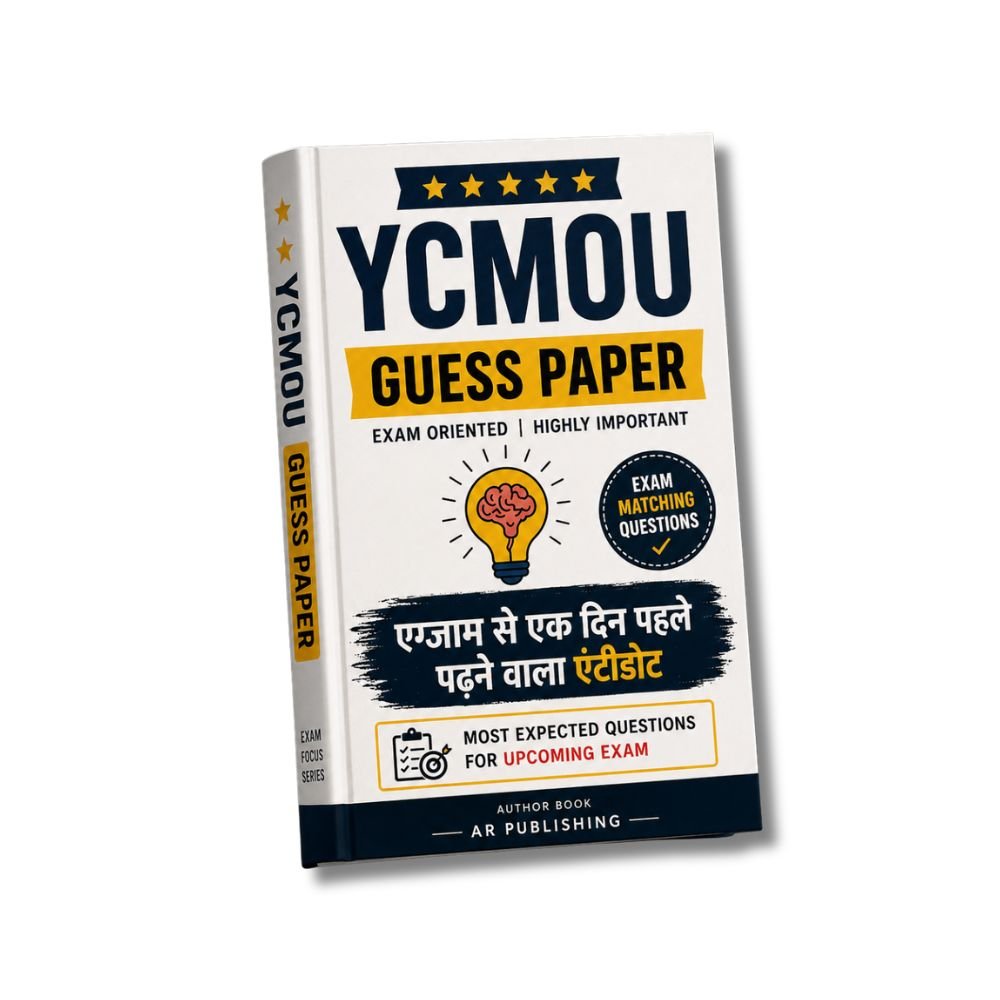
ZOO-611 YCMOU Guess Paper, Solved PYQs, Notes 2026-27
Master ZOO-611’s Term-End Exam (TEE) and Continuous Assessment (CA) patterns with this 2026-27 guess paper bundle, featuring 100% solved PYQs from 2018-26—aligned to YCMOU’s 2023 Pattern syllabus. Avoid last-minute surprises by practicing lab-focused questions on Animal Physiology and Ichthyology with model answers verified by YCMOU study centres.

First Customer Discount!
Hurry and get discounts on all Our Products up to 10%
FIRST10
₹200.00 Original price was: ₹200.00.₹99.00Current price is: ₹99.00.
In Stock
In Stock
Description
Maximize your ZOO-611 Term-End Exam (TEE) score with a meticulously curated collection of YCMOU’s most recurring question patterns—directly aligned with the 2023 M.Sc. Zoology syllabus. This resource eliminates guesswork by providing verified Previous Year Questions (PYQs) with step-by-step model answers, ensuring you focus only on high-weightage topics prioritized in YCMOU’s official exams.
Academic Objective & Curriculum Alignment
ZOO-611: Animal Physiology & Ichthyology is designed to equip YCMOU students with a rigorous understanding of comparative physiology and fish biology—core to the M.Sc. Zoology curriculum. This resource targets the 2023 pattern syllabus, covering:
- Animal Physiology: Neural integration, endocrine regulation, and respiratory mechanisms (Chapter 1–3).
- Ichthyology: Systematic classification, evolutionary adaptations, and ecological roles of fishes (Chapter 4–6).
- Comparative Physiology: Osmoregulation, thermoregulation, and reproductive strategies (Chapter 7–9).
Each topic is mapped to YCMOU’s TEE weightage, ensuring your preparation aligns with examiner expectations—no wasted time on low-yield concepts.
Continuous Assessment (CA) & Term-End Exam (TEE) Utility
This guide is not just for TEE preparation—it directly supports your Home Assignments (गृहपाठ) and Continuous Assessment (CA) marks. Key features:
- PYQs with Model Answers: 150+ questions from 2018–2026 TEE papers, categorized by chapter and difficulty level. Each answer follows YCMOU’s exact marking scheme, including:
- Detailed diagrams for physiological pathways (e.g., osmoregulation in marine vs. freshwater fishes).
- Step-by-step derivations for calculation-based questions (e.g., oxygen consumption rates in gill respiration).
- Critical analysis boxes highlighting common examiner pitfalls (e.g., misidentifying teleost vs. elasmobranch adaptations).
- Guess Paper with Predicted Patterns: A 2026–27 specific mock paper incorporating:
- Emerging trends from recent TEE papers (e.g., increased focus on ichthyofaunal diversity in Maharashtra’s rivers).
- Chapter-wise distribution matching YCMOU’s 2023 pattern (e.g., 30% weightage on Ichthyology vs. 40% on Animal Physiology).
- Time-bound practice sections for 3-hour TEE conditions, with answer key annotations for partial credit.
- CA Home Assignment Solutions: Directly addresses YCMOU’s 30% CA component by providing:
- Model responses for practical-based assignments (e.g., dissecting a fish specimen for anatomical features).
- Data interpretation guides for fieldwork reports (e.g., analyzing ichthyoplankton samples).
- Cross-referencing with Self-Instructional Material (SIM) for deeper conceptual clarity.
Study Guidelines for YCMOU Students
Optimize your preparation with this structured approach:
- Phase 1: Concept Mastery (Weeks 1–4)
- Use the Notes section to reinforce YCMOU’s SIM chapters (e.g., Chapter 2: Neural Control of Physiological Processes).
- Focus on diagrams and flowcharts (e.g., hormonal pathways in osmoregulation).
- Phase 2: PYQ Practice (Weeks 5–8)
- Solve 2–3 PYQs per week, timed under exam conditions.
- Compare your answers with the model solutions to identify gaps in YCMOU’s marking criteria.
- Prioritize high-frequency questions (marked with a 🔹 in the guide).
- Phase 3: Guess Paper Simulation (Weeks 9–10)
- Attempt the 2026–27 Guess Paper as a full TEE mock exam.
- Review examiner comments in the answer key for common mistakes.
- Revisit weak areas using the Notes section for clarification.
- Phase 4: Final Review (Week 11)
- Sketch key diagrams (e.g., fish gill structure) from memory.
- Memorize YCMOU’s preferred terminology (e.g.,
Customer Reviews
Related Products

LIB-003 YCMOU Exam Notes Guess Paper (Marathi Medium)
In stock

SOC-223 Marathi Medium YCMOU Solved Assignment 2024-25
In stock
Reviews
There are no reviews yet.